The yacht people ask for by name
What reputation do you want your yacht to have five years from now? …

Lisa Airasca, Head of Charter Management Europe at Fraser Yachts, explores how the choices made by the owner are fundamental to shaping a memorable charter.
Sooner or later, almost every owner asks the question that turns pleasure into strategy: Should I charter my yacht? It’s a sensible question, but not always the most revealing one. Sensible questions tend to arrive wearing the clothes of spreadsheets: running costs, projected revenue, charter weeks and availability. All of that matters. A yacht is a serious asset and sentiment is no substitute for sound management and fiscal responsibility. But when an owner asks me whether charter is worth it, I usually begin somewhere else: what reputation do you want your yacht to have five years from now?
A charter yacht is no longer only a private asset, it has entered public life, albeit the discreet, rarefied version that exists between Capri, St Barths and a handful of anchorages whose appeal lies partly in not being too widely discussed. Every guest leaves with a memory, every broker forms an opinion, and every captain, chef, stewardess and deckhand contributes to an experience that travels quietly through the market.
In yachting, reputation rarely announces itself, it circulates. That is why the most successful charter programmes are not built around revenue alone. Revenue is the visible return, the line one can point to. Reputation is more elusive but far more powerful. It influences who books the yacht, which brokers recommend it, whether guests return, whether crew stay and how the vessel is perceived, valued, and eventually sold.
I learned this early through CHRISTINA O, one of the rare yachts people remember before they ever step on board. It was my entrance into the industry, and what a grand entrance it was. CHRISTINA O taught me that a yacht can be more than elegance, engineering or provenance; it can carry history, glamour, mythology and human presence. To be close to a yacht like that is to understand stewardship: honouring those who have cared for it before, while protecting the story for whoever comes next.
The market has been resilient, even exuberant in places. For Fraser, 2025 marked its strongest year to date, with more than 7,000 charter days booked. Demand for exceptional yachts remains robust, supported by a growing global population of ultra-high-net-worth clients. Many are younger, more international and less interested in luxury as theatre. They are not impressed by abundance alone, they have already seen the marble, the beach clubs and the infinity pools. What they want is harder to buy: privacy without stiffness, service without performance, imagination without fuss. They want to feel understood before they have explained themselves.
This is where many first-time owners misread charter. A great charter yacht is not necessarily the newest, largest or most aggressively equipped. It is the yacht guests ask for by name because they remember how it made them feel. It has a point of view, the coherence of a brand and the quiet confidence of a place that knows exactly what it does well.
A great charter yacht has something in common with a great hotel, except the expectations are higher and the excuses fewer. On a vessel, there is nowhere for disappointment to go. The experience is intimate, uninterrupted and intensely personal. If something is wrong, it is wrong at breakfast, at lunch, at anchor, at sunset and again at dinner.
This is the point worth saying plainly: every owner’s decision leaves a trace. The condition of the yacht, the confidence of the crew, the respect for each enquiry, the quality of the experience on board – together, these choices become the yacht’s standing in the market.
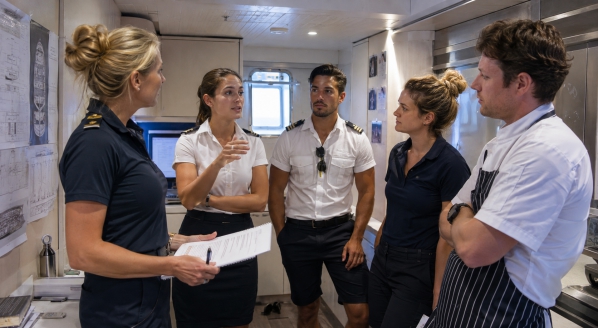
Design, amenities and condition all matter. Yet over the years, I have come to believe that the most valuable asset on any charter yacht is the one no shipyard can install: a happy, experienced crew. It sounds simple, which is perhaps why it is so often underestimated.
Guests rarely return home talking about specifications. They remember the chef who overheard a passing remark and recreated the dessert their grandmother used to make. They remember the captain who found a quiet anchorage just as the light began to fall. They remember the crew who transformed an afternoon treasure hunt into a private epic, convincing the children that, for a few golden hours, they were pirates in earnest.
These gestures are not decoration, they are the product, and they are impossible to fake at scale. A crew that has worked together over several seasons develops a kind of choreography: the small glances, the anticipated movements, the calm handover before a guest has noticed a need. That fluency is one of the great luxuries on board, precisely because it is invisible when executed properly. For this reason, owners who invest in crew stability are investing in every guest experience. They are also protecting the yacht’s reputation.
The same far-sighted approach should guide the calendar. Success is not measured simply by how full it looks. A yacht, unlike a hotel, cannot absorb volume endlessly; it needs space for maintenance, for crew to rest, for standards to remain sharp. The best charter programmes are therefore curated as carefully as they are managed.
That discipline continues far from the guest’s sight. It lives in the enquiry answered at midnight, the negotiation handled with tact, and the careful orchestration of dates, cruising areas, owner use and operational rhythm. It also means being almost infinitely flexible, while knowing in advance what simply cannot be done, quietly steering the yacht and crew away from impossible situations. When all this is done well, nobody notices the machinery, they only feel ease.
This is the point worth saying plainly: every owner’s decision leaves a trace. The condition of the yacht, the confidence of the crew, the respect for each enquiry, the quality of the experience on board – together, these choices become the yacht’s standing in the market. And the market, however confidential, is not blind. It can tell when a yacht is genuinely cared for, and when it is simply available.
After many years working alongside owners, captains, brokers, owner’s representatives and charter guests, I have learnt that the best charter programmes are crafted by owners who care about something larger than income: pride of ownership, consistency and the generosity of sharing what first drew so many of us to yachting: the freedom, beauty and deep emotional pull of life at sea.
This article first appeared in The Superyacht Report: Owners Focus. With our open-source policy, it is available to all by following this link, so read and download the latest issue and any of our previous issues in our library.
Profile links
NEW: Sign up for SuperyachtNewsweek!
Get the latest weekly news, in-depth reports, intelligence, and strategic insights, delivered directly from The Superyacht Group's editors and market analysts.
Stay at the forefront of the superyacht industry with SuperyachtNewsweek
Click here to become part of The Superyacht Group community, and join us in our mission to make this industry accessible to all, and prosperous for the long-term. We are offering access to the superyacht industry’s most comprehensive and longstanding archive of business-critical information, as well as a comprehensive, real-time superyacht fleet database, for just £10 per month, because we are One Industry with One Mission. Sign up here.
Related news

The rotation problem
Why does yachting struggle to attract commercial masters? An argument for the industry to align its employment model with the realities of professional maritime
Opinion
A superyacht is still a ship
Why operational judgement matters more as yachts venture further – and some thoughts about what can be learned from the commercial sector
Opinion
When guest pressure exposes gaps in crew preparedness
The founder of Yacht Evolve 360°, Aggeliki Monastirioti, explores how professionally the yacht responds when plans change can have commercial consequences
Opinion
.jpg)
Who gets to work in yachting – and who never gets the chance?
Chris Frisby, COO at UKSA, argues that yachting has a pipeline problem and its reluctance to take on green crew is breaking the system it depends on
Crew
Related news
The rotation problem
3 weeks ago
The familiarisation gap
4 weeks ago
A superyacht is still a ship
1 month ago
NEW: Sign up for
SuperyachtNewsweek!
Get the latest weekly news, in-depth reports, intelligence, and strategic insights, delivered directly from The Superyacht Group's editors and market analysts.
Stay at the forefront of the superyacht industry with SuperyachtNewsweek