
When guest pressure exposes gaps in crew preparedness
The founder of Yacht Evolve 360°, Aggeliki Monastirioti, explores how professionally the yacht responds when plans change can have commercial consequences…
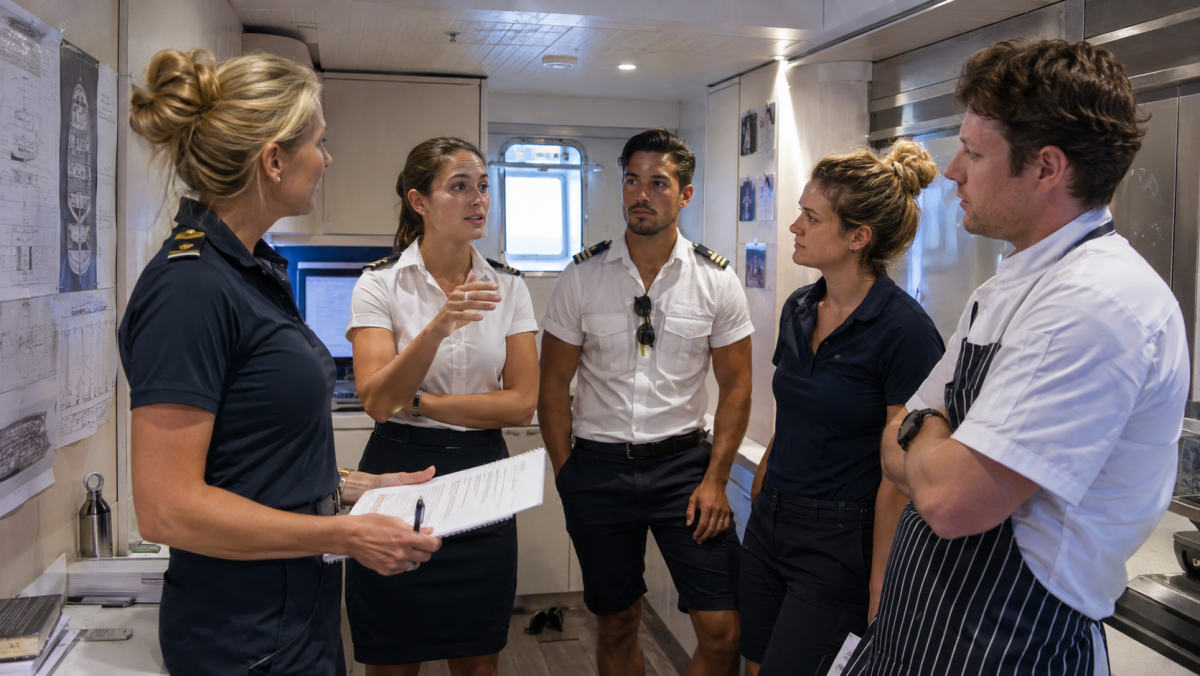
Demanding requests and changing expectations are part of charter reality. The crew’s ability to manage them depends on preparation well before service expectations, professional boundaries and operational pressure collide.
Anyone who has worked through a busy charter will recognise the situation: dinner is scheduled for eight, but at twenty minutes to eight, the guests decide that they would prefer to eat on the upper deck rather than in the main saloon. A few minutes later, one guest asks whether the menu can be changed, while another announces that they would like to eat earlier. The table has already been prepared below, the chef is working according to the original timing and the weather is beginning to shift.
A junior crew member is approached directly and, wanting to appear capable and responsive, assures the guest that everything will be ready shortly. The intention is positive, but the promise has been made before anyone has confirmed whether it can realistically be delivered.
Within minutes, the interior team is relocating the table setting, the galley is rebuilding the service sequence, the deck team is assessing whether the new location remains suitable and the chief stewardess is trying to establish exactly what the guest was told. When the guest then asks why everything is taking so long, the crew are managing both a change of plan and an expectation that was created without proper coordination.
Luxury service is tested when expectations change, time is limited and several departments must adjust without allowing the pressure behind the scenes to enter the guest experience.
Describing the person making these requests as a ‘difficult guest’ offers the team a convenient explanation for the pressure they are experiencing. It leaves the operational questions unanswered: whether the request is achievable, who can approve it and which departments will be affected.
The guest may be demanding, tired, frustrated or unfamiliar with the operational limitations of a yacht. Their behaviour may also become unreasonable or inappropriate. The crew still need to respond with clarity and control.
Without preparation, crewmembers rely on instinct. One person may promise too much, another may blame a delay on another department and a third may avoid answering because they are unsure what they can say. Each response can weaken the guest’s confidence.
Staffing difficulties, delayed preparation and disagreement behind the scenes should remain within the team. The guest needs confidence that their request has been heard and is being managed competently.
Service recovery also begins earlier than many teams realise. The first expression, sentence and
decision made when pressure appears can shape everything that follows.
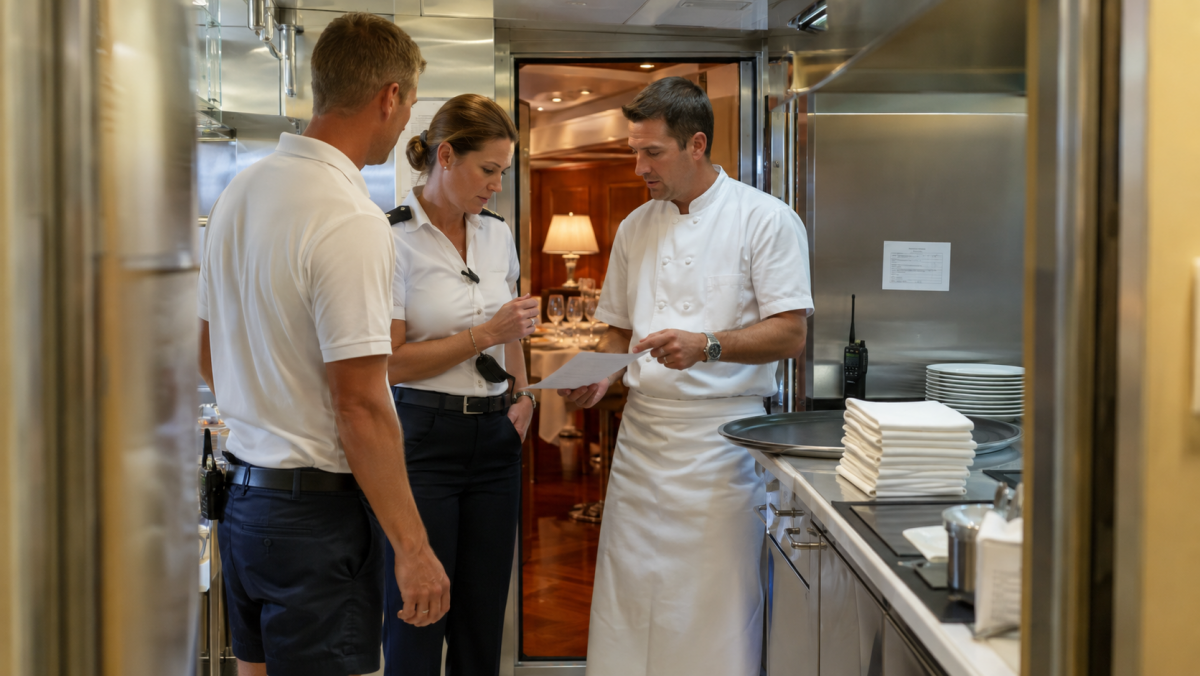
A safer response is, “Of course. Let me confirm the arrangements and come back to you.” It acknowledges the request while giving the crewmember time to consult the appropriate person, coordinate with the affected departments and return with an answer the yacht can genuinely deliver.
A response this simple still needs to be rehearsed across an international crew with different backgrounds and interpretations of luxury service. A junior stewardess may believe that independence means handling every request alone, while a chef may assume that a menu change has already been approved.
Service recovery also begins earlier than many teams realise. The first expression, sentence and decision made when pressure appears can shape everything that follows. A defensive tone can turn a minor delay into a complaint, visible frustration may make the guest feel that their request is an inconvenience and an unverified promise can create an expectation the yacht cannot meet.
A prepared crew acknowledges the request, establishes the facts, checks before committing and coordinates privately through the appropriate person. Maintaining this approach when the team is tired and several demands arrive at once is the difficult part.
Preparation should establish how crew are expected to think and communicate when something unexpected happens, which requests they may manage independently, what must be escalated and how departments should coordinate.
Preparation must also cover situations in which professional service requires a boundary. Interpreting guest satisfaction without judgement can expose crew to aggression, discrimination, sexual harassment, unsafe instructions or behaviour that threatens their dignity or wellbeing. These behaviours remain unacceptable within luxury service.
General hospitality training provides sound principles, while each yacht must define its own
authority structure, service style and reporting expectations.
Responsibility for deciding whether an inappropriate interaction requires further action must sit with the appropriate senior personnel. Crew need to understand when the HOD should become involved, when the captain must be informed, how the matter should be recorded and what immediate protection or support is available. Clear boundaries allow service to be delivered safely and consistently while protecting the crew member and the wider interests of the yacht.
These boundaries, like many on-board standards, differ between yachts. General hospitality training provides sound principles, while each yacht must define its own authority structure, service style and reporting expectations. On one yacht, junior interior crew may be encouraged to manage most guest requests independently; on another, any significant change must pass through the chief stewardess. One captain may wish to hear about every complaint immediately, while another may expect the HOD to manage the situation first.
Either arrangement can work when it is clearly understood. The problem arises when crew members are left to discover the yacht’s expectations by watching others, interpreting reactions and making avoidable mistakes. They learn which promises they are permitted to make only after making the wrong one or how the captain expects information to be communicated only after a briefing has gone badly.
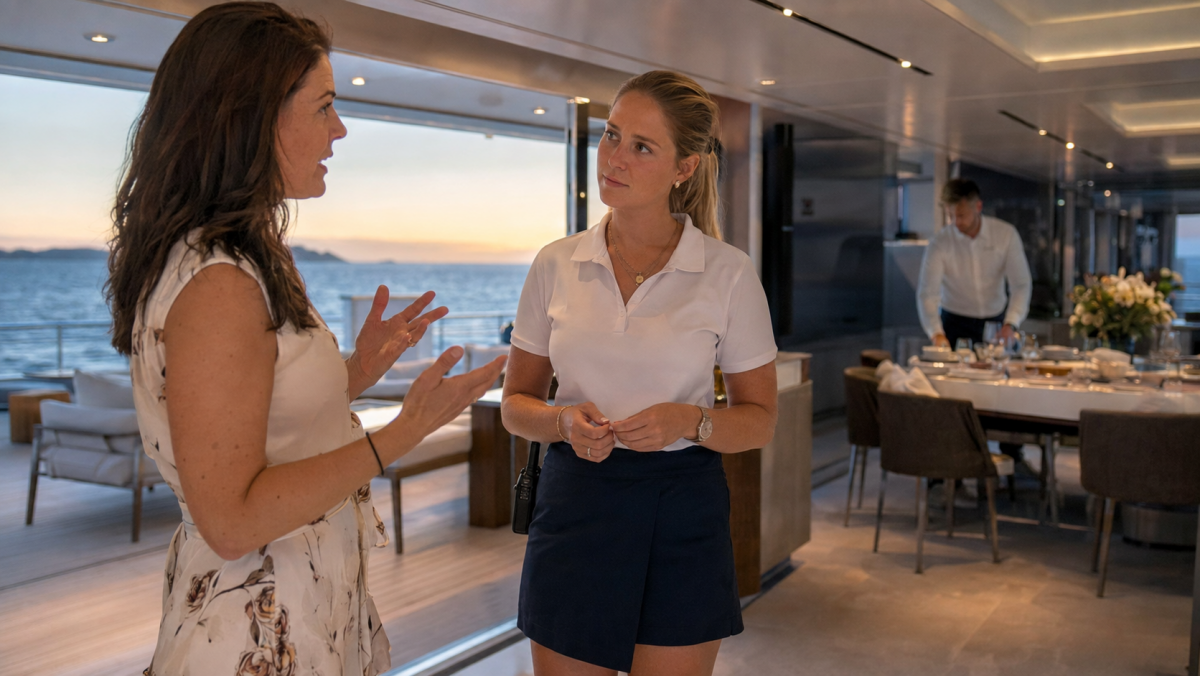
Pre-charter briefings provide an obvious opportunity to address this. Alongside itineraries, preferences, allergies, activities and meal requirements, they should prepare the crew for the pressure they may encounter while delivering them.
If guests are known to change arrangements at short notice, the team should discuss how those changes will be communicated and confirmed. If guests have conflicting preferences, crew should understand who has the authority to confirm the final decision. If a guest tends to bypass the HOD and approach junior crew directly, the expected response should be clear before it happens.
A short scenario discussion can expose uncertainty that might otherwise emerge in front of the guest. Asking what a crew member would say if dinner were moved forward by thirty minutes, who they would contact first, what they should avoid promising and when the captain should be informed is practical preparation for decisions they may have to make later that day.
One difficult evening can become a useful briefing scenario. One complaint can produce a
clearer communication standard and one departmental failure can lead to a more dependable
escalation process.
The learning should continue after the charter because every challenging interaction produces operational knowledge. A complaint may reveal where communication failed, while a last-minute change shows whether departments can adapt together. An inappropriate interaction tests whether reporting lines and boundaries are understood, and a successful recovery shows which behaviours should be repeated.
Too often, this knowledge remains in informal conversations between the people who were present. When experienced crew rotate off or leave, the next team may be forced to learn the same lesson under similar pressure. A short debrief can prevent this by recording what caused the uncertainty, which response protected the guest experience and what the next rotation should understand.
One difficult evening can become a useful briefing scenario. One complaint can produce a clearer communication standard and one departmental failure can lead to a more dependable escalation process. Capturing these lessons makes practical experience part of the yacht’s preparation and preserves it beyond the individuals involved.
The commercial consequences are significant. Guest confidence, charter reputation, owner expectations and management trust are influenced by how professionally the yacht responds when plans change. Gratuities may also be affected by whether the guests felt that the crew remained attentive, calm and in control.
The guest may never know that dinner was relocated, the menu revised and several departments reorganised within twenty minutes. They experience only the result, which is the essence of invisible service.
Demanding guests often reveal weaknesses that were already present. Unclear authority, inconsistent communication, fragile departmental coordination, uncertain boundaries and standards that were assumed rather than explained and practised. Addressing those weaknesses gives crew the judgement and shared understanding to manage changing plans, rising pressure and requests that cannot be fulfilled.
Guest demands become an operational risk when an unprepared crew is expected to manage a high-pressure situation through instinct alone.
As an open-source platform we offer an industry-wide invitation to anyone and everyone in our sector to share their knowledge, experience and opinions. If you have an interesting and valuable contribution to make, and would like to join our growing community of guest columnists, share your ideas with us at newsdesk@thesuperyachtgroup.com
NEW: Sign up for SuperyachtNewsweek!
Get the latest weekly news, in-depth reports, intelligence, and strategic insights, delivered directly from The Superyacht Group's editors and market analysts.
Stay at the forefront of the superyacht industry with SuperyachtNewsweek
Click here to become part of The Superyacht Group community, and join us in our mission to make this industry accessible to all, and prosperous for the long-term. We are offering access to the superyacht industry’s most comprehensive and longstanding archive of business-critical information, as well as a comprehensive, real-time superyacht fleet database, for just £10 per month, because we are One Industry with One Mission. Sign up here.
Related news
Don’t get banned from Europe
Make sure you have the correct visa for yacht training and job hunting in the Schengen area – by Christophe Bourillon, CEO of the PYA
Crew

Command on the hard
A single word, “refit”, describes projects that differ from one another by a factor of 50 and are rarely resourced properly
Opinion

How digitalisation is transforming the yachting sector
Beyond AI: New MB92 report explores the future of intelligent refit
Opinion

Where crew readiness is really tested
Captain Aggeliki Monastirioti explores the gap between formal qualifications and practical performance once crew step on board
Opinion
.jpg)
Who gets to work in yachting – and who never gets the chance?
Chris Frisby, COO at UKSA, argues that yachting has a pipeline problem and its reluctance to take on green crew is breaking the system it depends on
Crew
Related news
Don’t get banned from Europe
2 months ago
Command on the hard
2 months ago
Where crew readiness is really tested
3 months ago
NEW: Sign up for
SuperyachtNewsweek!
Get the latest weekly news, in-depth reports, intelligence, and strategic insights, delivered directly from The Superyacht Group's editors and market analysts.
Stay at the forefront of the superyacht industry with SuperyachtNewsweek