
How digitalisation is transforming the yachting sector
Beyond AI: New MB92 report explores the future of intelligent refit…
What follows is a snapshot from the recently released report by MB92 Group ‘The Intelligent Refit Era’, which asks whether growing digitalisation and emerging technologies such as AI risk automating away the trust, accountability and human relationships at the heart of the industry. It brings together input from a panel of experts and includes an industry survey of more than 70 stakeholders along with interviews with a yacht designer and a maritime cybersecurity specialist.
What’s working, what’s not
As the superyacht sector faces one of the most profound periods of transformation in its recent history, digitalisation and the intelligent use of data are allowing increasingly “smart” superyachts to become more efficient, personalised and sustainable. So what are the most transformational technologies? AI is already having a huge impact, but it is still at an early stage of development. The biggest transformation may not be from one breakthrough tool; perhaps the most important development is connected intelligence.
Digital twins will reshape yachting, with a shift away from reactive decisions towards continuous optimisation, and predictive maintenance that reduces downtime and improves life-cycle planning. Navigation systems can now analyse complex data sets to find the most fuel-efficient and safest routes, minimising human error and avoiding collisions. Alternative fuels have huge potential to reduce carbon footprints over the next few years, while Low Earth Orbit (LEO) satellites, such as Starlink, are enabling increasingly higher bandwidth. WAN connectivity allows local area networks (LANs) to communicate with each other over long distances.
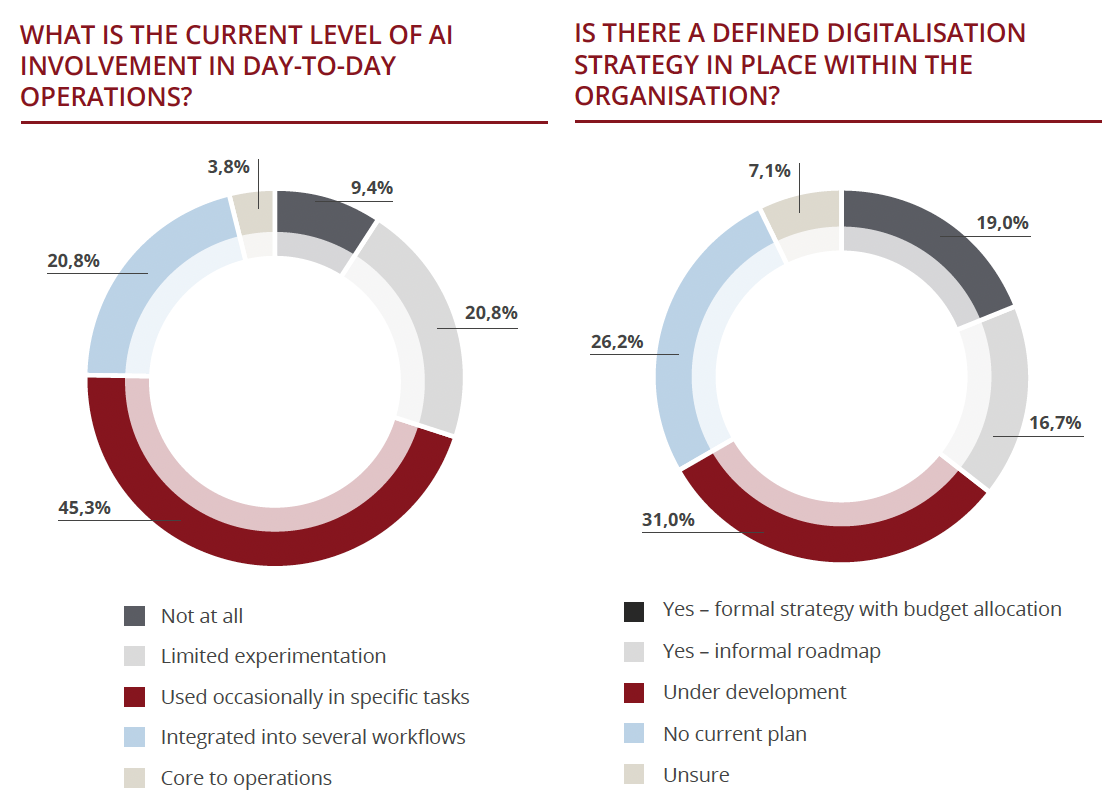
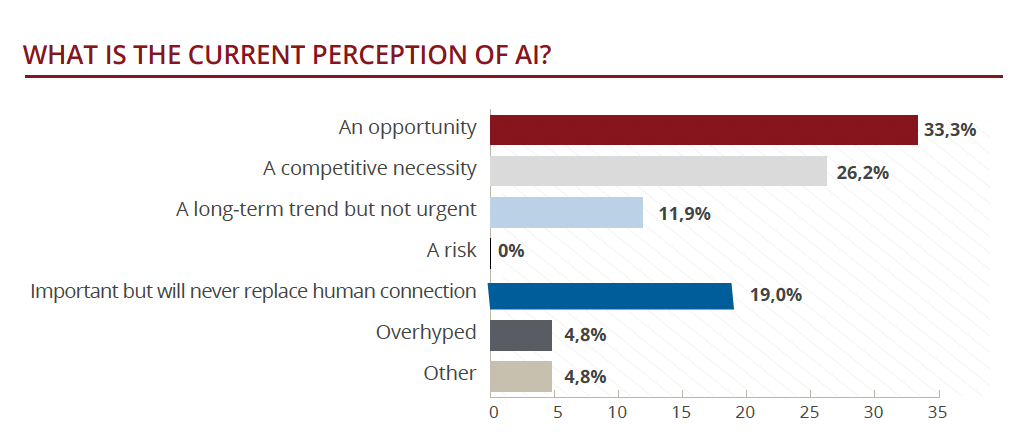
Technological adoption is accelerating. An MB92 survey of superyacht industry stakeholders shows that while just 24.6 per cent of respondents have already integrated AI into their operations, 78.5 per cent expect to increase their digital and AI investment in the next three years. Respondents considered AI as an opportunity rather than a risk, and 71.4 per cent believe that its biggest impact will be on operational efficiency.
At the same time, the survey revealed that 66.7 per cent of organisations now have at least some form of digital strategy, but only 19.0 per cent have a formal strategy with an allocated budget. As many as 35.7 per cent still offer no digital training at all.
From problems of complexity, the existence of legacy systems and technological integration, the superyacht sector faces multiple barriers to adoption of emerging technologies such as AI, clouds, digital twins, augmented reality and virtual reality. Some of the toughest challenges include:
• Culture: Many yachts operate as unique custom-built ecosystems, making interoperability and data integration difficult. Even when the tech works, adoption is hard if crew and operators do not trust or understand tools. Technology investment must be paired with training and cultural alignment.
• Return on Investment (ROI): This can be hard to quantify in an industry that values craftsmanship and guest experience. The difficulty in predicting the financial impact of innovation complicates getting support for new projects.
• Data: Unifying, managing and improving the quality of data is crucial, especially to optimise the impact of AI. Over-automation is not yet a major concern. Bespoke craftsmanship is one of the sector’s most valuable features, but many technological innovations have great potential – if applied with care. AI can lead to greater operational efficiency, but ultimately it is just a tool, and must be supervised by humans. Clear reasons for using AI and goals must be established: it should not be used just because it exists.
In this craft-led industry, the goal should be smart assistance. Automation should amplify human judgement rather than eliminate it, freeing experts to focus on the art of the craft rather than mundane tasks that can be handled by technology. On board, there is significant scope to continue automating to enhance the efficiency of crews and user experiences.
The biggest transformation may not be from one breakthrough tool; perhaps the most important development is connected intelligence
Much can be learned from more technologically advanced sectors, including the legal, banking and telecommunications sectors. The energy sector is especially relevant, as many superyachts now have their own micro grids: diesel-electric systems now often have multiple generators, large batteries and different types of fuel cells – a significant development from just a few years ago. There are useful lessons from the aviation and defence sectors and, closer to home, commercial shipping and extreme sailing.
Design, sustainability and strategic pressure points
Technological innovations, especially IoT sensors, mean that environmental impact can be measured with growing accuracy, so that sustainability goals can be met. But data must be collected, structured and used more efficiently so that it is more trustworthy, transparent, and connected. That way, qualitative information can be turned into quantitative information, allowing owners, designers and regulators to demonstrate ESG performance. Lifecycle impact, recyclability and end-of-life planning are now becoming part of the design brief alongside performance and comfort. This is of growing importance, with more than a third of the roughly 6,000 yachts over 30 metres in operation visiting refit shipyards in 2024.
Initiatives such as the Water Revolution Foundation’s YETI (Yacht Environmental Transparency Index) and the Yacht Club de Monaco’s SEA Index have contributed to transparently quantifying the operational impact of yachts and standardising methodologies. Again, standardised data is key to share, compare and learn from each other.
Regulation can play a greater role in incentivising innovation, especially to reduce emissions by increasing the cost of environmental impact. Yachting regulation has mostly been reactive, and many rules are voluntary, with most major international maritime conventions targeted at commercial or passenger ships. Forthcoming shipping regulation should include the recreational yachting sector.
In addition, the European Union’s AI Act imposes new compliance, transparency and risk-management obligations on manufacturers, operators and suppliers that use AI. Companies should take note, given significant sanctions of up to €35 million or 7 per cent of annual revenues.
People on board: changing roles, skills and expectations
Arguably the most important impact of technological change is on human beings. Technology is profoundly affecting life on board, for owners, guests and crew, while causing the necessary skills and roles to rapidly evolve. Already, essential competencies extend far beyond just navigation and engineering: data awareness, detailed troubleshooting, cybersecurity and human-machine collaboration are all key new areas. But while technology helps crews to operate more efficiently, it is also leading to greater expectations from owners and guests.
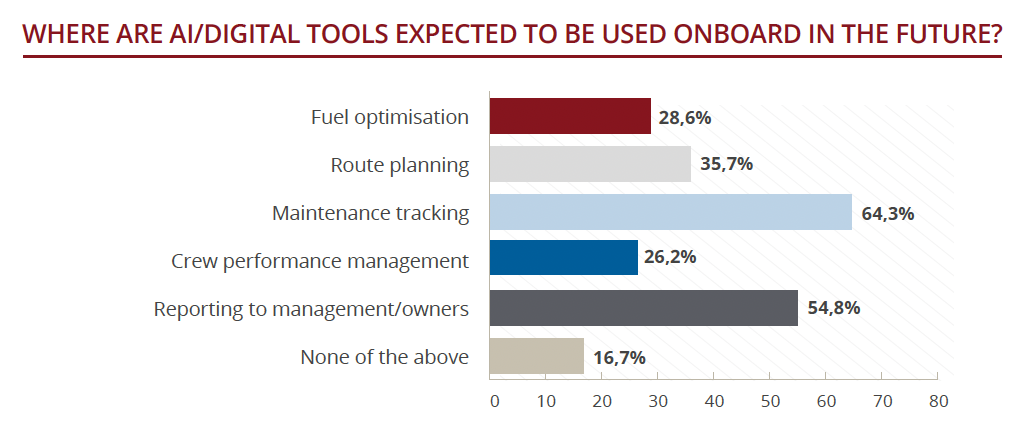
According to MB92’s survey, the top on-board needs for technology centre on maintenance tracking (64 per cent), reporting to owners (55 per cent), and route planning (36 per cent), as it strengthens decision-making and reduces uncertainty.
Technology will create multiple new roles in the maritime industry, just as in other sectors. For example, onshore positions will emerge to assist engineers on board to optimise increasingly complex systems, while engineers themselves will need to be more technologically literate. New roles will also emerge in design departments, in particular those that work with AI.
This all makes it essential to foster a stronger digital culture. The modern yachting industry is effectively a floating smart ecosystem, demanding a new blend of technical literacy and an adaptable and critical mindset, along with other important soft skills such as curiosity, continuous learning and a willingness to experiment.
In a context of rapid technological, regulatory and cultural change, MB92 says it is laying the foundations to lead the next phase of digital transformation in the superyacht refit sector. With 6 per cent of total Group investment allocated to IT and digitalisation, and an increasing share of projects managed through The Bridge digital platform, the Group is embedding data, connectivity and digital rigour at scale.
The delivery of 246 projects worldwide in 2025 illustrates how this approach is already enhancing execution, resilience and long-term competitiveness in an increasingly complex industry.
Click here to read the full report.
Profile links
NEW: Sign up for SuperyachtNewsweek!
Get the latest weekly news, in-depth reports, intelligence, and strategic insights, delivered directly from The Superyacht Group's editors and market analysts.
Stay at the forefront of the superyacht industry with SuperyachtNewsweek
Click here to become part of The Superyacht Group community, and join us in our mission to make this industry accessible to all, and prosperous for the long-term. We are offering access to the superyacht industry’s most comprehensive and longstanding archive of business-critical information, as well as a comprehensive, real-time superyacht fleet database, for just £10 per month, because we are One Industry with One Mission. Sign up here.
Related news

Where crew readiness is really tested
Captain Aggeliki Monastirioti explores the gap between formal qualifications and practical performance once crew step on board
Opinion
.jpg)
Who gets to work in yachting – and who never gets the chance?
Chris Frisby, COO at UKSA, argues that yachting has a pipeline problem and its reluctance to take on green crew is breaking the system it depends on
Crew

Maritime workforce not keeping pace with digital change, warns new global study
Lloyd’s Register Foundation report calls for urgent action on training, regulation and investment
Crew

How data reveals the real impact of the new-build sector
The facts and figures behind the economic significance of new-build activity and its contribution to the global economy
Opinion

A new chapter for Water Revolution Foundation – and for our industry
Setting out a vision for raising the standards of environmental performance with clear metrics, credible standards and alignment across all stakeholders
Opinion
Related news
Where crew readiness is really tested
3 months ago
NEW: Sign up for
SuperyachtNewsweek!
Get the latest weekly news, in-depth reports, intelligence, and strategic insights, delivered directly from The Superyacht Group's editors and market analysts.
Stay at the forefront of the superyacht industry with SuperyachtNewsweek