The owner asked a simple question and seven reports arrived
An impressive collection of specialists is assembled around the owner. What happens when the question that matters most falls between their responsibilities?

A simple question
November fog has settled over the Mediterranean and somewhere an owner is trying to understand why the yacht has cost rather more to operate than anticipated.
The management company produces a budget comparison, the captain explains the planned itinerary, engineering supplies its maintenance figures and the crew department prepares an employment-cost analysis. An independent technical adviser submits an assessment, a supplier explains disputed charges, the family office sends its financial review. Seven documents, each prepared by someone who knows a great deal about a particular part of the yacht. Somebody suggests a meeting.
The owner now has more information than when the question was asked, although the answer seems no closer. Perhaps the yacht was used more intensively than planned, its technical condition has become more demanding or the owner has developed an expensive taste for spontaneity. Another possibility is harder to locate in the accounts: expenditure has accumulated through decisions that made sense individually, without anyone examining what they meant together.
A report can explain where the money went. Whether it was necessary, avoidable or worth spending calls for appraisal of another kind. For all the expertise assembled around a superyacht, that broader judgement can remain surprisingly difficult to locate.
What, exactly, has the owner purchased?
Specialisation is not an industry defect – it gives owners access to technical, financial and operational capabilities they have little reason to employ permanently, alongside independent advisers able to challenge day-to-day decisions. The difficulty begins where the boundaries that make specialists useful also leave a question unanswered.
The owner experiences one vessel; the professionals may be operating within several organisations whose responsibilities meet only intermittently.
Consider a proposal to replace equipment before the next season. Engineering assesses the risks of continued operation, the captain considers the consequences for the yacht’s operations, the contractor prices the work and the management company checks the budget and approvals. Each contribution is necessary. None, by itself, establishes whether replacement is the best use of the owner’s money, given the yacht’s intended use, alternative arrangements and tolerance for interruption.
Knowledge is dispersed, as economists have long recognised, among people who possess different information and answer to different incentives. On a yacht it is also distributed across companies, contracts and lines of authority. The owner experiences one vessel; the professionals may be operating within several organisations whose responsibilities meet only intermittently.
Yacht-management agreements vary considerably. Financial administration, technical oversight, compliance, crew management and operational support may be combined or divided among providers. A company might possess the figures but lack authority to challenge an operational decision. A family office might control expenditure without knowing enough about the vessel to judge the consequences of refusing it. The manager may fulfil its mandate impeccably while the owner assumes that someone has accepted a broader responsibility. The services listed in an agreement do not, by themselves, establish who is responsible for judging their combined economic consequences. That responsibility must be located in the actual arrangement, rather than inferred from the breadth of services advertised.
Before recommending another reporting system or a more expensive management package, I would want to know what the owner believed had been purchased and what the professionals understood they were engaged to deliver.
The truth has an employer
The question is not only who possesses the information, it’s who is entitled, equipped and willing to draw a conclusion from it. An engineer recommending preventive maintenance is properly concerned with reliability. A captain must think about the itinerary and the consequences of disruption. A contractor is engaged to deliver a defined service. Their advice can be entirely sound, yet rest on different ideas of what a satisfactory outcome looks like.
Suppose a particular on-board capability has become steadily more expensive to maintain. The technical explanation is persuasive: specialist servicing is essential, components are costly and postponement raises the likelihood of failure. But the economic question may begin earlier. How often is that capability used? Does it still serve the owner’s priorities? What would be lost by changing or dispensing with it? A professional asked how to keep something operating may never have been asked whether it should continue operating in the same form.
Who is expected to explain that the owner’s preferences are driving the increase?
Commercial relationships deserve equally careful examination. A contractor paid to undertake work, a manager engaged to administer it and an adviser retained to scrutinise its necessity occupy different positions. Financial interests do not automatically discredit professional advice. They do, however, help explain why certain questions are more likely to be asked than others. The person recommending a solution may benefit from its approval; the person best placed to challenge it may lack the information, authority or appetite to intervene.
Sometimes the hardest conclusion concerns the owner. Repeated itinerary changes and an expectation of immediate availability can compress maintenance windows, complicate crew arrangements and increase logistics costs. The captain knows what is required to accommodate these demands. The management company sees the expenditure. The family office notices how far the original budget has drifted. Who is expected to explain that the owner’s preferences are driving the increase?
There may be perfectly good reasons for those choices. The freedom to change plans at short notice may be worth far more to the owner than the savings offered by a predictable cruising schedule. What matters is having someone capable of explaining the economic consequences without treating respect for the owner’s wishes as a prohibition on questioning them. Such conversations require trust, professional independence and, crucially, permission to speak.
When oversight becomes the owner’s job
It is tempting to conclude that one person should simply be put in charge of everything. Yet divided responsibility is sometimes exactly what protects the owner. A family office may retain control of payments to preserve financial scrutiny. An independent technical adviser may be appointed precisely because the owner does not want the management company’s recommendations to go unchallenged. An owner’s representative may hold a different kind of authority again.
These arrangements may be thoughtful governance rather than fragmentation. Their effectiveness becomes apparent when opinions conflict. Who can establish which disagreement matters, uncover the assumptions behind competing recommendations and translate them into a choice the owner can actually make?
On some yachts an experienced captain or owner’s representative performs this integrative work almost invisibly. Familiarity with the owner, relationships built over years and knowledge of the yacht’s history allow decisions to move across boundaries that look awkward on paper. It is a valuable capability, but also a fragile one if it resides largely in a person’s memory and judgement. A departure can reveal how much of the operating arrangement was never institutionalised.
Elsewhere, the unresolved work finds its way back to the owner. A query about expenditure leads to a conversation with the captain, a technical explanation, a review of the management agreement and a further request to the family office. Each professional has contributed something useful. Meanwhile the owner has quietly become the person responsible for reconciling the expertise hired to make ownership less demanding.
Proper records remain indispensable, especially for safety and compliance; their value also depends on whether they enable action in time.
The cost extends beyond another meeting. Professional time is consumed preparing and interpreting material; decisions wait while participants establish who may approve what; the owner’s attention becomes the scarce resource holding the arrangement together. None of this necessarily appears in the accounts.
Reports offer reassuring evidence that a matter has received attention. Judgement is more exposed, particularly when it involves challenging established practice or accepting responsibility for an uncertain outcome. Where authority is unclear, more documentation may be easier to defend than a decision. Proper records remain indispensable, especially for safety and compliance; their value also depends on whether they enable action in time.
The eighth report
Eventually the owner has read the documents, listened to the explanations and asks again: ‘Yes, but what does all this mean?’
The answer may involve an overlooked fact, a frank conversation about risk, a commercial interest requiring independent scrutiny or a management mandate that no longer fits the owner’s expectations. Establishing where the difficulty lies matters: another report cannot repair a missing mandate, while concentrating authority may undermine the independence the owner deliberately purchased.
The figures may be correct, the reports carefully prepared and every professional justified in the advice given. Yet an owner who has paid for management might reasonably ask what, beyond the individual services, has actually been managed.
Seven reports may be entirely necessary. The owner should not need an eighth to discover who understands what the first seven mean.
As an open-source platform we offer an industry-wide invitation to anyone and everyone in our sector to share their knowledge, experience and opinions. If you have an interesting and valuable contribution to make, and would like to join our growing community of guest columnists, share your ideas with us at newsdesk@thesuperyachtgroup.com
NEW: Sign up for SuperyachtNewsweek!
Get the latest weekly news, in-depth reports, intelligence, and strategic insights, delivered directly from The Superyacht Group's editors and market analysts.
Stay at the forefront of the superyacht industry with SuperyachtNewsweek
Click here to become part of The Superyacht Group community, and join us in our mission to make this industry accessible to all, and prosperous for the long-term. We are offering access to the superyacht industry’s most comprehensive and longstanding archive of business-critical information, as well as a comprehensive, real-time superyacht fleet database, for just £10 per month, because we are One Industry with One Mission. Sign up here.
Related news

The yacht is now part of the owner’s online reputation
Tony McChrystal works with owners, family offices and senior executives on their online reputation and privacy. This is his take on reputation management
Opinion

What owners bring to crew
The best-run vessels in this industry share one thing in common – Karine Rayson explains what the owners who get it right are actually doing differently
Owner

What it really costs to run a superyacht
Will Christie, Founder and CEO of Christie Yachts, debunks the myths and presents the true facts and figures
Owner

So you want to build a yacht?
Moving from serial charterer to first-time owner can seem a natural progression, but commissioning a large yacht demands a very different kind of experience
Owner
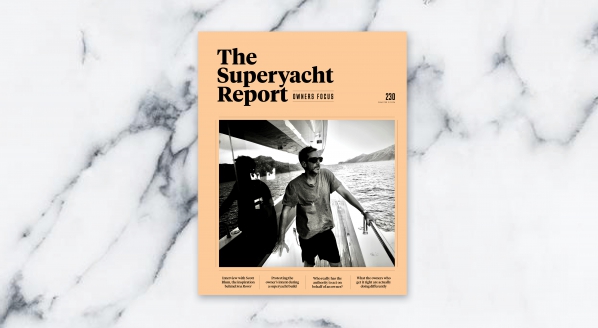
The Superyacht Report 230: Owners Focus – Out Now
From a guide to the do’s and don’ts for new yacht owners to who has the authority to act on behalf of an owner, the latest TSR is a must-read
Owner
Related news
What owners bring to crew
1 week ago
What it really costs to run a superyacht
2 weeks ago
So you want to build a yacht?
4 weeks ago
NEW: Sign up for
SuperyachtNewsweek!
Get the latest weekly news, in-depth reports, intelligence, and strategic insights, delivered directly from The Superyacht Group's editors and market analysts.
Stay at the forefront of the superyacht industry with SuperyachtNewsweek