What it really costs to run a superyacht
Will Christie, Founder and CEO of Christie Yachts, debunks the myths and presents the true facts and figures…
If I had a dime every time I heard someone say that a superyacht costs 10 per cent of its value each year to run, I would probably own a very big superyacht myself!
It is one of the most repeated rules of thumb in yachting, and one of the least useful. The problem is that a yacht’s market value and its operating cost are not directly linked. Age, size, crew structure, cruising programme and the owner’s expectations all have a much greater bearing on what it actually costs to run.
That does not mean buyers should be frightened of the numbers. It means they should understand them properly before they buy. In my experience, owners enjoy yachting far more when the financial expectations have been set accurately from the outset.
Why the 10 per cent rule does not work
Take a 10-year-old 30-metre yacht as a simple example. Imagine it originally cost 10 million euros and perhaps cost around 1 million euros a year to operate when new. Ten years later it might be worth EUR 5 million euros, but its running costs have not halved with its value. With inflation and an ageing yacht, they will have certainly increased. Repaints, equipment replacement and major class surveys also tend to come around as a yacht gets older.
At the other end of the scale, a 90-metre-plus yacht might have cost more than 300 million euros to build, but thankfully that does not mean it costs 30 million euros a year to operate.
So the “percentage-of-value” formula quickly falls apart. What matters is the yacht itself and, just as importantly, how the owner intends to use it.
There is no meaningful one-size-fits-all answer to the question: ‘What does a superyacht cost to run?’
How you use the yacht changes everything
There are enormous variables in the operating profile of a yacht. Some yachts are essentially single-season boats, spending the summer in the Mediterranean and then having a quieter winter period. Others run a full dual-season programme, combining the Mediterranean with the Caribbean, Pacific, Indian Ocean or, increasingly, more adventurous cruising areas like Antarctica.
A dual-season yacht will burn more fuel, put more hours on machinery and equipment which brings service intervals around more quickly. It is also much more likely to carry a full rotational crew, which has a significant impact on payroll.
Where the yacht spends its time matters too. A yacht paying for prime berths in St Tropez through the summer and Antibes through the winter will have a very different berthing budget from one that spends much of the summer cruising and at anchor. Fuel consumption can vary dramatically according to itinerary, cruising speed and how much the yacht moves. Guest numbers, provisioning requirements, water sports, helicopter operations, chase boats and the owner’s preferred level of service can all move the number again.
This is why there is no meaningful one-size-fits-all answer to the question: ‘What does a superyacht cost to run?’
Do not simply rely on the previous owner’s budget
When we represent buyers of brokerage yachts, one of the first requests is often for the yacht’s current operating budget. It will contain some useful information, but I would never treat it as an accurate answer to what that yacht will cost the next owner.
I once represented the buyer of a 45-metre Feadship. Under the previous owner, the yacht had operated a dual-season programme and, in my view, was not being run particularly efficiently. The new owner chose a single-season programme, did not require rotational crew and reduced the winter crewing level. The annual operating budget fell by around 40 per cent. The yacht had not changed, the operating philosophy and programme had.
Crew salaries and associated employment costs make up the largest single part of the operating budget.
The reverse can obviously happen too. A buyer may acquire a yacht that has been lightly used and then decide to travel extensively, increase the crew, charter commercially or run two seasons. In that case, the previous owner’s budget could substantially understate what the yacht will cost under the new ownership.
Crew is the biggest cost
Crew salaries and associated employment costs make up the largest single part of the operating budget. On busy dual-season yachts, rotational crew are now common across all departments. That means the owner is employing considerably more people than are physically on board at any one time.
It is tempting to look at crew rotation as an area where money can be saved, but I think that can be a false economy. Crew work exceptionally long hours during busy cruising periods, often without conventional weekends or days off.
In my experience, if you don’t provide proper rotation on a very busy yacht, you eventually burn through crew. You also make it harder to attract the very best people in the first place. It can quickly become a false economy as you spend more on recruitment, while constantly having to replace people.
Equally, it affects the owner’s experience. Part of the pleasure of yacht ownership is returning to familiar faces who already know how you, your family and guests like things done. The best crews build up an extraordinary amount of knowledge about an owner’s preferences, often without the owner ever having to ask.
Keeping excellent people is therefore not simply a crewing issue, it is part of protecting the quality of the ownership experience.
Maintenance, fuel, berthing and everything else
Crew may be the largest line item, but the rest of the budget is made up of a long list of costs that can move considerably from year to year and owner to owner. Fuel, berthing, insurance, routine maintenance, spare parts, class and flag requirements, communications, provisioning, travel, training, uniforms, shore support and management all need to be considered.
Then there are the less regular costs. A repaint or major technical project can create a significant spike in expenditure in a particular year. The same applies to five-year surveys and major servicing or replacement of equipment. A sensible budget therefore needs to distinguish between ordinary annual running costs and larger capital or periodic works, rather than pretending every year will look exactly the same.
As a buyer I would still want to ask a fairly obvious question: am I being shown the most realistic,
warts-and-all operating budget or a budget that makes ownership of this particular yacht look
slightly more attractive?
Who should prepare the budget?
The best people to prepare a detailed operational budget are experienced yacht managers who can understand exactly how an owner intends to use the yacht and then build a realistic budget using real-world numbers from comparable vessels that they manage.
At Christie Yachts, we deliberately work with independent yacht management companies, rather than offering yacht management ourselves. There is a simple reason for that. I believe there can be an inherent conflict of interest when the company selling you a yacht is also hoping to secure the management contract afterwards.
Imagine that you are considering buying a particular yacht and ask your broker’s company to prepare an operating budget themselves. That same company potentially benefits twice if the transaction completes: firstly, from the brokerage commission and then from an ongoing yacht management fee.
That does not mean the budget will necessarily be wrong, and there are many excellent yacht managers working within larger brokerage companies. But as a buyer I would still want to ask a fairly obvious question: am I being shown the most realistic, warts-and-all operating budget or a budget that makes ownership of this particular yacht look slightly more attractive?
For me, independence totally removes that question. An independent yacht management company is a specialist and has one core job: to manage yachts professionally. If the realistic annual budget is higher than the buyer had hoped, there is no reason for them to soften the message in order to help a brokerage transaction complete.
The same applies once the yacht is operational. When there is a technical, crewing or operational issue requiring urgent attention, yacht management is their core business, rather than one service amongst many others. The key figures at the company won’t be distracted by more financially rewarding things like big sales transactions. Yacht management is not the core business of these large yacht brokerage businesses.
Two yachts of the same size can vary massively in technical complexity, crew numbers and usage,
and therefore have very different budgets. They are a starting point for a conversation, not a substitute
for an accurate yacht-specific budget.
There are a number of very good independent yacht management companies, each with different strengths, locations and areas of expertise. Part of our role is to introduce clients to the manager we think best suits their particular yacht and intended operation.
We do not charge an introductory fee for doing so. Where Christie Yachts does not provide a particular service, our preference is simply to introduce the client to the specialist we believe is best placed to provide it. To me, that is part of representing the client’s interests, rather than trying to provide every service ourselves.
A rough guide to annual superyacht operating budgets
A proper budget should always be prepared for the individual yacht and owner. However, the table below is intended to provide a very broad indication of the scale of annual operating budgets for motoryachts of different sizes and operating profiles. 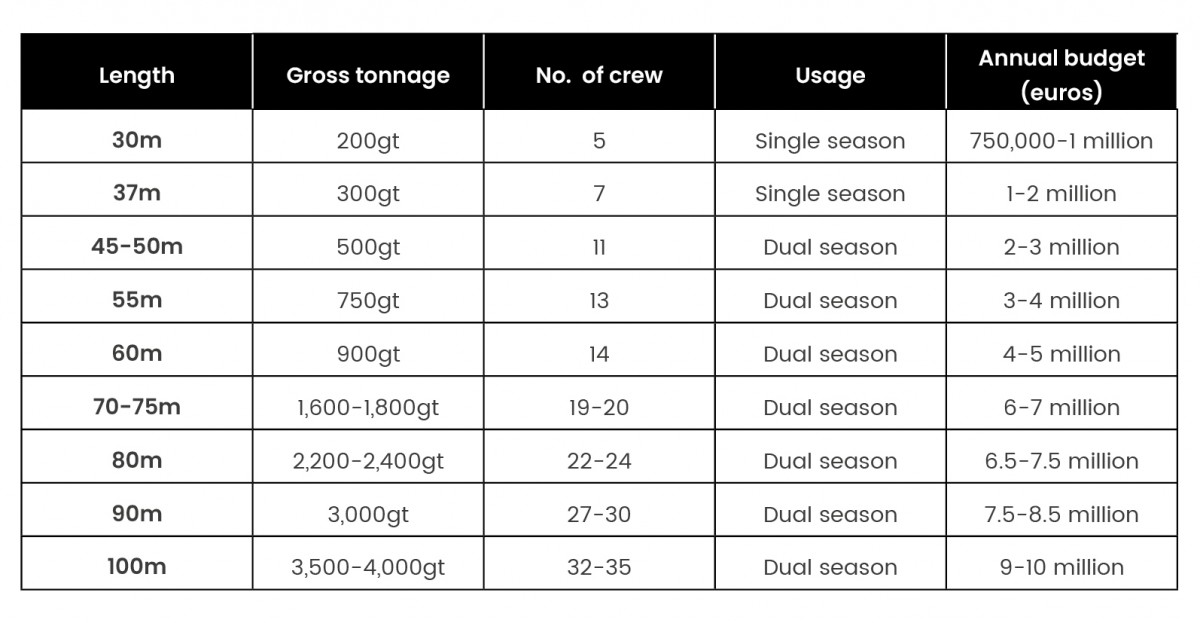 These figures should never be treated as scientific. Two yachts of the same size can vary massively in technical complexity, crew numbers and usage, and therefore have very different budgets. They are a starting point for a conversation, not a substitute for an accurate yacht-specific budget.
I would never recommend buying a yacht on the assumption that charter will make the
ownership economics work.
Can charter income offset the cost?
Some operating costs can, of course, be offset by charter income. For the right owner and the right yacht, charter can make a meaningful contribution towards annual expenditure. But I would never recommend buying a yacht on the assumption that charter will make the ownership economics work.
I have written separately about chartering your superyacht because I actually think some of the greatest benefits of chartering are operational rather than purely financial. A busy yacht and a practised crew can often deliver a better experience for the owner too.
The right mindset matters more than the formula
If realistic operating costs make a prospective owner come out in a cold sweat, then yacht ownership is not for you. There is nothing wrong with that. Charter can provide extraordinary access to yachting without the commitment and responsibility of ownership.
But for the right person, ownership offers something very different. A yacht gives you freedom, privacy and the ability to create experiences with family and friends that are difficult to replicate in any other way. It is an extraordinary luxury, and it should be approached as exactly that.
The important thing is to go into ownership with your eyes open. Properly advised, with the likely costs understood and expectations set accurately from the beginning, I genuinely believe that for the right client yachting can be one of the best things they ever do.
Profile links
NEW: Sign up for SuperyachtNewsweek!
Get the latest weekly news, in-depth reports, intelligence, and strategic insights, delivered directly from The Superyacht Group's editors and market analysts.
Stay at the forefront of the superyacht industry with SuperyachtNewsweek
Click here to become part of The Superyacht Group community, and join us in our mission to make this industry accessible to all, and prosperous for the long-term. We are offering access to the superyacht industry’s most comprehensive and longstanding archive of business-critical information, as well as a comprehensive, real-time superyacht fleet database, for just £10 per month, because we are One Industry with One Mission. Sign up here.
Related news

The EU reporting rules reshaping private yacht purchases
Why ownership structure and intended use must be settled before completion
Owner
The right to vanish
Benjamin Maltby, lawyer and General Secretary of The Owners Club, offers a practical guidance on owners’ right not to be tracked through AIS
Owner
The superyacht as a cross-border institutional asset
Superyachts exist inside a complex network of jurisdictions and institutions – the importance of understanding the broader institutional picture
Owner

So you want to build a yacht?
Moving from serial charterer to first-time owner can seem a natural progression, but commissioning a large yacht demands a very different kind of experience
Owner
The Superyacht Report 230: Owners Focus – Out Now
From a guide to the do’s and don’ts for new yacht owners to who has the authority to act on behalf of an owner, the latest TSR is a must-read
Owner
NEW: Sign up for
SuperyachtNewsweek!
Get the latest weekly news, in-depth reports, intelligence, and strategic insights, delivered directly from The Superyacht Group's editors and market analysts.
Stay at the forefront of the superyacht industry with SuperyachtNewsweek