So you want to build a yacht?
Moving from serial charterer to first-time owner can seem a natural progression, but commissioning a large yacht demands a very different kind of experience…
Someone who has spent ten years chartering large yachts rarely thinks of themselves as a newcomer to yachting. They have crossed the Mediterranean several times over, spent winters in the Caribbean, know the yachts they like and, quite often, the designers and shipyards that built them. They understand good service, have strong opinions about layout and may know more about certain cruising grounds than many people working in the industry.
Then they decide to buy. I find that transition fascinating because familiarity can create its own assumptions. A highly experienced charterer knows a great deal about being aboard a yacht. Ownership asks different questions.
One of the first things I tell a client making that transition is that chartering has taught them something extremely valuable: what they enjoy. My job is to work out how much of that should influence what they own. The two aren’t always the same.
This becomes particularly important as yachts become larger. A client may arrive with 70, 80 or 100 metres in mind, but length is a fairly crude starting point for a conversation about how somebody intends to live. I want to know who will be aboard, how often and where. Do three generations of the family travel together? Will there regularly be ten guests or occasionally twenty? Does the owner want everyone congregating around one part of the yacht or enough separation to disappear for half a day? How important is spontaneity? Where will the yacht spend winter?
These sound like lifestyle questions because they are. They also have technical and operational consequences. At the larger end of the market, the landscape has changed considerably. At the end of 2020 there were 145 yachts over 80 metres in operation. Five years later, that figure was approaching 185. The 100-metre fleet has moved too: from 56 yachts at the end of 2021 to more than 70 in operation by mid-2025.
More choice does not necessarily make the decision easier. If anything, it places a greater premium on knowing what matters.
There is something important in those numbers. A size of yacht that once occupied the extreme edge of private ownership is becoming a more established part of the market. Shipyards have accumulated experience, technical possibilities have expanded and owners arriving at this level have more routes into ownership than their predecessors did.
More choice does not necessarily make the decision easier. If anything, it places a greater premium on knowing what matters.
I recently worked on the sale of an Amels 80 new build. What struck me about that conversation was that price wasn’t driving it in the way people might assume. The owner kept coming back to going bigger. That sounds simple, but it required us to understand what greater scale was actually going to give him. At this level, there is always another capability to add, more volume to create, something else the yacht could carry. The useful conversation is about how those capabilities will be used.
Is 80 metres a sweet spot? For some owners, absolutely. It delivers serious range, volume and capability while remaining a yacht that can work for the way they actually live, but size alone is no measure of progress. The right yacht is the one that fits the owner.

Nick Gelevert, CEO, Boatsters Black
Image © Reborn Yacht Media
Knowing when the next build slot exists, which opportunities are being discussed privately or who needs to be brought into a conversation remains part of the job. I have built much of my business through those relationships and through information entrusted to me privately. Discretion matters, yet information alone is becoming less impressive. Owners are surrounded by it; what they need is judgement. There are opportunities I know about that I won’t put in front of certain clients. If I understand what somebody is trying to achieve, part of my job is filtering out the noise. Bringing ten possibilities to the table when only two make sense isn’t better service. That sometimes means telling somebody to stop. I do it regularly. It may mean advising against a particular project, changing direction or simply saying that now is not the moment to proceed. There are occasions when another season of chartering will teach a future owner more than rushing into a build because the opportunity happens to be available.
A good deal has to leave everybody able to work together the following morning. Wanting a deal to work for all parties does not mean abandoning your client’s interests. Sometimes preserving goodwill is firmly in the client’s interest ... reputation travels quickly and memory is long.
Of course, that can postpone a commission. Over the course of a relationship, I think it is also very good business. I am an entrepreneur. I enjoy putting deals together and I like the momentum of finding a solution when something initially appears difficult, but the transaction cannot become the objective.
Large-yacht transactions involve extraordinary sums and sophisticated parties, and nobody expects an adviser to be commercially timid. I will push hard for my client. What I don’t believe in is confusing aggression with good negotiation. This is especially apparent in a new build. The contract may be signed today, but the owner, their team and the shipyard could be working together for four years. There will be changes and difficult conversations. There will almost certainly be a moment when the contract doesn’t contain a neat answer and somebody has to decide how they want to behave.
I have seen negotiations where somebody becomes so focused on winning that they lose sight of the relationship they need for the next three or four years. A good deal has to leave everybody able to work together the following morning. Wanting a deal to work for all parties does not mean abandoning your client’s interests. Sometimes preserving goodwill is firmly in the client’s interest. The yacht business is smaller than its global footprint suggests – owners, yards, designers, captains, project managers and brokers meet repeatedly, reputation travels quickly and memory is long.
Perhaps this is something first-time owners should demand more explicitly from those advising them. They should be looking for a partnership that can extend through their yachting life and for an adviser whose loyalty isn’t dependent on the next transaction. Ask what somebody knows, certainly, but also how they decide what to do with that knowledge. Ask when they last told a client to walk away.
For me, the most interesting part of a transaction is difficult to capture in a sales announcement. The photograph, the length, the GT and the shipyard tell you that a deal happened. They tell you very little about whether it was a good one. That answer comes later. It comes when the yacht has been used rather than imagined; when the children and grandchildren have spent time on board, when plans have changed at short notice, when something technical has gone wrong, and the owner has discovered which spaces they actually inhabit and which impressive features they rarely visit. It comes after the first summer, and probably after the third.
If they call me when they’re ready to build the next one, I know we got it right the first time.
This article first appeared in The Superyacht Report: Owners Focus. With our open-source policy, it is available to all by following this link, so read and download the latest issue and any of our previous issues in our library.
NEW: Sign up for SuperyachtNewsweek!
Get the latest weekly news, in-depth reports, intelligence, and strategic insights, delivered directly from The Superyacht Group's editors and market analysts.
Stay at the forefront of the superyacht industry with SuperyachtNewsweek
Click here to become part of The Superyacht Group community, and join us in our mission to make this industry accessible to all, and prosperous for the long-term. We are offering access to the superyacht industry’s most comprehensive and longstanding archive of business-critical information, as well as a comprehensive, real-time superyacht fleet database, for just £10 per month, because we are One Industry with One Mission. Sign up here.
Related news
The Superyacht Report 230: Owners Focus – Out Now
From a guide to the do’s and don’ts for new yacht owners to who has the authority to act on behalf of an owner, the latest TSR is a must-read
Owner
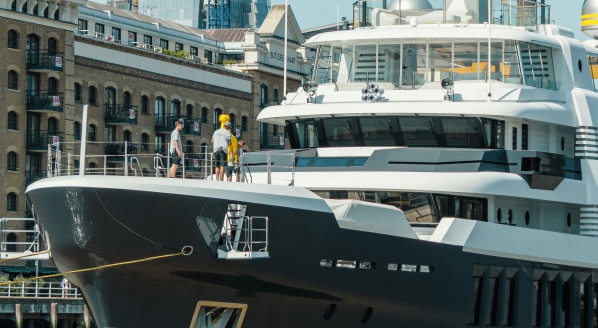
The crew management conundrum
Deep Blue Software’s recently upgraded Crew Management Package joins up all of the admin that comes with hiring and managing a team on board
Crew

Specialty lending: the ballast in uncertain markets
Steven Hawkins, Head of Specialty Lending, J.P. Morgan International Private Bank, on the role financing can play in keeping the industry resilient
Opinion

Cannes 2026: The buyer takes time
Six days at the Cannes Yachting Festival exposed the pressures facing yacht builders and their distribution networks
Opinion
Related news
The crew management conundrum
4 weeks ago
Cannes 2026: The buyer takes time
1 month ago
NEW: Sign up for
SuperyachtNewsweek!
Get the latest weekly news, in-depth reports, intelligence, and strategic insights, delivered directly from The Superyacht Group's editors and market analysts.
Stay at the forefront of the superyacht industry with SuperyachtNewsweek