How electric yachting can extend range
What it will take to move on-board methanol reforming from a successful prototype towards commercial deployment, and the potential impact on yacht design and operation…
For owners, useful range is measured in itinerary freedom. On-board methanol reforming, tested through the Methanol Pathfinder UK project, could extend that freedom while preserving quiet electric propulsion, explains Dave Lee, Executive Director at e1 Marine.
On a yacht, range has always meant more than the distance between two coordinates. For an owner, it determines the freedom to change plans, explore beyond established cruising grounds and remain away from shore-side infrastructure for as long as possible. For a designer, every additional mile has consequences for weight, volume, layout and performance.
Electric propulsion heightens that tension. It can transform the on-board experience through lowering noise, reducing vibration and providing responsive power delivery, yet traditionally, extending a battery-electric yacht’s range meant carrying more cells. On a yacht, those additions compete with payload, accommodation and performance. Beyond a certain point, adding batteries to extend range can undermine the efficiency and design freedom that made electric propulsion attractive in the first place.
This has encouraged the industry to treat the next advance in battery chemistry as the gateway to longer-range electric yachting. Battery development will remain important, but it is only one route for advancing electric propulsion. One option is drawing reserve energy from a liquid carrier fuel during longer periods away from charging. Methanol Pathfinder UK has provided measured evidence for how that architecture could work: by using an on-board reformer to generate fuel-cell-grade hydrogen from methanol and water as it is needed, and feeding the resulting electricity into a high-voltage battery system. Because hydrogen is produced on demand, none has to be stored aboard.
The components’ readiness gives the concept an inherently scalable foundation and means it does not rely on a technology breakthrough that has yet to happen, such as the next advance in battery chemistry.
Evidence for a broader design idea
Led by WSW Marine, trading as Archipelago Expedition Yachts, with Chartwell Marine Testing, this architecture was tested during a project funded by Britain’s Department for Transport through Innovate UK’s Clean Maritime Demonstration Competition Round 6 under the UK SHORE programme. The S75 methanol-to-hydrogen reformer at the heart of the system was supplied by e1 Marine, and Auriga Energy provided the 10 kW AurigaGen fuel-cell module.
The prototype combined those technologies with a 100kW electric motor, a 614.4VDC, 100kWh lithium iron phosphate battery, DC/DC conversion and a 3.25kW nominal solar array. Installed in a modified 20-foot container, the system was tested on the Isle of Wight between November 2025 and March 2026. Every major component is commercially available, which is an important consideration in terms of near-term deployment. With these solutions being proven already, the challenge was more around integration, packaging, certification and manufacturing. The components’ readiness gives the concept an inherently scalable foundation and means it does not rely on a technology breakthrough that has yet to happen, such as the next advance in battery chemistry.

Dave Lee, Executive Director, e1 Marine
The reformer is where the energy-density gain begins. Inside e1 Marine’s S75, methanol and water are converted through steam reforming and membrane purification into hydrogen of at least 99.97 per cent purity. Rejected gas is returned to the burner to support the reaction, while recovered thermal energy pre-heats the feedstock. Heat recovery matters because parasitic loads directly affect the net electrical output available to the yacht. During integrated testing, the system consumed approximately 3kg of methanol per hour and delivered around 4.5kW to the high-voltage battery. The reformer’s conversion efficiency from methanol energy to hydrogen was measured at approximately 71 per cent. Once fuel-cell parasitic loads and DC/DC conversion were included, end-to-end efficiency from methanol to the battery was approximately 30 per cent. The resulting effective energy density was around 1.5kWh per kilogram of methanol feedstock at the battery, compared with approximately 0.13kWh/kg for the best marine-grade lithium iron phosphate batteries assessed by the project. The measured result was roughly 12 times higher.
A yacht-level assessment must include the tanks, reformer, fuel cell, ventilation, thermal management, electrical conversion and safety systems, together with hull efficiency, hotel load, speed and operating profile. Even after those factors are accounted for, the result gives naval architects a significantly larger energy-density margin with which to work.
Explorer yachts could spend longer away from dense charging networks while retaining quiet electric propulsion in anchorages, harbours and environmentally sensitive areas.
Designing for useful range
A range extender does not need to match the electric motor’s maximum output. The battery can deliver acceleration, manoeuvring and other high-power events, while the reformer and fuel cell operate steadily to replenish energy over time. The yacht’s energy system can therefore be designed around its real pattern of use rather than a single maximum-range calculation.
For some projects, this could reduce the battery capacity required for a given mission. For others, it could increase endurance while preserving more space and weight for the yacht’s primary purpose. The attraction is design optionality as naval architects gain another way to balance range, performance, accommodation and redundancy.
It also changes the owner’s relationship with infrastructure. High-power charging will remain valuable wherever it is available, but it would no longer have to define every itinerary. Explorer yachts could spend longer away from dense charging networks while retaining quiet electric propulsion in anchorages, harbours and environmentally sensitive areas.
On larger yachts, auxiliary and hotel loads may provide the most practical first application. They offer sustained demand and allow the architecture to be introduced within a wider energy system before it assumes a greater share of propulsion. The same platform also has potential in crew transfer vessels, pilot boats and fast ferries, whose operating hours could help mature the technology alongside yacht deployments.
Methanol brings a different set of design considerations, many of them more familiar to yards and crews than those of hydrogen itself. It remains liquid at ambient temperature and pressure, avoiding the tank demands of compressed or cryogenic hydrogen. Its hazards are well understood: it is toxic and has a low flashpoint, requiring engineered containment, ventilation, vapour detection, hazardous-area electrical design and emergency shutdown. These are marine integration problems that can be addressed through established risk-based design practices.
A convincing product will require defined installation interfaces, remote monitoring and a service network capable of supporting yachts wherever they operate.
From technical possibility to owner confidence
The next phase must translate system performance into owner confidence. The project identified a dedicated 20 to 30kW marine-grade range extender as the next step, with overall efficiency potentially improving towards 30 to 35 per cent through tighter integration, better heat recovery and lower balance-of-plant loads. Reducing mass, footprint, complexity and cost may prove just as important as increasing efficiency.
The project report proposed at least 500 hours of marine operation and open-water trials against representative mission profiles. Builders, captains and owners will need evidence covering reliability, transient response, start-up and shutdown, noise, maintenance, fuel sensitivity and component life. A convincing product will also require defined installation interfaces, remote monitoring and a service network capable of supporting yachts wherever they operate.
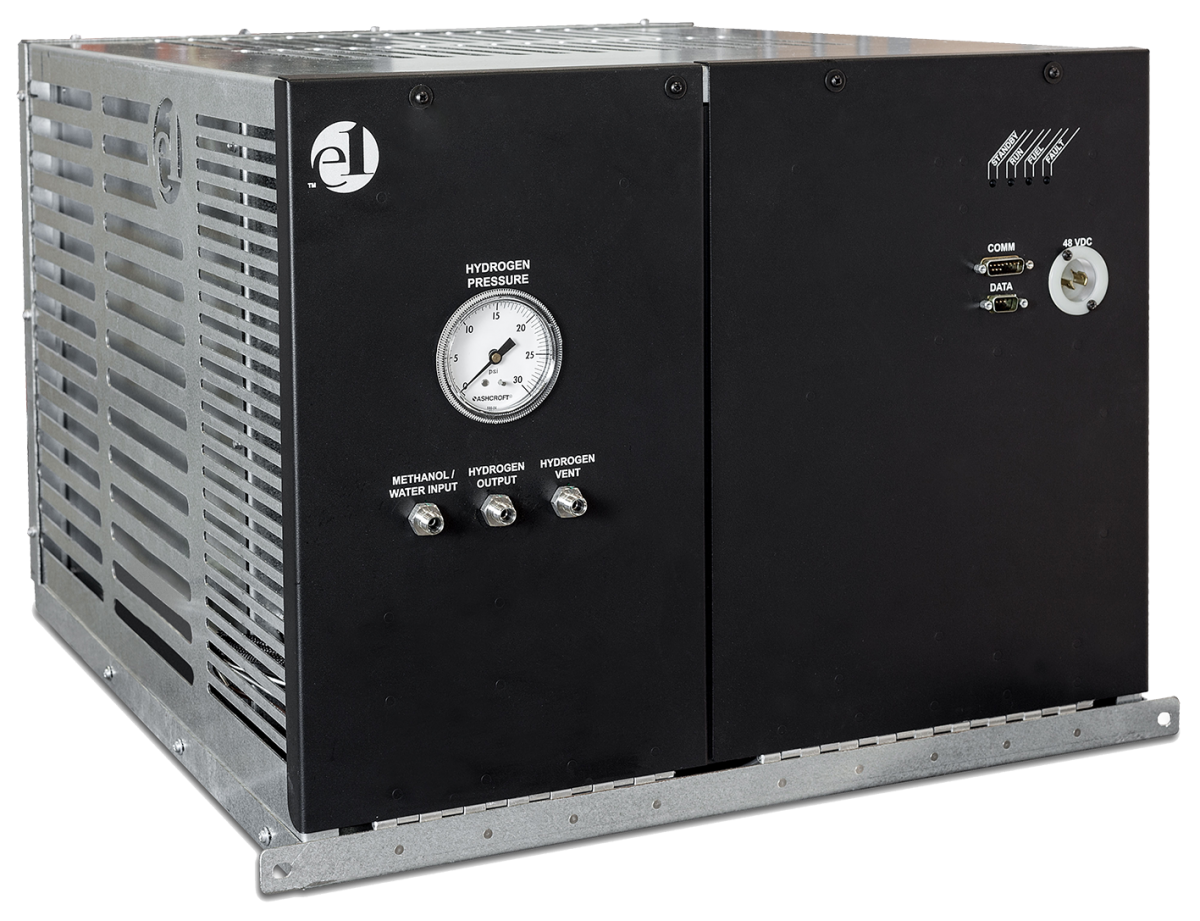
The e1 Marine S-Series reformer converts methanol into hydrogen on board, which a fuel cell can use to extend an electric yacht’s range.
Class, flag and regulatory engagement must progress alongside product design. The project completed a gap analysis against Bureau Veritas NR670 and NR547 and drew on earlier hazard work with Lloyd’s Register. In the UK, for example, no prescriptive standard currently covers on-board methanol reforming for smaller leisure vessels, so early projects are likely to follow risk-based, case-specific approval. HAZID, HAZOP and failure-mode analysis can turn those first approvals into a repeatable pathway.
Infrastructure is part of the product proposition too. Methanol can be moved using adapted liquid-fuel logistics, but suitable bunkering is not yet available at most UK ports and marinas. The environmental case also depends on fuel origin. The project assessed genuinely green methanol as a near-zero net well-to-wake pathway, with near-total elimination of nitrogen oxides, sulphur oxides and particulate matter. Grey or brown methanol carries a very different upstream footprint, making certification and transparent lifecycle accounting essential.
Commercial momentum is not confined to the Pathfinder consortium. e1 Marine has two yacht projects in progress with PowerCell, pairing its reformer technology with PowerCell’s marine fuel cells. Within Pathfinder itself, at the project’s completion, the consortium reported investor discussions and interest from a potential first customer who is already purchasing an all-electric Archipelago 40. That interest matters because productisation needs a real vessel, operating profile and owner requirements to design the first marine-optimised system.
Owners place a high value on acoustic comfort, autonomy and access to remote destinations, creating a strong reason to solve the integration challenge properly.
A new design vocabulary for electric yachting
Methanol Pathfinder’s wider significance lies in expanding the design vocabulary available to electric-yacht projects. Battery capacity becomes one part of the energy strategy, alongside hull efficiency, hotel load, charging access, operating profile and low-carbon fuel supply.
That perspective also gives the superyacht sector a useful role in technology development. Bespoke projects already bring naval architects, integrators, class, equipment suppliers and owners together around demanding briefs. Owners place a high value on acoustic comfort, autonomy and access to remote destinations, creating a strong reason to solve the integration challenge properly.
Future electric yachts can combine quiet, responsive propulsion with the endurance expected of serious cruising platforms. Methanol Pathfinder provides measured evidence that on-board reforming can contribute to that ambition. Engineering optimisation, sea trials, approval and green-fuel availability must now convert the energy-density result into something more meaningful for an owner: greater freedom over where the yacht can go and how it feels when it gets there.
NEW: Sign up for SuperyachtNewsweek!
Get the latest weekly news, in-depth reports, intelligence, and strategic insights, delivered directly from The Superyacht Group's editors and market analysts.
Stay at the forefront of the superyacht industry with SuperyachtNewsweek
Click here to become part of The Superyacht Group community, and join us in our mission to make this industry accessible to all, and prosperous for the long-term. We are offering access to the superyacht industry’s most comprehensive and longstanding archive of business-critical information, as well as a comprehensive, real-time superyacht fleet database, for just £10 per month, because we are One Industry with One Mission. Sign up here.
Related news

Williams Grand Prix Technologies debuts battery system at Metstrade
Managing Director to deliver keynote at The Superyacht Forum on accelerating innovation from racing to yachting
Technology
How far can batteries take you?
Battery-based energy architecture is no longer a technology of the future and it’s proving to be not just an alternative, but a better proposition
Crew

Yacht sector must prepare for potential expansion of EU ETS
Proposed EU ETS changes could extend carbon pricing to yachts from 400gt, increasing the focus on emissions performance and energy efficiency sector-wide
Crew
Sanlorenzo partners with BYD Energy Storage in battery tech push
The La Spezia-based shipyard is deepening ties to advanced battery and energy storage technology firms on its “Road to 2030”
Business

A new chapter for Water Revolution Foundation – and for our industry
Setting out a vision for raising the standards of environmental performance with clear metrics, credible standards and alignment across all stakeholders
Opinion
Related news
How far can batteries take you?
2 months ago
NEW: Sign up for
SuperyachtNewsweek!
Get the latest weekly news, in-depth reports, intelligence, and strategic insights, delivered directly from The Superyacht Group's editors and market analysts.
Stay at the forefront of the superyacht industry with SuperyachtNewsweek