
The 3% case
What the residual value gap between a certified expedition yacht and an explorer-styled look-alike actually costs…
Image credit: Pelorus Yachting
On a 50-metre acquisition held for 15 years, the residual value gap between a properly certified ice-class hull and a vessel that merely looks the part runs to approximately 16.5 million euros. That’s not a marketing claim, it’s the output of a depreciation model built from brokerage-reported rates across the segment, and it deserves to be examined rather than simply quoted because the reasoning behind it tells buyers and their advisors something the specification sheet does not.
Start with what ice class actually is: Lloyd’s Register Ice Class 1D is built for Baltic winter conditions. It is a legitimate, useful classification and it is common across this segment. It does not convey Polar access. Polar Class 5, an IACS standard, covers year-round navigation through medium first-year ice with old ice inclusions. A vessel carrying that certification can operate somewhere a Lloyd’s 1D vessel will be stopped at the ice edge. Rather than a grading of quality between two good options, this is a binary constraint. Either the hull is certified for the water the owner wants to reach or it is not, and no amount of exterior styling changes that fact once the vessel is at sea.
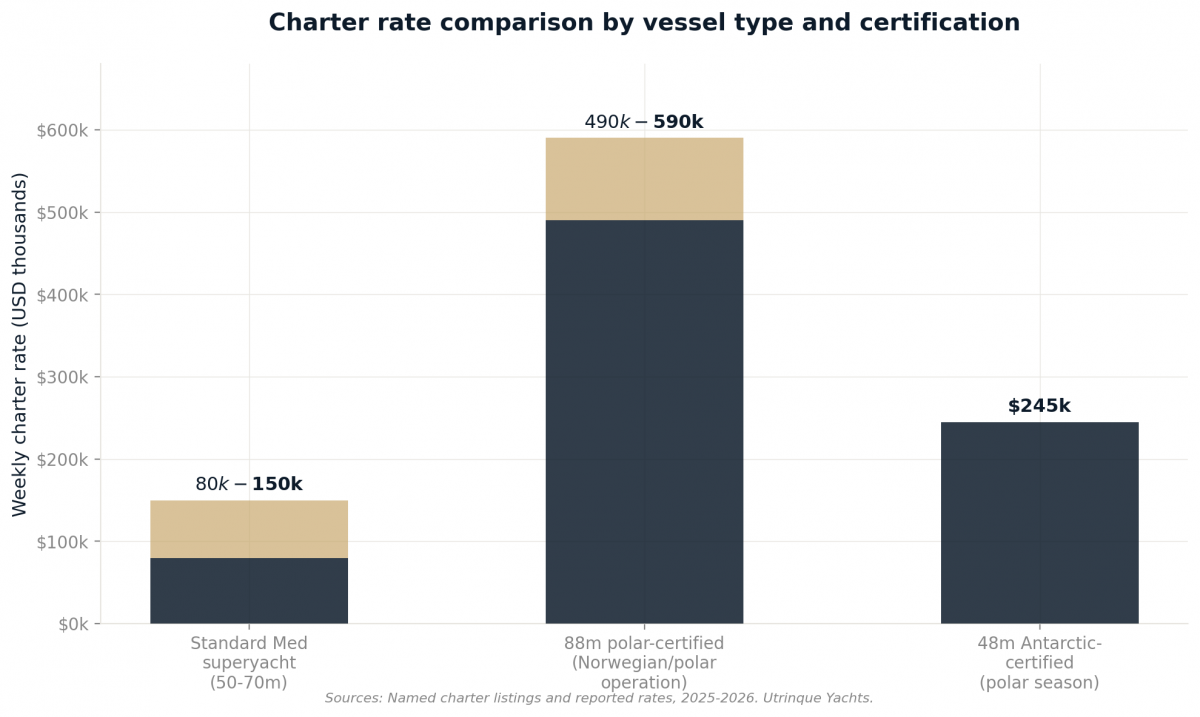
That distinction shows up immediately in what these vessels can earn on charter. A standard 50 to 70-metre motor superyacht in the Mediterranean charters at somewhere between 80,000 and 150,000 US dollars a week in season. An 88-metre vessel certified for Norwegian and Polar operation has chartered at 490,000 to to 590,000 US dollars a week. A 48-metre vessel with Antarctic access has commanded 245,000 US dollars a week in the Polar season, a rate well above what a much larger conventional yacht earns in the Mediterranean at the height of summer. Certification does not add a premium to the same product but opens an entirely different, thinner and more valuable market.
That earning gap is the mechanism, the depreciation gap is the consequence and this is where the 16.5-euro figure comes from.
Why the data problem exists
A family office buying a townhouse in Mayfair can pull 20 comparable sales from the Land Registry within an afternoon. A private jet buyer has decades of published transaction data through specialist valuation services built specifically for that market. Fine art, an asset class no less opaque in its own right, still publishes auction results that anyone can search freely.
A principal contemplating an eight or nine-figure expedition yacht has none of that. What exists instead is a handful of asking prices, most of them stale by the time anyone sees them, and a scattering of headline sale figures repeated across trade press with no consistent way to check whether any of them are accurate. Ice class notation compounds the problem rather than resolving it, because the term itself is used loosely in marketing material. A vessel can be described as ice-classed, ice-strengthened or built to expedition standard without any of those phrases mapping onto a specific, checkable certificate. Two vessels can carry near-identical marketing language and sit at opposite ends of what they are actually capable of doing at sea. That is precisely why the classification certificate, not the brochure, is the only document worth trusting in this part of the due diligence.
The depreciation curve
I have modelled indicative residual value curves for three vessel types across a 15-year hold: a well maintained, genuinely ice-classed explorer, a conventional Mediterranean superyacht and a vessel styled to look like an expedition yacht without the underlying certification. The three curves start together, at 100 per cent of delivery price, and diverge from year one. By year 15, the certified explorer retains approximately 59 per cent of its original value. The conventional superyacht sits at 44 per cent. The explorer-styled vessel without genuine capability falls to 26 per cent. On a 50-million-euro vessel, the 33 percentage point gap between the certified explorer and the look-alike is the 16.5-million-euro figure.
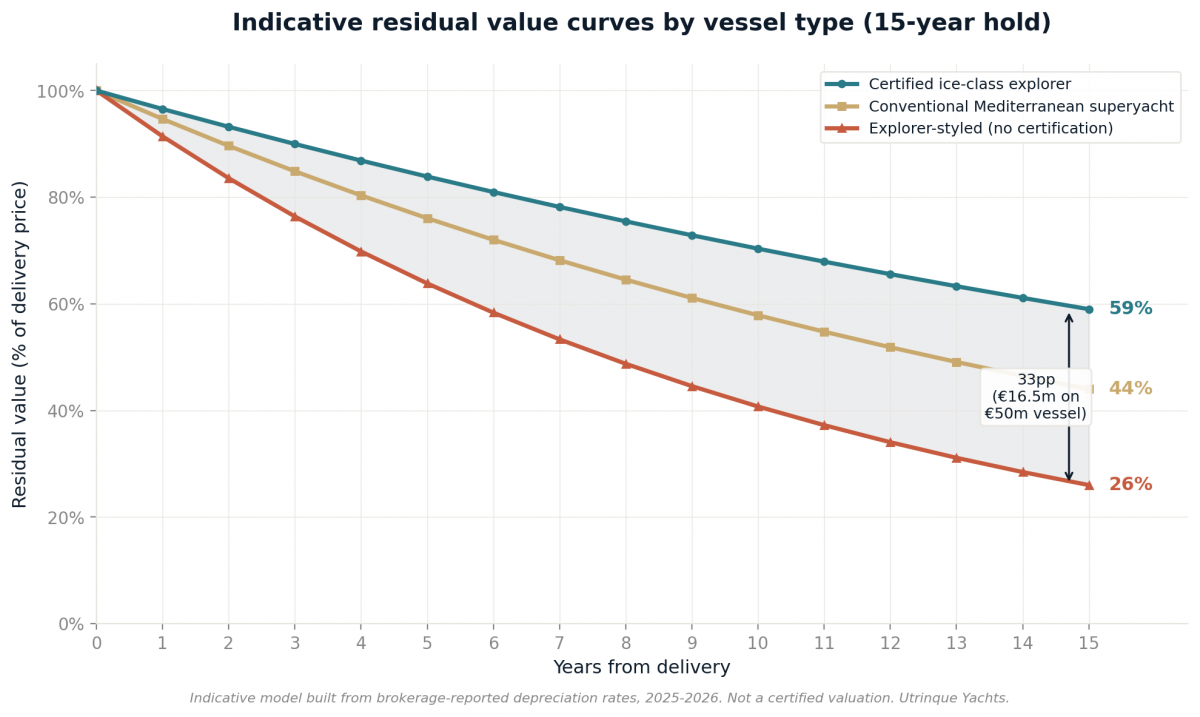
I want to be precise about what that model is and is not. It is built from brokerage-aggregated depreciation rates published across several yacht finance and brokerage sources, not from a single verified valuation service, and no peer-reviewed academic study of superyacht depreciation currently exists. The segment is too opaque and too thinly traded for one to have been produced. What the model represents is a considered, directionally sound estimate consistent with how brokers who work this market describe it, not a certified valuation. Anyone advising a principal on the strength of this figure should treat it as an informed estimate rather than an audited number, and I would say the same to any advisor reading this before they repeat it to a client.
What lends the model credibility is that it is consistent with observed, real transaction behaviour, not just theory.
Two confirmed sales, 18 months apart
I maintain a private comparable transaction register for the 50-metre-plus expedition and explorer segment. Most of what sits in it cannot be used for pricing analysis, prices undisclosed, sanctioned assets, private transfers with no arm’s length negotiation. Two entries, however, are genuine, industry-reported transactions close enough in time and specification to compare directly.
Polar Star, formerly Northern Star, a 65-metre Lürssen-built expedition yacht carrying Lloyd’s Register Ice Class 1D, sold in 2024 at approximately 35,400 dollars per gross tonne. Q, formerly Ragnar, a 68-metre Polar Class 5 conversion, sold in 2023 at approximately 37,400 dollars per gross tonne, despite being eight years younger, a factor that alone would ordinarily be expected to widen the gap further, and despite the two vessels transacting within 18 months of each other in the same segment.
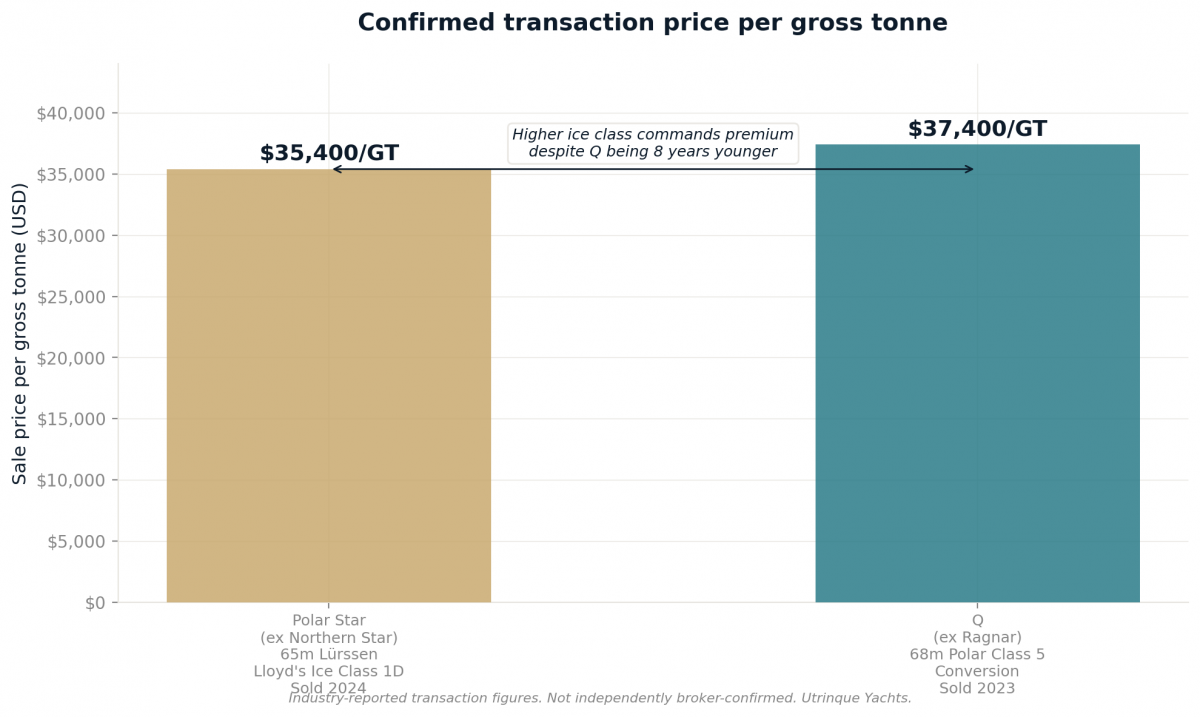
Age ordinarily pulls price per tonne down as a vessel gets older relative to a comparable. Here it did not overcome the higher ice class. That single data point will not carry a model on its own, and I have said elsewhere that the ice class premium implied by these two transactions, once age is roughly controlled for, sits somewhere between 1,500 and 2,500 US dollars per gross tonne. But it is directionally the same story the depreciation curve tells over a longer horizon: the market is pricing genuine ice-class capability as a durable asset, not a cosmetic feature, and it is pricing the absence of it as a liability that compounds every year the vessel is held.
What this means in practice
For a principal weighing a 50-metre-plus acquisition, the practical question is not whether a vessel looks capable of expedition cruising, it is whether the classification certificate, not the marketing material, confirms it. A hull styled with an X-bow, a shallow draft and expedition branded interiors can still be built to conventional Mediterranean specification underneath. The certificate will say so plainly; the brochure will not.
A vessel is either built for the water the owner wants to reach or it is not, and that single fact, more than length, more than styling, is what the market appears to be paying for over the long run.
For an advisor structuring the acquisition, the residual value implication is the one worth carrying into the negotiation. A 16.5-million-euro divergence over 15 years on a 50-million-euro asset is not a rounding error against the purchase price. It changes the exit assumptions the entire ownership structure is built on, and it is a variable that standard superyacht depreciation benchmarks, built from the broader market rather than this specific segment, do not capture at all.
There is a second, less obvious implication for advisors specifically: because reliable comparable data barely exists in this segment, an advisor who simply repeats a headline asking price to a principal as though it were a grounded market figure is passing on more confidence than the underlying data supports. A 40-million-euro asking price on a vessel with no genuine ice classification sounds specific and considered, right up until someone checks whether any comparable vessel of that specification has actually sold at that level. Often none has. The more defensible position is to say plainly that reliable data does not yet exist for the exact comparison a client is trying to make and to price that uncertainty into the advice given, rather than to borrow false precision from a market that has not earned it yet.
The honest conclusion is not that certified ice class always justifies its premium at acquisition. Plenty of owners never intend to leave the Mediterranean and for them the certification buys optionality they may never use. The honest conclusion is that the premium and the depreciation gap both exist, are measurable in the way described above and are currently under-priced in how most advisors frame the decision to their principals. A vessel is either built for the water the owner wants to reach or it is not, and that single fact, more than length, more than styling, is what the market appears to be paying for over the long run.
Methodology note
The residual value curves are an indicative model, not a certified valuation, built from brokerage-reported depreciation rates published across multiple yacht finance and brokerage sources during 2025 and 2026, cross-checked against each other for consistency. No peer-reviewed academic dataset on superyacht depreciation exists at the time of writing. Charter rate figures are drawn from named, sourced listings and reported rates, cited beneath each chart above. Transaction figures for Polar Star and Q are industry-reported and not independently broker-confirmed; euro-denominated prices are converted at the approximate exchange rate at the time of sale. All figures should be independently verified before being relied upon for a specific transaction.
Ben Abbott is the founder of Utrinque Yachts, a brokerage working exclusively in the 50-metre-plus expedition and explorer segment.
As an open-source platform we offer an industry-wide invitation to anyone and everyone in our sector to share their knowledge, experience and opinions. So if you have an interesting and valuable contribution to make, and would like to join our growing community of guest columnists, share your ideas with us at newsdesk@thesuperyachtgroup.com
NEW: Sign up for SuperyachtNewsweek!
Get the latest weekly news, in-depth reports, intelligence, and strategic insights, delivered directly from The Superyacht Group's editors and market analysts.
Stay at the forefront of the superyacht industry with SuperyachtNewsweek
Click here to become part of The Superyacht Group community, and join us in our mission to make this industry accessible to all, and prosperous for the long-term. We are offering access to the superyacht industry’s most comprehensive and longstanding archive of business-critical information, as well as a comprehensive, real-time superyacht fleet database, for just £10 per month, because we are One Industry with One Mission. Sign up here.
Related news

What a judge already told us about yacht valuation
Why length is a poor proxy for value on any individual hull – a judicial specification for how to value a yacht
Owner
No fuel. No fun. Can we still afford to charter?
Alexander Griffiths of Tidal Communications attends MYBA to find out how operational costs are affecting the demand for charter
Owner

Camper & Nicholsons to change ownership in €40 million deal
Lai Sun are set to sell 80 per cent of C&N to a Chinese e-commerce giant, with a full takeover on the cards in 2027
Business

Charter, VAT and its accrual in international waters
Tax advisor Miguel Ángel Serra explains how VAT regulations could tip the balance in favour of Spain as a charter destination
Opinion

Disrupt or be disrupted
Hot off the press from METS, Prof. Dr Christoph Ph. Schließmann comments on the new paridigm facing the superyacht industry
Opinion
Related news
What a judge already told us about yacht valuation
3 months ago
No fuel. No fun. Can we still afford to charter?
4 months ago
Charter, VAT and its accrual in international waters
9 months ago
Disrupt or be disrupted
11 months ago
NEW: Sign up for
SuperyachtNewsweek!
Get the latest weekly news, in-depth reports, intelligence, and strategic insights, delivered directly from The Superyacht Group's editors and market analysts.
Stay at the forefront of the superyacht industry with SuperyachtNewsweek