
What a judge already told us about yacht valuation
Why length is a poor proxy for value on any individual hull – a judicial specification for how to value a yacht …
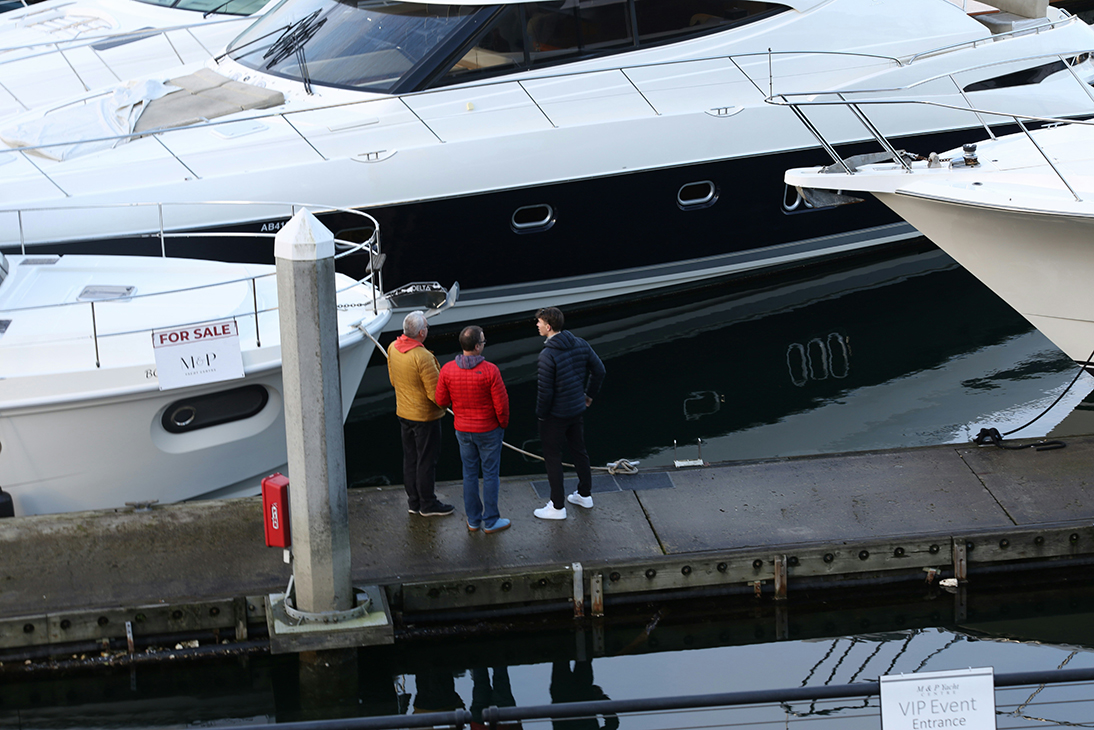
Fourteen motoryachts are on the market today at 50 metres – not ‘about 50’ – and each sits within 20 centimetres of the figure, which is to say they differ in length by less than half of one per cent. The cheapest is asking €8.0 million, the dearest is asking €31.5 million, while the median is €24.3 million: four times the money for what a spreadsheet would call the same boat.
Three of them were built in the same year, 2011. They are asking €10.8 million, €15.2 million and €24.0 million. They are the same length, same vintage and more than twice the money between the cheapest and the dearest. The only material thing separating them is who built them.
I mention it because this industry has a habit of treating length as a proxy for value – and, in aggregate, it very nearly is. The index I publish prices motoryachts on three variables: length overall, age and builder tier. Between them they explain roughly 92 per cent of the variation in asking prices across the brokered fleet, which is a high figure for a cross-sectional asset model.
However, ‘across the fleet’ is doing an enormous amount of work in that sentence. R² [the predictive accuracy of a statistical model] measures how well a model ranks vessels against each other, it says nothing about how accurately it prices any particular hull. On that measure my own model carries an error of ±41 per cent*, which I publish for the same reason a surveyor writes his limitations on the face of his report.
You might reasonably take that as an admission that the model is weak. It is worth knowing that the alternative isn’t better, it’s worse, and we have known so, in detail, for over a decade.
Two experts, one yacht, three times the money
In 2015 the Commercial Court decided Involnert Management v Aprilgrange — the Galatea case. A Riva 115 had been insured for an agreed value of €13 million. The yacht’s owners had obtained a market valuation putting it at €7 to €8 million, and through 2011 it was marketed for sale at €8 million. Neither fact was disclosed to the underwriter. In December 2011 the vessel caught fire at its mooring in Athens and was damaged beyond economic repair.
Leggatt J [Sir George Leggatt (now Lord Leggatt), formerly Justice of the High Court] held that both facts were material, and that the non-disclosure – although entirely innocent – entitled underwriters to avoid the policy. The yacht was a total loss and the claim failed in its entirety. That finding alone deserves to be better known than it is: no fraud, no concealment, simply a gap between the figure the yacht was carried at and the figure it was worth, which nobody in the chain thought worth mentioning.
Estimating the value of a large yacht ... is “a very imprecise and subjective exercise”, because the market is illiquid and opaque and every hull is close to unique.
The part of the judgement this industry ought to read is the valuation evidence. Each side called an expert valuer to say what Galatea was worth in May 2011 – the same yacht, at the same date, on the same facts, with both experts on oath and cross-examined across a three-week trial. The claimant’s expert put its worth at just under €10 million, while the insurers’ expert put it between €3.5 and €4.5 million – nearly three times apart.
Faced with that, Leggatt J declined to find a ‘true’ market value at all – he decided he did not need to – and instead wrote a passage headed “The indeterminacy of market value”. Estimating the value of a large yacht, he found, is “a very imprecise and subjective exercise”, because the market is illiquid and opaque and every hull is close to unique. Sale prices, he noted, are not published and are known only to the parties: “The only publicly available price information consists of asking prices, which may often differ substantially from actual sale prices.”
That is a High Court judge, ten years ago, describing the central problem of this market more plainly than the market usually describes it itself. Asking prices are imperfect; but they are also very nearly all there is.
The judge’s specification
What makes the judgement valuable is that Leggatt J did not stop at declaring the exercise imprecise. He said why each expert’s method failed and in doing so he effectively wrote a specification for defensible yacht valuation. It has gone largely unread.
The claimant’s expert reasoned from depreciation: a Riva 115, well maintained, would lose about 25 per cent of its value over four years, so €13 million paid becomes €9.75 million. The judge rejected it and the reasoning is worth quoting: there was no objective evidence for the rate and the method took no account of market conditions: “There is accordingly no such thing as a typical or expected rate of depreciation”. Anyone who has ever produced a valuation by applying a percentage to a purchase price should sit with that sentence for a moment.
The insurers’ expert reasoned from comparables: 13 broadly similar yachts then on the market, average asking price €5.68 million, less a 30 per cent discount drawn from sales brokered by his own company between 2010 and 2012, giving roughly €4 million with a range of half a million either side.
Don’t reason from a depreciation rule of thumb, don’t drop comparables you dislike. Adjust for builder and know what is inside your discount.
The judge preferred that structure – and then took its execution apart on three specific grounds.
First, sample selection. The expert had left out a comparable Riva 115 asking €9.8 million, on the grounds that he thought the asking price too high. The judge did not accept that as a reason: the need to discount asking prices was already built into the method, so “omitting Cleopatra biased his sample”. A comparable may not be dropped for being inconveniently priced.
Second, quality. The expert accepted that Riva was a better yacht than some in his comparison table, but made no adjustment for it, so his average asking price was understated. Those three 50-metre yachts from 2011, asking €10.8 million, €15.2 million and €24.0 million, are the same criticism in live data: average them and you have a number that describes none of them.
Third, and most instructive, the discount itself. Around a quarter of the sales from which he had derived his 30 per cent were forced sales by banks – transactions the expert accepted were likely to depress price and were not apposite to Galatea. A discount measured partly on distress is not a measure of the market.
The judge’s conclusion: “It is not possible to quantify the overall effect of these biases, but it seems to me that they make Mr Maclaurin’s estimates too low.” He would have found, had he needed to, that a realistic figure was €5 to €6 million.
So … don’t reason from a depreciation rule of thumb, don’t drop comparables you dislike. Adjust for builder and know what is inside your discount. That is not my checklist. It’s a judge’s and it’s free.
That last criticism is pointed at me as much as at him. My own discount – the 15 per cent I use to convert asking price to estimated transaction value – came from 61 matched deals where I knew both the advertised price and the price achieved. They came from one brokerage’s book, in 2007, because that is where I was and that is how anyone gets this data at all. One house, one moment, near the top of the market. His came from one house’s book near the bottom of it.
That is the bargain anyone who tries to measure this ends up making: the only people who know what yachts actually sell for are the people who sold them. So no, my 15 per cent is not the market’s number handed down from somewhere – it’s a reading, from one book, taken at a moment that has passed. I publish it, and the workings, so that it can be argued with, and I would revise it tomorrow if this market produced the data to revise it against. It doesn’t and that is the whole problem, and it is why all of us are still estimating.
For a buyer below 40 metres, asking prices are softer than a flat index implies, and one seller in four has already shown a willingness to move. For a buyer at the top, headline prices are firm, comparables are few and patience is the instrument that matters.
Where the discounting actually is
Which brings us to what is happening now. The second-quarter index barely moved — 100.7, up 0.7 per cent, statistically indistinguishable from flat. Beneath it, the market was anything but uniform. Of the motoryachts listed in both the April and July snapshots, one in five reduced their asking price, by a median of 11 per cent. Those reductions were not spread evenly:
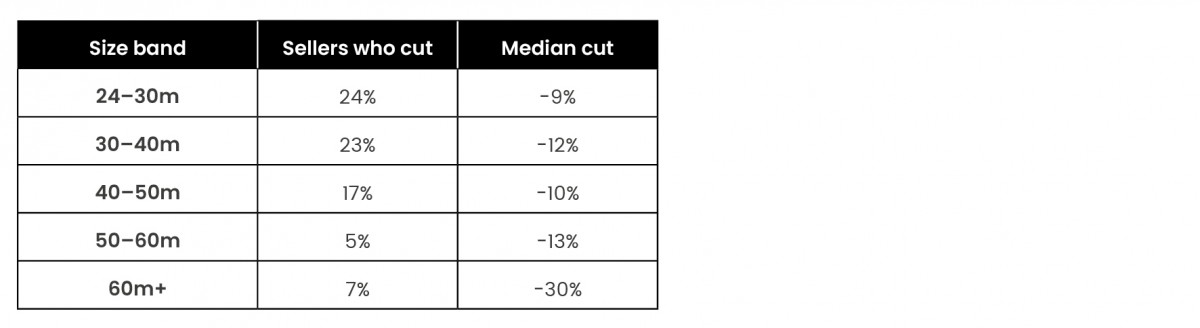
In the most liquid part of the market, close to a quarter of sellers marked down. Move up the size ladder and reductions become rarer – above 50 metres, only about one vessel in 20 moved at all.
It is tempting to read the large-yacht end as resilient, but note the last row. When a 60-metre-plus vessel does move on price, it moves hard: a median reduction of around 30 per cent. Firmness at the top is not strength, it’s the absence of price discovery – and it is exactly the condition Leggatt J was describing.
What it means
For a buyer below 40 metres, asking prices are softer than a flat index implies, and one seller in four has already shown a willingness to move. For a buyer at the top, headline prices are firm, comparables are few and patience is the instrument that matters.
For a lender or an insurer, Galatea is the cautionary text and its most alarming feature is that nobody involved did anything dishonest. The figure on the policy and the figure the market would pay had simply drifted apart and the drift cost an owner his entire claim on a total loss.
And for the rest of us: 14 boats, 50 metres, €8 million to €31.5 million. Two experts, one yacht, €4 million and €10 million. The spread is not noise around the answer, it is the answer, and the profession’s task is to be honest about its width rather than to disguise it behind a decimal point.
A note on method
These figures come from advertised asking prices across the brokerage houses I track, refreshed quarterly. Asking prices are used for the reason the court identified: sale prices in this market are not published. A disclosed 15 per cent discount converts modelled asking price to estimated transaction value. The 14 50-metre yachts are listed across three brokerage houses, and the cheapest and the dearest are at different houses; each one has a verified builder and a live listing behind it. The 50-metre-plus bands in the table are thin – around 60 vessels each – so those rows are indicative rather than precise. The comparison is possible only because there are now two quarterly snapshots to set against one another. The method is published in full and is independent of any brokerage.
*Since submission the author has revised his model following a data correction; the error band is now ±35 per cent.
Andrew Williams has worked in the maritime industry for 38 years, 26 of them in the superyacht sector, and has practised as a marine surveyor and consultant for the last 17. He publishes the Williams Superyacht Index, an independent quarterly price index for motor and sailing yachts over 24 metres.
As an open-source platform we offer an industry-wide invitation to anyone and everyone in our sector to share their knowledge, experience and opinions. So if you have an interesting and valuable contribution to make, and would like to join our growing community of guest columnists, share your ideas with us at newsdesk@thesuperyachtgroup.com
NEW: Sign up for SuperyachtNewsweek!
Get the latest weekly news, in-depth reports, intelligence, and strategic insights, delivered directly from The Superyacht Group's editors and market analysts.
Stay at the forefront of the superyacht industry with SuperyachtNewsweek
Click here to become part of The Superyacht Group community, and join us in our mission to make this industry accessible to all, and prosperous for the long-term. We are offering access to the superyacht industry’s most comprehensive and longstanding archive of business-critical information, as well as a comprehensive, real-time superyacht fleet database, for just £10 per month, because we are One Industry with One Mission. Sign up here.
Related news

Sailing against the tide
How exchange controls and currency risk threaten multi-million-rand acquisitions
Owner

Camper & Nicholsons to change ownership in €40 million deal
Lai Sun are set to sell 80 per cent of C&N to a Chinese e-commerce giant, with a full takeover on the cards in 2027
Business

Trust and serendipity - Anders Kurtén talks Fraser
Moving from shipyard to brokerage isn’t quite the cosmic career jump some might think
Business
The Big Brokerage Market
Chairman Martin H. Redmayne looks at what a good broker can bring to the table and who’s been doing the deals this year
Business
The value of a yacht broker and owner representative partnership
Explaining the differing roles of the broker and owner representative and what each can bring to the yacht purchase process
Opinion
Related news
Sailing against the tide
4 months ago
Trust and serendipity - Anders Kurtén talks Fraser
7 months ago
The Big Brokerage Market
1 year ago
NEW: Sign up for
SuperyachtNewsweek!
Get the latest weekly news, in-depth reports, intelligence, and strategic insights, delivered directly from The Superyacht Group's editors and market analysts.
Stay at the forefront of the superyacht industry with SuperyachtNewsweek