Trust and serendipity - Anders Kurtén talks Fraser
Moving from shipyard to brokerage isn’t quite the cosmic career jump some might think…
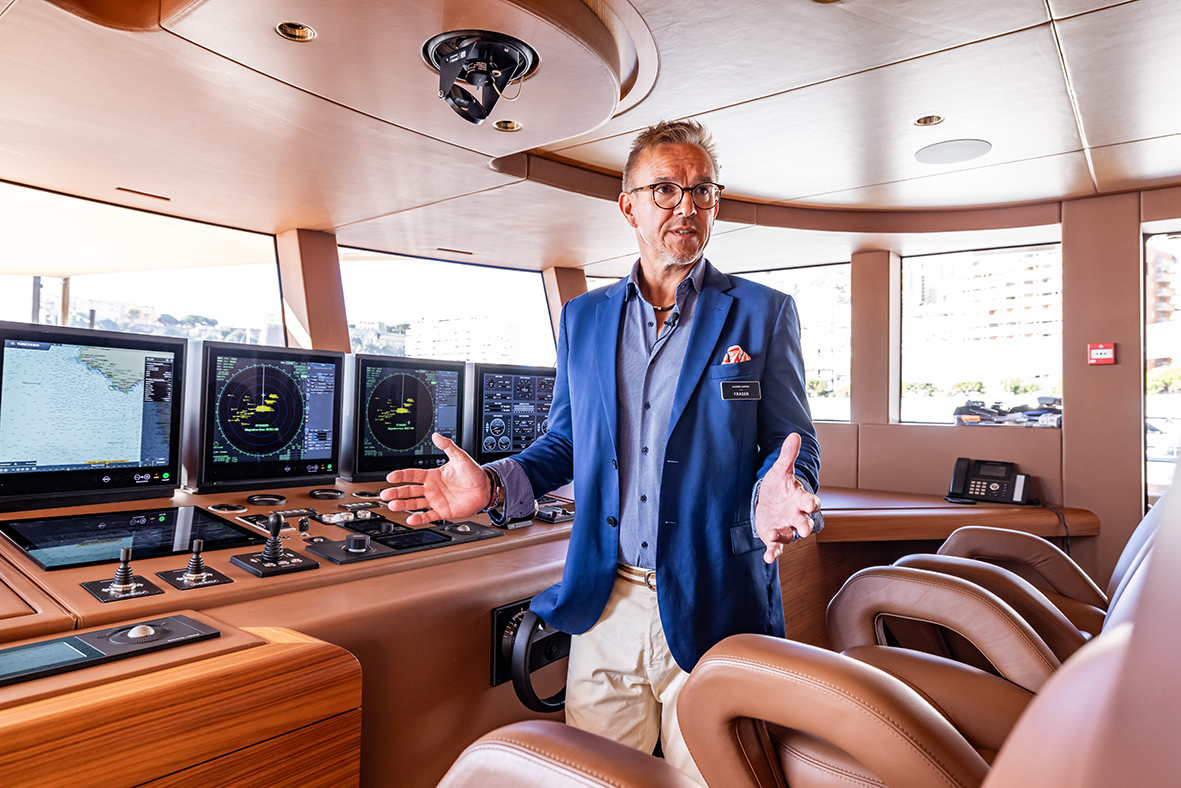
Image credit: Guy Fleury
For someone who now sits at the helm of one of the world’s most recognisable brokerage houses, Anders Kurtén talks about the yachting market in a way that feels disarmingly uncorporate. Our discussion doesn’t start with market data, fleet sizes or absorption rates, but with a memory of being carried aboard his grandfather’s boat before he could walk, while spending blue-skied summers in the south-west Finnish archipelago, where small sailing yachts were a simple fact of life. “I never really thought about boating as a hobby,” he reflects. “It was just always there – more like an integral part of life.”
Now the head of brokerage stalwart Fraser, Kurtén’s perspective is vanishingly rare as the Finn moved from dot-com era businesses to restoring wooden classics in a shed to wrestling with the economics of fully custom carbon yachts. It is this long arc – from boat shed to boardroom – that now informs how he thinks about value, risk and where the market might go next. We talk through his business outlook for the future, as Fraser’s performance under Anders is focused on exploiting a structurally scarce market by deepening trust, mining off-market opportunities and reading the right signals.
Yachting was always the backdrop to Kurtén’s existence. That perspective makes his career arc all the more interesting. Before he became CEO of Fraser, Kurtén was on the other side of the super-yacht equation. A business degree from the Swedish School of Economics and Business Administration in Helsinki first led to an early web career in the late 1990s and early 2000s, and then to an abrupt pivot. “I woke up one morning and realised that this is not a dress rehearsal,” he says. “For me, it was more important to work with something that actually resonated emotionally.”
It was a radical call to follow his passion while pairing it with his business aptitude, taking a gap year and enrolling at a wooden boatbuilding school, a role he still (sometimes) misses. That, in turn, led to several years of restoring classic wooden yachts by hand. “It was emotionally very satisfying,” he admits, “but financially slightly less so.” Eventually, the pendulum swung back towards the business side of the sector. He took over a small yard in southern Finland, building semi custom performance sailing boats under the Finngulf name, only to see the 2008 global financial crisis expose just how fragile that model had become. The boats were expensive, production builders were getting better and the three- to four-times price gap no longer made sense.
From there, he crossed the threshold, what he jokingly calls “to the dark side”: almost a decade running marketing and product development for a serial powerboat manufacturer in the Baltic region, building aluminium and GRP bowriders and day cruisers. Midway through his tenure, the company was acquired by Yamaha. Then, in 2019, came the call to take on a very different challenge at the rarefied names high performance composite sailing shipyard, Baltic Yachts.
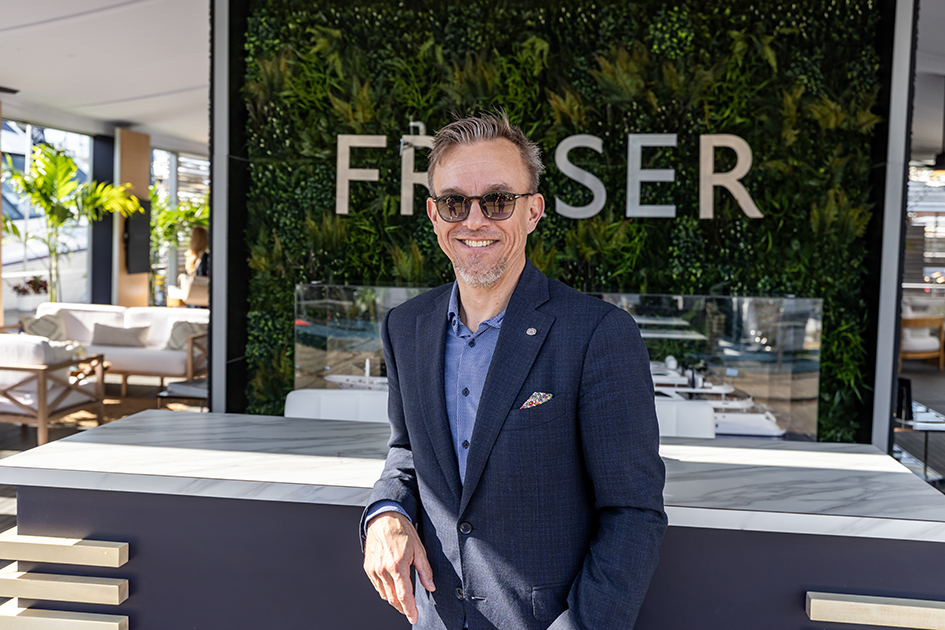
Image credit: Guy Fleury
“I find that most [clients] aren’t really particularly interested in working with the biggest company. They want to work with whoever can provide them with the best solutions and the highest probability of ticking the boxes for whatever the dream may happen to be.”
When Kurtén talks about Baltic, he describes it as a “micro niche within a niche”. The yard’s proposition is unusually pure high end, fully custom sailing superyachts in carbon composite. It is the sharp end of an already rarefied market. “The addressable market, just in terms of projects that even make sense to bid on, is small enough that you can count them on the fingers of your two hands,” he explains.
“So that’s a pretty small box from a business development perspective. What then attracted me to the services side was really the higher clock frequency, the larger global addressable market, and just a much bigger churn, much more that you can do with the business.” On paper, moving from a Finnish shipyard to Monaco-based Fraser in September 2023 looks like a major leap, but the continuity is more interesting than the contrast. “If you really sort of try to simplify the equation, there’s actually more similarities than there are differences,” he argues.
“Whether you’re constructing a custom yacht or trying to find a customer the dream brokerage yacht, or even just crafting the perfect two week charter itinerary for a dream vacation, really, the goal is the same. Your client has a dream of sorts, and you do your utmost to make it come true. Then, as a CEO, what you’re essentially doing is you’re trying to create an atmosphere that facilitates all the other team members to do their very best and perform at their highest level. And there, it doesn’t really matter whether you’re actually physically crafting products or whether you’re shaping an experience or trying to get to terms with how to sell an owner’s boat best, the fundamentals are the same.”
“My firm conviction is that if you consistently manage to deliver the best solutions across all business areas, then size and volume and business success will follow.”
But if you try to speak with Kurtén using a traditional corporate growth mindset, you quickly find yourself out of step with the company’s definition of success. It’s easy to fixate on market share, but trust remains the fuel of choice when propelling the company forward. Context matters here: depending on who you ask and how you count, there are perhaps six to seven thousand superyachts over 30 metres around the world. They are all, in varying degrees, idiosyncratically demanding not just in their configuration and history but also in the personalities and circumstances of the people who own or charter them. In that environment of “extreme scarcity”, as he puts it, the idea that clients are drawn to the biggest company by default doesn’t really hold. “I find that most of them aren’t really particularly interested in working with the biggest company,” he says. “They want to work with whoever can provide them with the best solutions and the highest probability of ticking the boxes for whatever the dream may happen to be.”
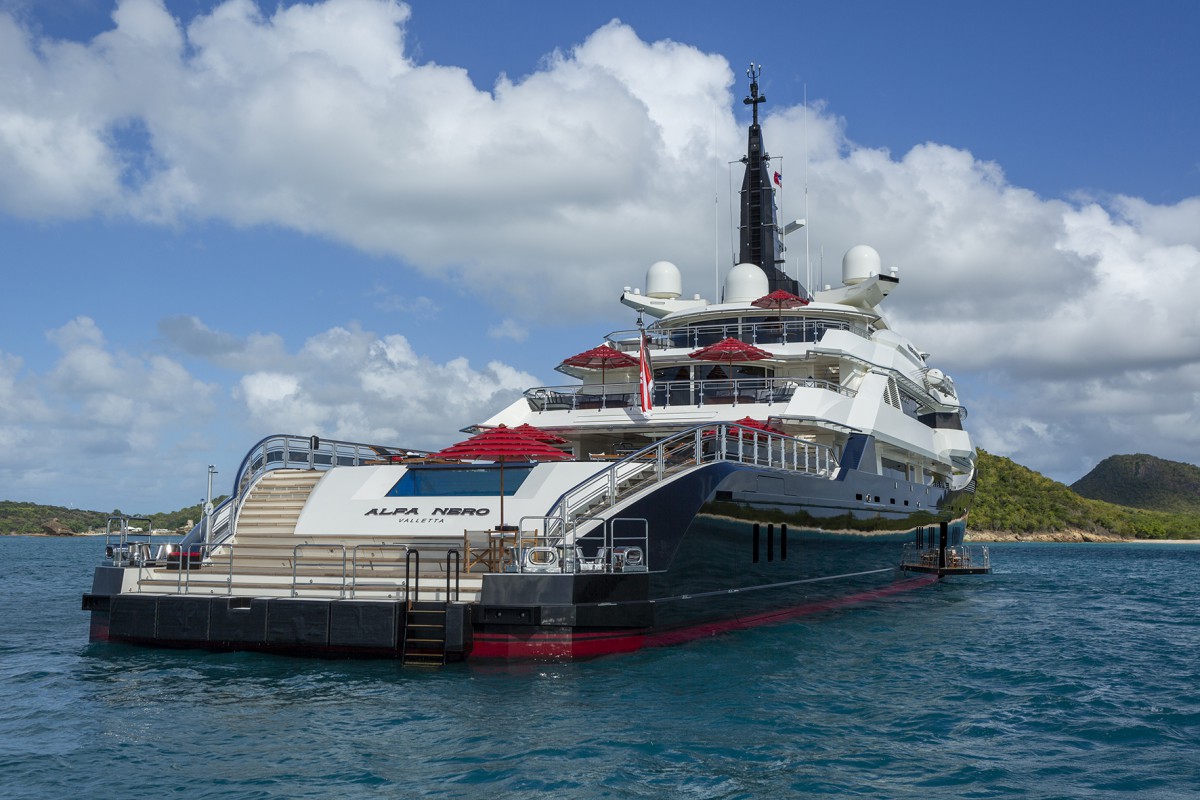
82-metre Alfa Nero, built by Oceanco and designed by Nuvolari Lenard, was refitted in 2024.
Fraser’s numbers bear this out, as Kurtén explains that somewhere between 85 and 90 per cent of its business comes from existing clients. The impressive 10 per cent cohort of new owners and charterers typically arrive via word of mouth from friends, peers or advisers who have already had good experiences and are willing to open the door. Of course, there is the acknowledgement that marketing has evolved; digital tools are more sophisticated than they were in the late 1990s when Kurtén first worked online. But in a world where individual transactions can be as emotionally charged as they are financially significant, the single most effective channel remains an old fashioned referral. The result has been some of the strongest years in Fraser’s history, including through the pandemic and its aftermath. Still, Kurtén resists the temptation to rewrite the company’s story around growth alone. “Growth per se is not an outright stated end all, be all,” he says. “My firm conviction is that if you consistently manage to deliver the best solutions across all business areas, then size and volume and business success will follow.”
In an industry often obsessed by the bigger numbers, that stance sounds slightly contrarian. In practice, it may be precisely what has allowed Fraser to endure for nearly eight decades. From the outside, it is easy to fixate on the headline deals: the handful of 100 metre plus sales that skew annual value statistics and the record pandemic years when transaction volumes spiked. So it stands to informed reason that Kurtén is cautious about drawing sweeping con-clusions from any single season, particularly at the very top end.
“We operate in an environment of extreme scarcity,” he explains. “There are some six or seven thousand superyachts over 30 metres, depending on who you ask and how you count – and they’re all, in many perspectives, quite unique. There were around 600 brokerage transactions last year, and we handled 56 of them. It could have been 590 or 650.”
“Even a year is too short a time,” he warns. “There’s a bunch of serendipity that goes into what closes in ’24, what closes in ’25, what closes in ’26. Instead, he looks for what he calls more reliable baro-meters. One of those sits far below the 100 metre bracket that so often dominates the conversation: the 24 to 30-metre segment. In 2024, transactions in this size range grew from roughly 250 to about 285 boats – a rise of around 15 per cent.
“In 24 to 30 metres we grew from about 250 to 285 transactions, so roughly 15 per cent,” he says. “In some ways, that segment outperformed the rest of the market if you treat the rest as one figure. And that’s important because that’s the most sensitive factor to the parameters that measure actual client sentiment.”
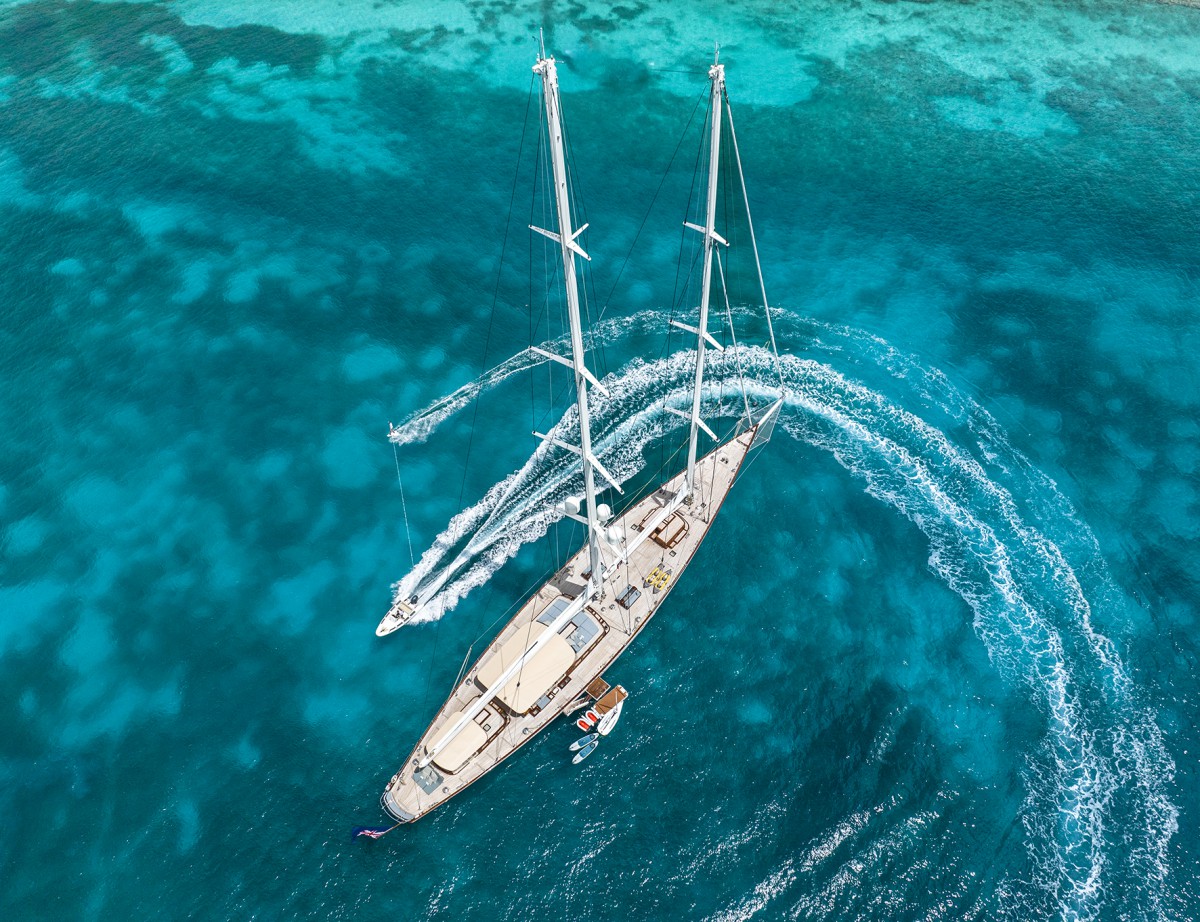
64-metre Athos, the largest two-masted schooner in the world, was built by Holland Jachtbouw and extensively refitted by Royal Huisman in 2022.
At the very large end – 70 metres and above – the market has been chronically short of inventory. New-build prices at the pre-eminent yards are up significantly since Covid, order books are fuller and delivery slots are pushed several years out. Many owners are either unwilling to sell until their next yacht is in the water or decide not to sell at all. That makes the ultra-large bracket a poor proxy for sentiment. A handful of completions or cancellations can move the numbers disproportionately.
“Theoretically, I would agree that the top end dictates the pace,” he says, “were the top end not significantly inventory restricted, but it is. At the bigger ranges above 70 metres, the last few years have really been characterised by inventory restriction.” By contrast, the 24 to 30-metre band operates with fewer structural constraints. There is more stock, more liquidity and more transparency. It is also crucial for many new owners take their first step into superyachting. “Many times this is not the last yacht they will own and this is not the last charter they will do,” he adds. “Charter, in many cases, was the gateway drug that introduced them to the lifestyle.”
A rebound and outperformance in this range, then, suggests not just that existing players are trading up or sideways, but that new money is willing to commit at a level that responds quickly to changes in sentiment. Coupled with steady overall growth since 2023 – and a pandemic period that he describes as “for all intents and purposes, a positive market aberration” in terms of broadening the client base – it underpins his reading of a market that is more resilient than many outside the sector assume.
“It’s W, F, Y and I know sounds like a profanity, but it’s not. It’s working from the yacht, which now, due to Starlink, is actually feasible. You can run a board meeting from your yacht without interruption.”
If the data suggests an industry in reasonable health, the conversations behind it point to some-thing more fundamental: a shift in how clients think about what a yacht is for. “Today it is significantly less about the yacht as an object, especially for charter,” Kurtén continues, “and it is much more about where it can take you and with whom, and what you can experience together.” New entrants increasingly start with a scenario rather than a specification, such as multi generational family time, wellness led escapes, off grid exploration and hyper connected weeks that blend work and leisure. A growing cohort of younger clients, in particular, expect to lift and drop their onshore lifestyle almost wholesale onto the water.
This is especially pronounced among younger generations, Kurtén noting that they really expect to be able to take their onshore lifestyle and pretty much port it directly onto the yacht. Connectivity has been the revolution that makes this possible. What used to be a compromise – fragile links, unreliable streaming, crew scouring islands for DVDs – has been replaced by something far closer to a metropolitan experience. “It’s W, F, Y and I know sounds like a profanity, but it’s not,” he laughs. “It’s working from the yacht, which now, due to Starlink, is actually feasible. You can run a board meeting from your yacht without interruption.” That, in turn, is changing how long and how often yachts are used, and what they are asked to be: office, spa, restaurant, live music venue, family home and exploration platform, sometimes within a single week. It is also raising the bar for the human infrastructure that enables those experiences.
Nowhere is that escalation more visible than in the job descriptions landing at Fraser’s crewing subsidiary, Crew Network. “Ten years ago, you were looking for a deckhand who had great credentials from a seafaring safety and client relations perspective,” Kurtén says. “Today, ideally he speaks three major European world languages, can mix a mean martini, has a little bit of a singing voice, can accompany himself on a guitar – and if he can run a yoga class or do Pilates or massage, it’s only a bonus.” It might be a slight exaggeration for effect, but not by much. The same expansion is evident across the service hierarchy. Stews are part sommelier, part barista, part events planner. Chefs are asked to handle an ever wider range of cuisines and dietary regimes. Pursers and chief stews need to orchestrate days that can swing from board meetings to beach club parties to silent, wellness led evenings.
To respond, Fraser has had to move well beyond database driven matching. “We actually interview every candidate,” Kurtén stresses. “And then we also work pretty hard on understanding the owners’ requirements – hard requirements, wishes, person-ality – so that we have the best possibility of crafting a good match. There’s really no shortcut, there’s a lot of hard work. It’s not just gathering CVs and sending them out.”
His experience at Baltic points to a similar lesson in terms of scale. In the run up to the 2008 crisis, many in the sailing sector assumed the future lay in ever larger boats, backed by ever larger construction sheds. The correction that followed exposed the limits of that logic. “Just prior to the global financial crisis, the ethos was that we need a bigger shed, because people are going to want bigger boats,” he recalls. “But the market normalised and really for sailing shipyards the sweet spot still is somewhere between 110 and 150 feet. That gives you the performance, it gives you the interior volume, and yet you still retain some semblance of a sensation of actually sailing.”
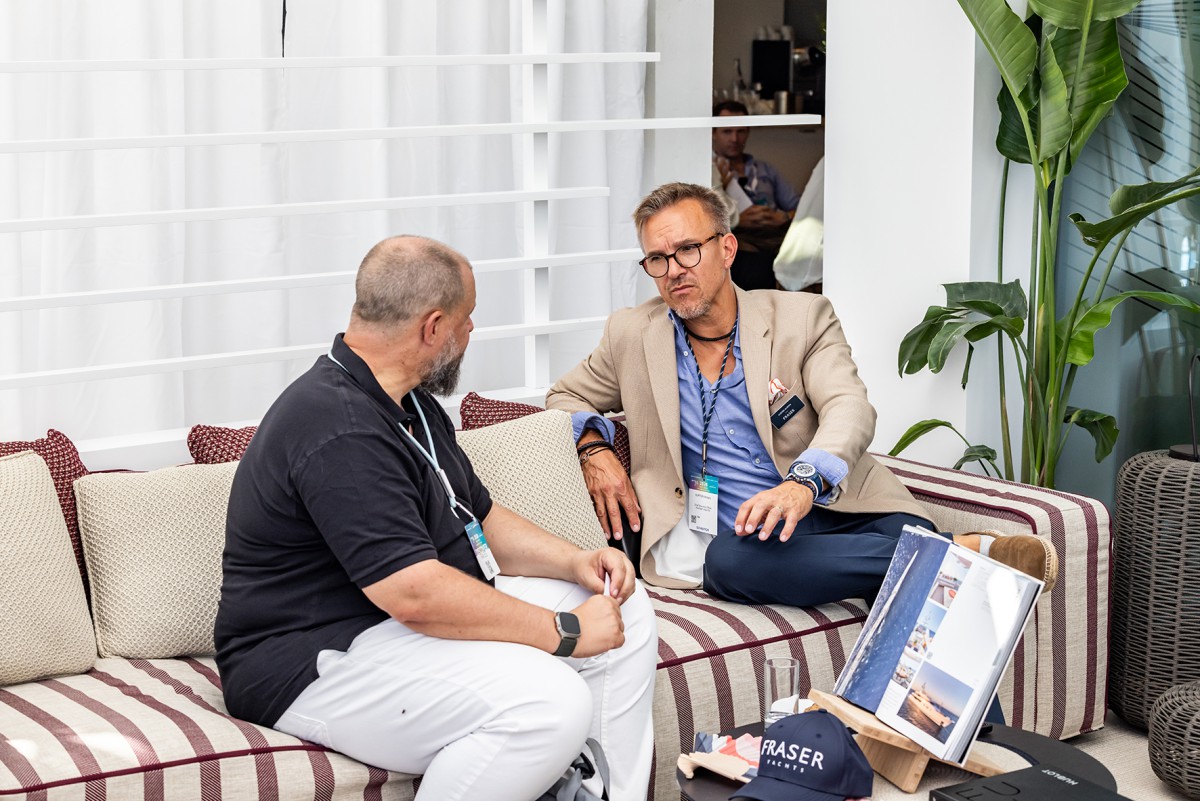
Image credit: Guy Fleury
“Inventory constraints at the large end will remain a structural headwind; it puts a little bit of an onus on working harder on the behind-the-scenes deals and actually tailoring, making sure that where there is demand, you create the supply, if you will.”
Push much beyond 200 feet, he argues, and the experiential line between a sailing yacht and a motoryacht begins to blur. On the motoryacht side, too, extreme size carries trade-offs with limited access to certain harbours and anchorages, complicated logistics, more support craft and less spontaneity. “You’re actually spot on,” he says when the notion that you can lose freedom as you go larger is put to him. “There’s more hassle, less freedom. So it’s not necessarily a conducive equation.”
That doesn’t mean the sector is about to shrink. If anything, every yacht shrinks as you use it. Once owners live aboard, constraints on space and versatility become more obvious, often prompting a move up in size. But the direction of travel in design is less about raw length and more about how intelligently volume is used and how well the yacht supports the experiences owners now expect. Within that framework, he sees several technologies as already credible for specific profiles: full electric on certain sailing yachts; diesel-electric hybrid as a robust, well-understood solution for many motoryachts; methanol reformers producing hydrogen as an emerging, promising option. But he resists the urge to anoint a single universal answer. The technologies exist, he says, but many have yet to reach full field-proven maturity.
A similar measured scepticism colours his take on AI. On the back office side, he is an enthusiastic user of ChatGPT and other tools. And over time, he sees clear potential in finance, legal, compliance and market intelligence, as well as in marketing content and data driven reporting. But on the client-facing front line, he struggles to see a near-term revolution. “For the sort of client interfacing part of the job, there’s no major impact yet, nor do I really foresee anything imminently around the corner that would fundamentally change the way we work,” he says. The work there is about trust, nuance and chemistry about reading a room.
As for the wider market, Kurtén describes himself as cautiously optimistic, but he is acutely aware that the spread between best- and worst-case scenarios has widened since the pandemic. “For the last maybe five, six years, ever since the pandemic, we’ve had a really, really interesting forecasting situation where the discrepancy between the worst case and the best case is bigger than we pre-pandemic would have usually expected it to be. Which makes forecasting kind of hard,” he adds. “Inventory constraints at the large end will remain a structural headwind; it puts a little bit of an onus on working harder on the behind-the-scenes deals and actually tailoring, making sure that where there is demand, you create the supply, if you will,” he says.
It’s a forecast that draws on a wealth of experience, but as I ask him to reflect on his career thus far, he smiles and says he loves what he does. “And if I could give any advice to my younger self, at 21, ready to start this journey, I would say have patience. You’re going to need it,” he laughs. It’s advice the market could abide by, too. In the end, though, his outlook is anchored less in spreadsheets than in something both simpler and harder to quantify. In a sector now threaded through with AI tools, alternative fuels and satellite constellations, that may sound quaint. But for Anders Kurtén, it is precisely this mix of advanced technology and very old human impulses that defines the future he is trying to steer Fraser towards, a future where, yes, the numbers matter, but serendipity and trust still play their part.
This article first appeared in The Superyacht Report: New Build Focus. With our open-source policy, it is available to all by following this link, so read and download the latest issue and any of our previous issues in our library.
Profile links
NEW: Sign up for SuperyachtNewsweek!
Get the latest weekly news, in-depth reports, intelligence, and strategic insights, delivered directly from The Superyacht Group's editors and market analysts.
Stay at the forefront of the superyacht industry with SuperyachtNewsweek
Click here to become part of The Superyacht Group community, and join us in our mission to make this industry accessible to all, and prosperous for the long-term. We are offering access to the superyacht industry’s most comprehensive and longstanding archive of business-critical information, as well as a comprehensive, real-time superyacht fleet database, for just £10 per month, because we are One Industry with One Mission. Sign up here.
Related news
Superyacht OpEx Survey: Captains and First Officers have your say
How much do superyachts really spend – and where does that money go?
Crew

New AV/IT training programme launches
The Professional Yachting Association announces the launch of a new AV/IT training programme to address the growing skills gap on board superyachts
Crew
Mandatory changes to the PSSR course
PYA update on the new STCW requirements included in the Personal Safety and Social Responsibility training module, taking effect on 1 January 2026
Crew

Acting, leadership and the future of command
What acting classes taught me about yachting – by Captain Carsten Franik
Opinion

Ancient invests in Burgess amid rising consolidation
Ancient’s partnership with Burgess comes as corporate owners and private capital reshape the sector
Business
Related news
New AV/IT training programme launches
9 months ago
Mandatory changes to the PSSR course
10 months ago
Acting, leadership and the future of command
10 months ago
Ancient invests in Burgess amid rising consolidation
11 months ago
NEW: Sign up for
SuperyachtNewsweek!
Get the latest weekly news, in-depth reports, intelligence, and strategic insights, delivered directly from The Superyacht Group's editors and market analysts.
Stay at the forefront of the superyacht industry with SuperyachtNewsweek