
Where does the Chinese yacht industry go from here?
A 20-year perspective from a Chinese yacht builder – by Allen Leng, founder of Heysea Yachts…
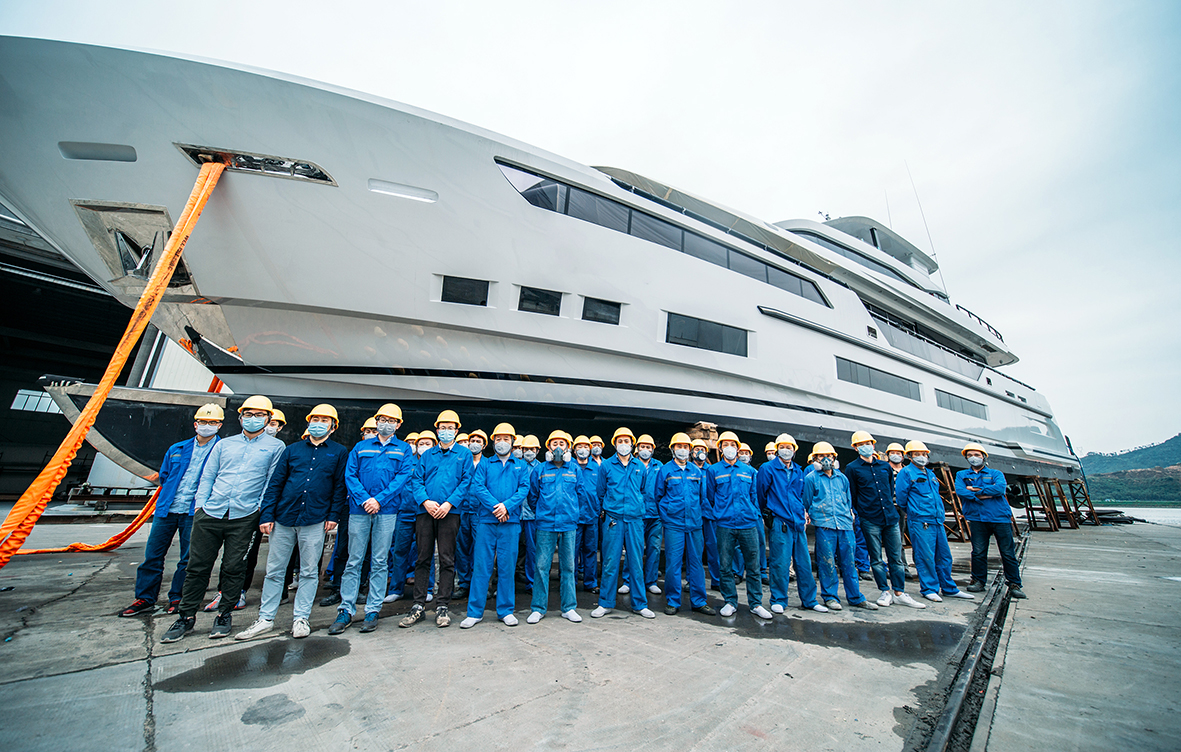
China’s yacht industry has been developing for more than two decades. Today, approximately 10,000 yachts are registered in China — a surprisingly small number for a country of more than 1.4 billion people and the world’s second-largest economy. Across almost every other major industry, China has experienced extraordinary growth. The yacht industry, meanwhile, started its modern development at roughly the same time as Turkey’s, yet its scale remains far behind. Why has the Chinese yacht industry struggled to move beyond its potential? And, more importantly, where does it go from here?
I have spent the past 20 years building yachts in China and watching this industry develop, contract and reinvent itself. What follows is my personal view of how we arrived here, why the domestic market has remained relatively small and where I believe China’s real opportunities now lie.
The first chapter: China becomes a yacht manufacturing base
China’s modern yacht-manufacturing industry began to take shape around 2000, when a number of Taiwanese yacht manufacturers established production facilities on the mainland. In Shanghai there was Double Happiness Yacht Co., Ltd (DHS) and Ocean Alexander; in Zhuhai, Sunshine Yachts and Jet-Tern Marine; and in Xiamen, Nordhavn and Marlow Yachts. Much of the production focused on trawler-style yachts and other established export products.
At that time there was virtually no domestic Chinese yacht market. The boats were built for export, primarily because China’s labour-cost advantage made the country highly competitive internationally. At its peak, Jet-Tern Marine alone employed close to 2,000 people and delivered almost 60 yachts in a single year.
The global financial crisis of 2008 brought that first wave of Chinese yacht manufacturing to an abrupt halt. As demand in overseas markets collapsed, many of these companies were forced to shrink dramatically or cease operations. Their fundamental weakness was a lack of independent research and development and, in particular, a lack of their own product strategy. When overseas demand changed, they could not develop new models quickly enough to respond.
Yet this first generation of factories left an extremely important legacy: skilled people. They trained a generation of yacht builders in composite construction, interiors, engineering, assembly and production management. Many of those people later became the technical foundation for China’s next generation of yacht companies.
The domestic yacht market experienced a modest peak between roughly 2009 and 2012 and then contracted sharply. There simply was not enough domestic demand to support the number of manufacturers that had entered the sector.
The second chapter: Chinese companies enter the market
From around 2005, Chinese entrepreneurs established dozens of domestic yacht companies. The ambition was understandable: China’s economy was growing rapidly, a wealthy consumer class was emerging and many believed that a substantial domestic yacht market would inevitably follow.
For most companies, however, that expectation did not materialise. The domestic yacht market experienced a modest peak between roughly 2009 and 2012 and then contracted sharply. There simply was not enough domestic demand to support the number of manufacturers that had entered the sector. At the same time, many products did not yet meet the quality, design and certification expectations required to compete in the mainstream European and North American export markets.
As a result, many manufacturers moved into government and commercial vessels, including enforcement boats, public-service craft and sightseeing vessels. Only a small number of companies developed a different path. Heysea, Hansheng and Aquila were among those that grew rapidly by building capabilities beyond the traditional low-cost manufacturing model. Their stories, however, deserve a separate article.
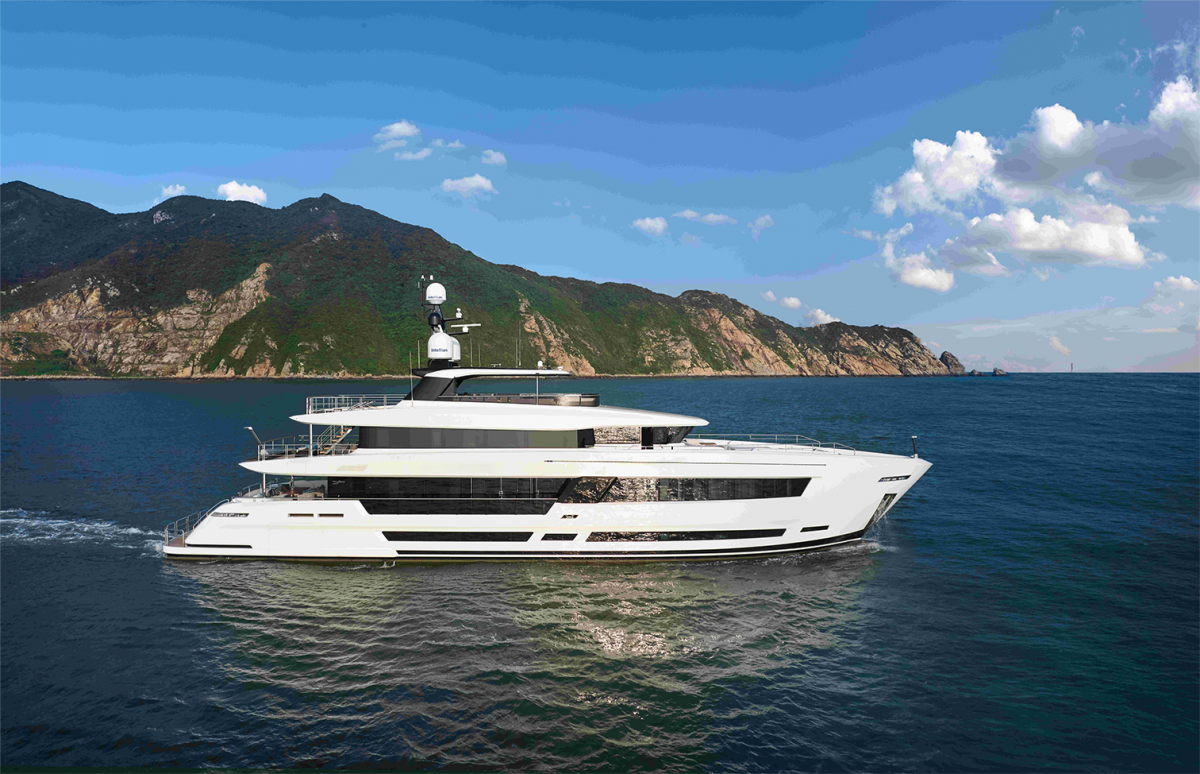
Why has China’s yacht market remained so small?
After the 2008 financial crisis, Chinese capital became deeply involved in the European yacht industry. Weichai Group acquired Ferretti, Dalian Wanda acquired Sunseeker and The New Continents Company took a stake in Sanlorenzo. The logic was straightforward: if China’s economy continued to grow at high speed, surely a large Chinese yacht market would emerge. By combining international yacht brands with China’s labour, manufacturing capacity and supply chain, it seemed possible to create world-class yacht businesses.
Twenty years later, the original expectation has not been fulfilled. China remains a potentially important yacht market rather than a market on the scale of the United States, Europe, Australia or New Zealand.
When an industry fails to develop as expected, explanations are easy to find. One common argument is that China is traditionally an agricultural civilisation rather than a maritime one and that Chinese consumers therefore lack an affinity with the sea. Another is that yachts have been negatively associated with corruption and conspicuous consumption, creating an image of yachts as a symbol of extravagance.
I believe both explanations have some influence, but neither gets to the heart of the issue. The more fundamental problem has been the regulatory and operating environment surrounding recreational boating.
If the regulatory framework can move towards managing navigation risk rather than
treating the existence of yachts themselves as a source of institutional risk, the industry will have
much more room to develop.
For many years, maritime safety administration in China was governed by a highly risk-averse framework. Yacht accidents could be treated within a broader public-safety and production-safety context, creating significant institutional pressure on local authorities. Where officials could potentially be held accountable for serious accidents, increasing the number of recreational boats naturally increased perceived administrative risk. The result was a system in which restricting yacht activity could appear safer than facilitating it.
This is fundamentally different from the normal logic of road transport. When a car accident occurs, the authorities determine responsibility and the insurance system deals with the resulting claims. Recreational boating needs a similarly clear division of responsibilities: regulators should set and enforce navigation and safety rules, while liability for an individual incident should be allocated according to the facts of that incident.
For years, people working in China’s yacht industry have called for this distinction. If the regulatory framework can move towards managing navigation risk rather than treating the existence of yachts themselves as a source of institutional risk, the industry will have much more room to develop.
A potentially important turning point in 2026
After two relatively quiet decades, 2026 has brought several developments that, from an industry perspective, could prove significant. In May 2026, the Ministry of Transport introduced new yacht safety-management provisions that, according to the industry’s understanding, change the way yacht safety incidents are classified. This could represent an important step towards a clearer distinction between maritime traffic management and production-safety administration.
The China Classification Society (CCS) has also revised relevant yacht rules, including provisions allowing yacht capacity of up to 26 persons and clearer distinctions between charter and private yachts. This is particularly important because yacht charter has historically operated in a regulatory grey area.
In addition, the yacht industry has been included in China’s 15th Five-Year Plan framework, with encouragement for local governments to develop public marinas and anchorages. Each change may appear relatively small in isolation. Together, however, they could have a meaningful effect on the ecosystem required for recreational boating.
I believe these developments create a more credible basis for the Chinese yacht market to grow. But the next opportunity is not simply to build more yachts in China. It is to identify where China can create lasting value in the global yacht industry.
China’s real advantage is the density of its industrial ecosystem. A yacht builder can access materials, components, engineering resources and manufacturing expertise within a relatively concentrated supply chain. That can become a strategic advantage for both Chinese and international yacht builders.
Where is China’s future yacht opportunity?
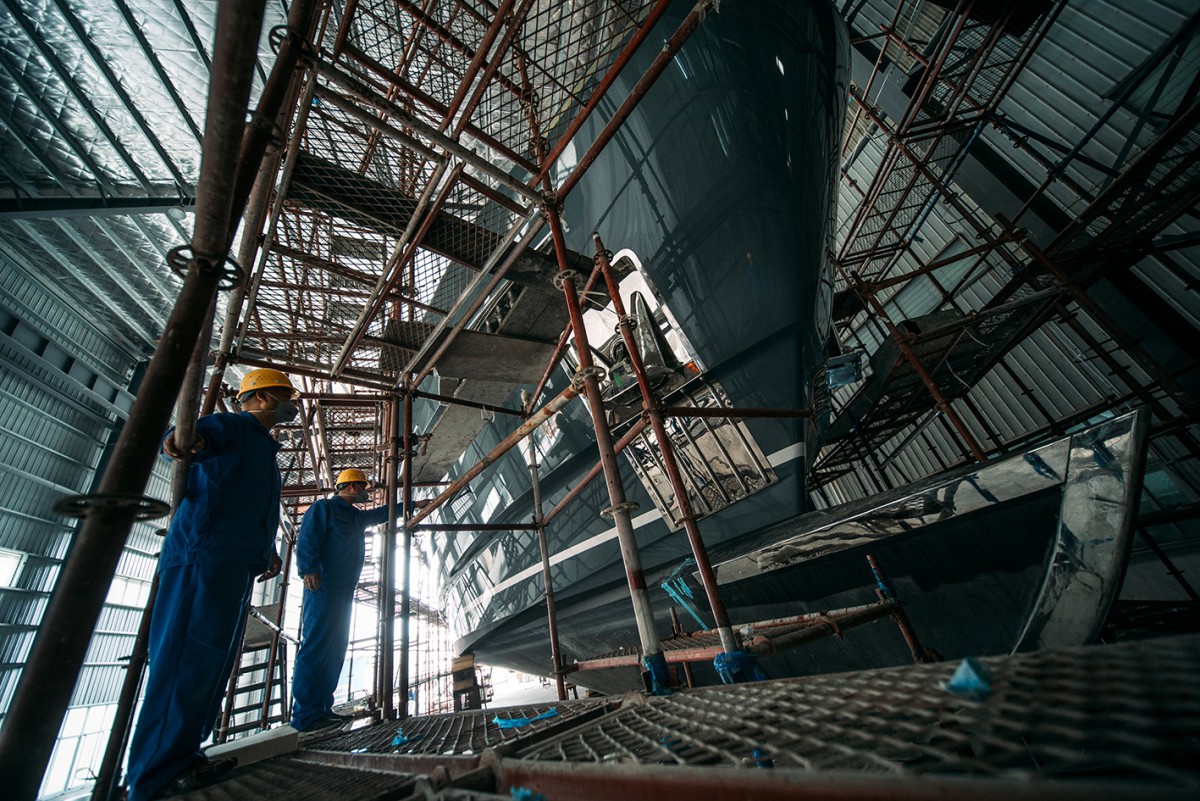
First, China has the potential to become a global supply-chain and engineering hub for the yacht industry. The capability already exists across an extraordinary range of categories: hull materials, interior materials and complete interior packages, vibration and acoustic insulation, deck hardware, bilge pumps, timber and metal fabrication, hardware, doors and windows, glass, stainless-steel railings and hull construction.
The same is true for complete systems and engineering: hatches, steering systems, propulsion, air conditioning, piping, watermakers, renewable-energy systems, lighting, audio-visual equipment, smart-yacht systems, ventilation, performance development and marine engineering. In many of these areas, Chinese suppliers can provide reliable products at highly competitive cost levels.
This is not simply a low-cost manufacturing story. China’s real advantage is the density of its industrial ecosystem. A yacht builder can access materials, components, engineering resources and manufacturing expertise within a relatively concentrated supply chain. That can become a strategic advantage for both Chinese and international yacht builders.
Second, I believe China has an opportunity to become a centre for new-energy yacht innovation.
There is still considerable debate about how quickly electric and hybrid propulsion will transform the yacht industry. But there is growing agreement that new-energy propulsion will be an important part of its future. The main technology pathways include energy-storage systems, fully electric propulsion, range-extender configurations and hybrid systems.
China has developed exceptional industrial depth in batteries, electric motors, power electronics, solar technology and battery-management systems as a result of its enormous electric-vehicle industry. Companies such as CATL, BYD, EVE Energy and CALB are investing heavily in next-generation battery technology, including solid-state batteries.
For yachts, however, the challenge is not simply to install automotive technology on a boat. Marine applications require different approaches to safety, thermal management, redundancy, certification, weight distribution and long-duration operation. This is precisely where China’s broader technology ecosystem could become valuable to the yacht industry.
An increasing number of European yacht companies are looking to China for new-energy solutions, while dozens of technology companies connected to marine electrification have attracted venture or industrial investment. I believe some of these companies will eventually emerge as globally relevant suppliers of new-energy yacht technology.
China already has enormous strengths in engineering management, technical manpower and
large-scale manufacturing. Where the gap remains more visible is in the artistic and highly detailed
aspects of yacht creation: exterior styling, interior design, material selection, detailing and the
final level of craftsmanship.
From manufacturing capability to superyacht capability
Recent trade tensions between China and the United States have, among other things, put the scale of China’s industrial and engineering capability under an unusually bright international spotlight. I do not want to make this article a political discussion, nor do I intend to judge who is right or wrong. What is relevant to the yacht industry is the sheer depth of China’s manufacturing capacity and engineering resources.
The same question applies to superyachts. Can China become a serious participant in the global superyacht market? I believe it can – and I believe it wants to.
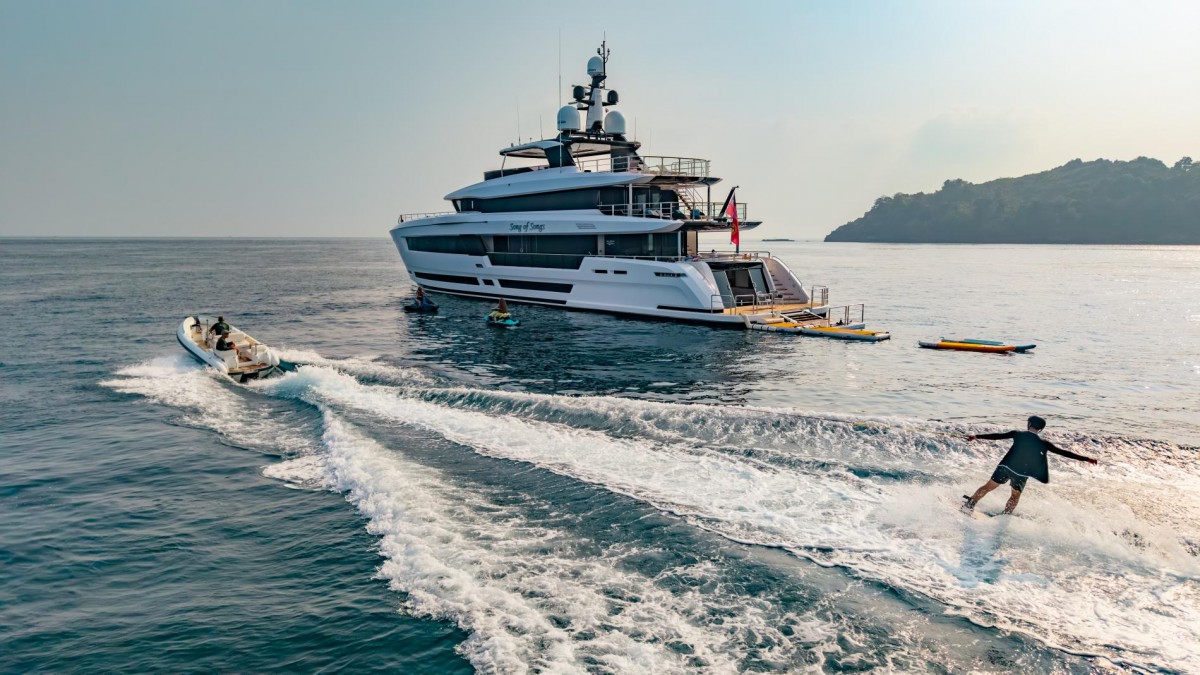
The two major challenges in superyacht construction are engineering/project management and craftsmanship. China already has enormous strengths in engineering management, technical manpower and large-scale manufacturing. Where the gap remains more visible is in the artistic and highly detailed aspects of yacht creation: exterior styling, interior design, material selection, detailing and the final level of craftsmanship.
That gap does not have to be permanent. A productive model is to combine the strengths of different regions: international designers and naval architects can contribute creative direction and global design language, while Chinese shipyards contribute engineering resources, project management, manufacturing depth and supply-chain capability.
If these strengths are combined effectively, I believe China’s superyacht-building capability can make a significant qualitative leap over the coming years and eventually establish China among the world’s leading superyacht-building countries.
There are already examples of companies moving in this direction, including Heysea Yachts and C&L Yachts, as well as Hansheng, which has built yachts as an OEM partner for the British Pearl brand. At the same time, China’s superyacht story has also included costly failures, including Yantai Raffles and Zhuhai-based IAG. Their experiences demonstrate that engineering and manufacturing capability alone are not enough: capital discipline, product strategy, design, international sales, project management and after-sales support are equally critical.
For the domestic market, regulatory reform, accessible marinas, anchorages, charter rules and practical opportunities to go boating will determine whether China’s enormous potential consumer base can finally become an active boating community.
The road ahead
The Chinese yacht industry has spent the past 20 years learning a difficult lesson: a large economy does not automatically create a large yacht market and low manufacturing costs do not automatically create a global yacht brand.
The next phase is different. China’s opportunity may be less about trying to replicate the traditional European yacht industry and more about contributing something new to it – through supply-chain depth, engineering, new-energy technology, manufacturing capability and, increasingly, internationally oriented yacht brands.
For the domestic market, regulatory reform, accessible marinas, anchorages, charter rules and practical opportunities to go boating will determine whether China’s enormous potential consumer base can finally become an active boating community.
For the global market, the challenge for Chinese yacht builders is to move beyond the label of ‘Chinese manufacturing’ and demonstrate, consistently, that they can deliver design, engineering, quality, craftsmanship, project management and after-sales support at an international level.
The foundations are now in place. The next 10 years will determine whether China remains primarily a supplier to the global yacht industry or becomes one of its leading participants.
As an open-source platform we offer an industry-wide invitation to anyone and everyone in our sector to share their knowledge, experience and opinions. If you have an interesting and valuable contribution to make, and would like to join our growing community of guest columnists, share your ideas with us at newsdesk@thesuperyachtgroup.com
NEW: Sign up for SuperyachtNewsweek!
Get the latest weekly news, in-depth reports, intelligence, and strategic insights, delivered directly from The Superyacht Group's editors and market analysts.
Stay at the forefront of the superyacht industry with SuperyachtNewsweek
Click here to become part of The Superyacht Group community, and join us in our mission to make this industry accessible to all, and prosperous for the long-term. We are offering access to the superyacht industry’s most comprehensive and longstanding archive of business-critical information, as well as a comprehensive, real-time superyacht fleet database, for just £10 per month, because we are One Industry with One Mission. Sign up here.
Related news
The biggest market in yachting is also the most broken
Why the sub-40-metre segment has the most potential buyers, the least margin – and what nobody is doing about it
Opinion

Trademark and design law in the luxury yachting industry
A case law analysis in light of Riva, Benetti and recent WIPO decisions – by Serap Sargin, Sargın Law Office
Owner
Global study reveals the economic power of the superyacht industry
New study positions yacht builders as the industrial foundation of a €54 billion global superyacht economy
Business

How data reveals the real impact of the new-build sector
The facts and figures behind the economic significance of new-build activity and its contribution to the global economy
Opinion
Largest yacht ever built in Turkey launches
Turquoise Yachts launches 87-metre flagship Project Vento
Fleet
Related news
Largest yacht ever built in Turkey launches
9 months ago
NEW: Sign up for
SuperyachtNewsweek!
Get the latest weekly news, in-depth reports, intelligence, and strategic insights, delivered directly from The Superyacht Group's editors and market analysts.
Stay at the forefront of the superyacht industry with SuperyachtNewsweek