The cost of waiting
Emmanuelle Votat and Andrew Williams dissect the costs of frozen-yacht deterioration and the results are fascinating…
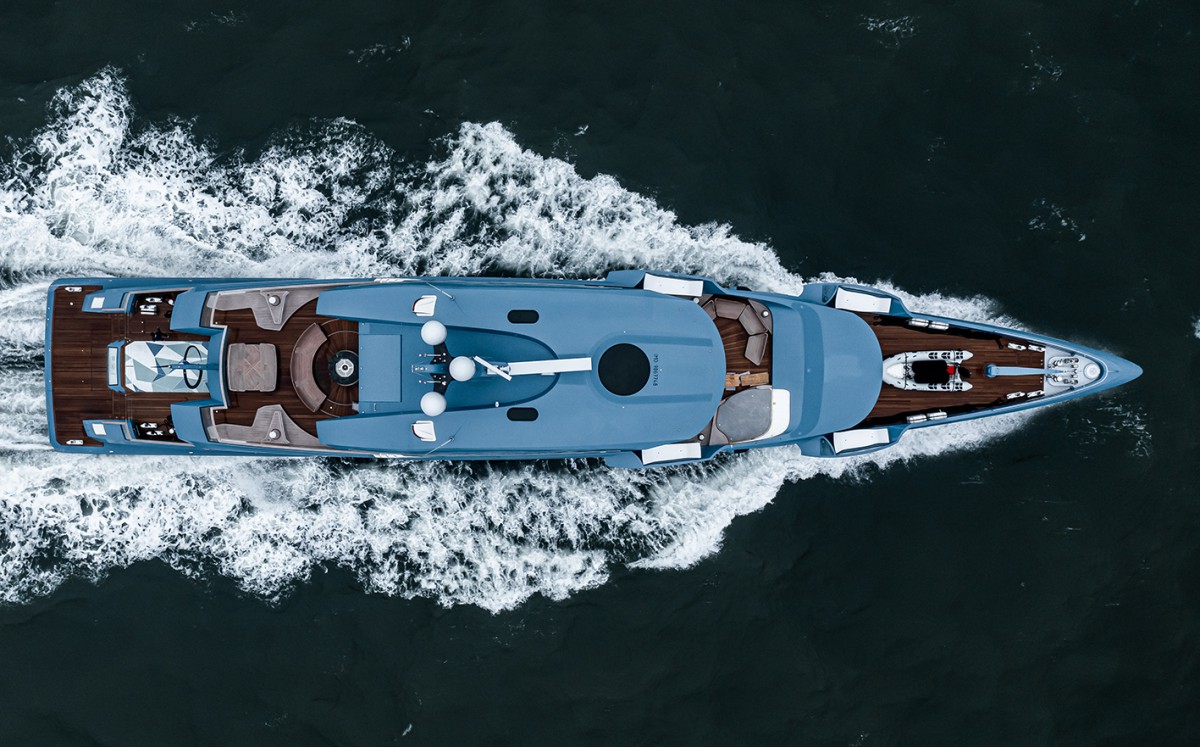
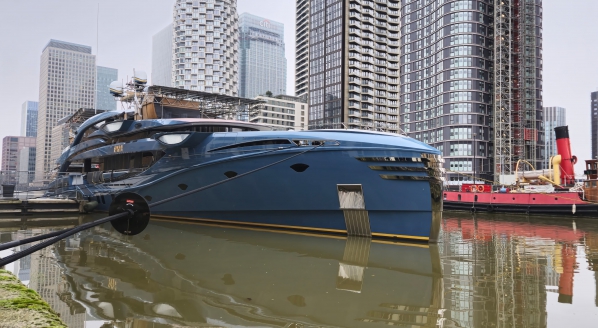
Phi. Image credit: Tom van Oossanen
Nearly five years after the wave of freezes that affected yachts linked to sanctioned individuals in March 2022, Europe remains entangled in its sanctions. It must now pay the bills.
Many yachts are still immobilised in European ports and shipyards. Some freezes have been compounded by criminal, customs or commercial proceedings. No decision indicates when they will be sold or even whether they will be sold. Meanwhile, they are ageing, taking up space and costing money.
Yet there have been official announcements. In February 2025, the Marseille public prosecutor announced the forthcoming sale of Amore Vero. In April 2026, the Ukrainian agency ARMA announced that of Royal Romance, immobilised in Croatia. Neither sale has yet taken place. A statement remains a statement. Only a sale stops the clock.
Our previous article, The Certificate and the Price, dealt with the price that a judicial sale can achieve. But before the sale comes the wait. That is what we seek to measure: the cost of not selling.
1. When freezing deepens depreciation
Frozen or not, a yacht loses value every year. This is the effect of age. But natural depreciation must be distinguished from deterioration. Freezing can accelerate the latter because it delays or blocks the decisions and payments that would prevent it. Some frozen yachts continue to receive minimal maintenance, sometimes with delays, such as Amore Vero, Sailing Yacht A or Royal Romance. Others are barely maintained, if at all, such as Luminosity or Phi.
To measure the real cost of freezing, two scenarios must be compared: selling early, under constraint and at a discount, with the sale proceeds placed in escrow until the dispute is resolved, or waiting several years when the yacht continues to lose value and custody costs accumulate.
One outcome may follow either scenario: restitution. The owner could then invoke deterioration resulting from a failure to preserve the yacht. Establishing liability would be difficult, as fault generally has to be proven, but allowing a vessel in the custody of the State to deteriorate could constitute such fault. Waiting then becomes risky, even for the State that believes it has nothing to lose.
Age can be quantified. Freezing makes the vessel age faster than its years, unless it is maintained. The question remains who pays.
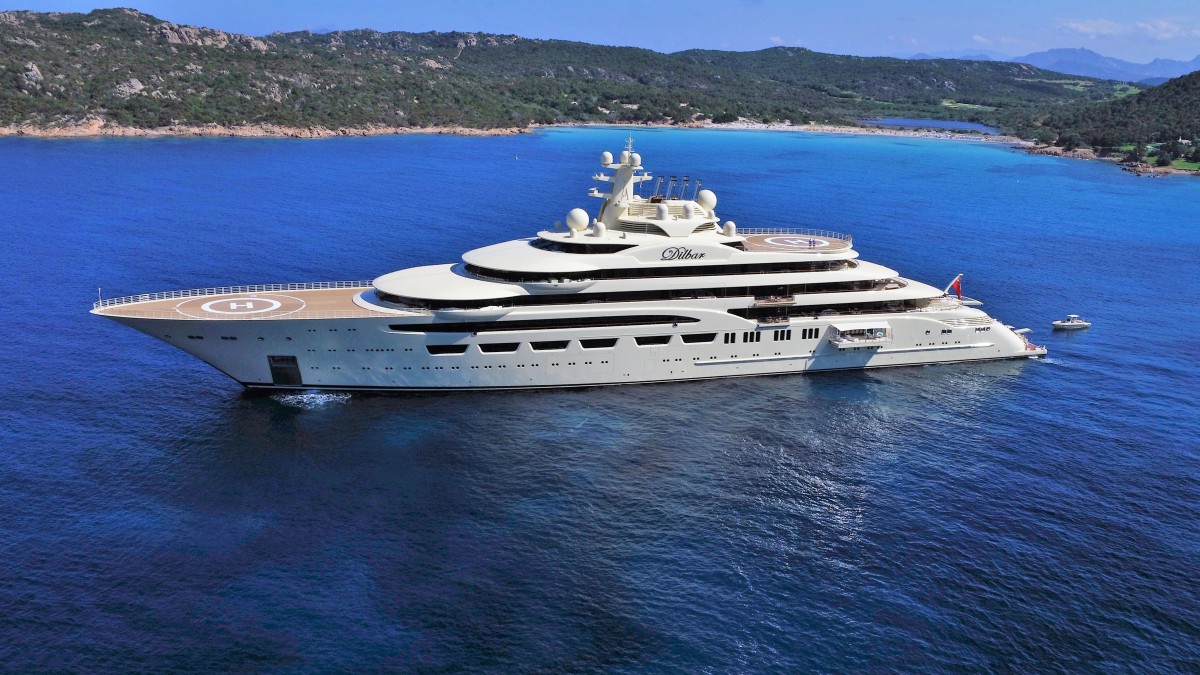
According to press reports, Lürssen kept Dilbar for more than four years without being paid. Image credit: ®Kyle Conlin
Who pays?
It all depends on the State and the legal regime. In France, as in Spain, a yacht that is merely frozen remains the responsibility of its owner, who must obtain authorisation to pay for maintenance from frozen funds. If the owner stops paying, no one has a mandate to manage the vessel: the port or shipyard intervenes for safety reasons and advances costs that it will later try to recover. When a criminal seizure is added to the freeze, the State generally advances the custody costs.
Elsewhere, each country does things its own way. Italy has placed frozen yachts under the administration of the Agenzia del Demanio. According to Corriere Adriatico, the custody of Sailing Yacht A reportedly cost Italian taxpayers more than €40 million before the State negotiated her departure from Trieste for major works. Tango, valued at around €85 million at the time of its seizure, has been immobilised in Palma since April 2022 at the request of the United States. According to the Spanish maritime press, its maintenance reportedly costs the US government approximately €10 million per year, or more than €40 million since 2022. In Germany, it’s the shipyard that has paid: according to press reports, Lürssen kept Dilbar for more than four years without being paid.
The risk of the tipping point
For the State seeking confiscation, waiting may seem reasonable: custody costs money, but the final sale proceeds will come to it. In the event of an authorised early sale, the proceeds may remain frozen. Yet this calculation has a limit. Every month of delay reduces the value, sometimes to nothing. There is a tipping point beyond which waiting destroys what it was supposed to preserve.
European Directive 2024/1260 recognises this in the context of criminal proceedings, including for the violation of sanctions. It requires Member States to provide for the sale of a seized asset before its final confiscation, particularly when it depreciates rapidly, its custody costs too much or it is too difficult to manage. It does not, however, create a right to sell all yachts subject to sanctions nor does it require this mechanism to be used. In each case, the decision remains with the judge.
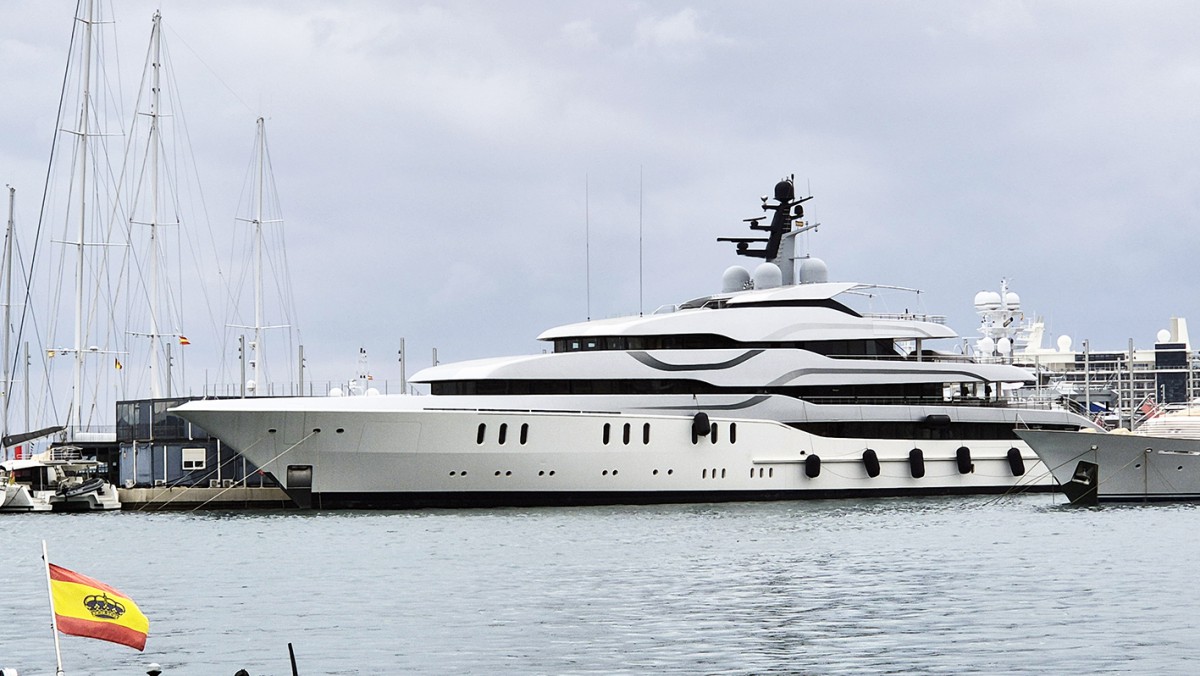
Tango, valued at around €85 million at the time of its seizure, has been immobilised in Palma since April 2022 at the request of the United States.
2. The clock – what one year of age costs
The age effect Emmanuelle describes can be stated precisely. From the published model (re-estimated every quarter on a fresh sweep of the brokered market; the current edition is fitted on 286 motor yachts): a large yacht loses about 6.3 per cent of its value in her fifth year, 5.7 per cent in its tenth, 5.1 per cent in its fifteenth, 4.5 per cent in its twentieth. In plain terms: 5 to 6 per cent of value per year is lost at the ages the frozen fleet has reached. Per year, every year – and this is the rate for an orderly market, meaning a maintained, certificated, marketable vessel. It is the clock that runs even in the best case of section 1.
3. Five frozen years
Compound the clock over the period the first freezes have now reached, and the calendar alone takes roughly a quarter of a vessel’s value:
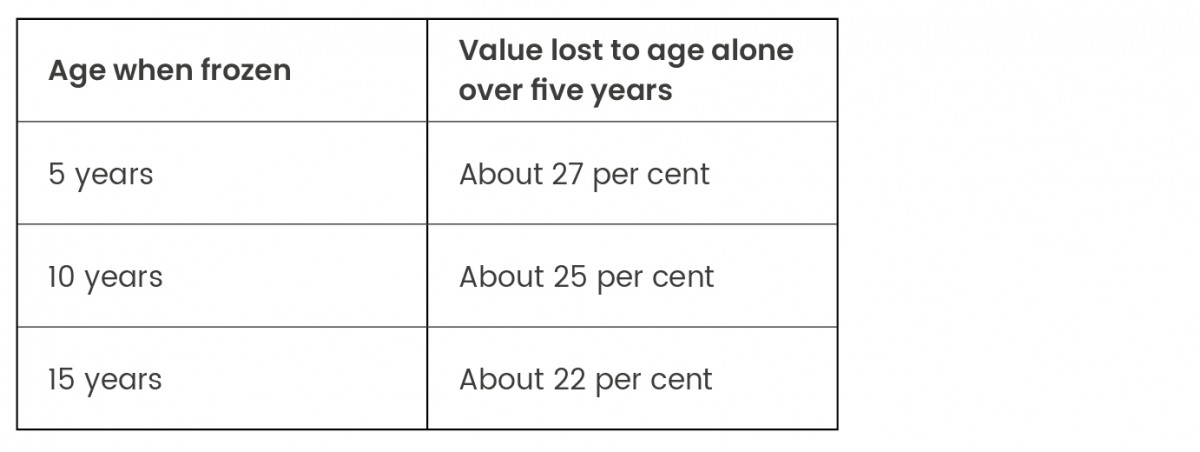
These figures are an age-related benchmark: the loss a maintained vessel would have suffered anyway. They are not the whole loss. Section 5 explains why a frozen vessel usually loses more.
4. What the frozen fleet loses to time
Applying the per-year rate to the aggregate value of the vessels held in Europe, the frozen fleet loses in the order of 150 to 200 million euros per year to time alone – before one euro of berthing, crew, insurance or maintenance. The custody costs described in section 1 come on top. For Amadea, held by the United States, court filings put them at about $32 million (29 million euros) in total since June 2022 – roughly $600,000 to $1 million (0.5 to 0.9 million euros) a month.
5. What these figures leave out
The model prices an orderly market. A frozen yacht accrues, on top of the clock, everything section 1 describes: deterioration where decisions and payments are blocked, lapsed certificates, deferred works. The market then prices the gap at sale. The Williams Superyacht Index’s published finding on refits gives its size: a yacht aged 20 to 29 with no advertised refit asks about 21 per cent below the age-related benchmark for her specification. Every omission runs in the same direction – the true loss is larger than the clock alone.
6. What process is worth – the observed range
Four judicial-sale outcomes since 2022, three vessels, different years and contexts. We measure each against the model's benchmark for the vessel's specification: an asking-price equivalent, calculated by the same published method for every yacht. (Our first article measured the same sales against their reported valuations, giving discounts of 42.5 to 61.9 per cent; the two scales differ because reported valuations vary in origin and optimism, while the model benchmark does not.)
On that common yardstick: a clean, marketed admiralty sale achieved about 78 per cent of benchmark. A maintained sealed-bid forfeiture achieved about 50 per cent. A title-contested auction saw a bid near 68 per cent collapse, and the eventual sale of the same vessel – the only case where the same yacht can be compared with itself – reached about 40 per cent. We present 78 to 40 per cent as an observed range, and as a working hypothesis on the value of preparation, title certainty and process design. Not as its price – each sale had its own circumstances.
One number deserves its explanation. For Amadea, the model's benchmark is about US$360 million (320 million euros) – higher than the US$325 million most often cited. The difference is in the quantity measured: the model states an asking-price equivalent for her specification, while public figures estimate what it might bring. At 106 metres the model also works at the edge of its data, and we say so. Against either yardstick the conclusion is the same: the sealed-bid sale realised about half.
For a yacht that is merely frozen, a sale remains impossible in principle, while selling quickly requires genuine coordination, a dedicated structure and a specialised team, which few authorities have.
7. The invisible cost to the state
Immobilising a yacht also means incurring legal costs, devoting time to the case and assigning personnel to it. According to Le Figaro (2 November 2026), the recent move of Amore Vero from La Ciotat to Antibes, requested by the lawyers of the owning company to reduce port fees, involved military personnel from the Var and customs officers. The operation had to be prepared, the vessel moved over nearly eight hours, the teams brought back, custody at the berth ensured and judicial and port formalities completed.
Saving on port fees by mobilising public resources does not reduce the bill, it makes it invisible. What is missing is consolidated public accounting for each yacht, allowing its full cost to be measured.
The choice to wait
What tips the balance? First, the law: for a yacht that is merely frozen, a sale remains impossible in principle. Then, capacity: selling quickly requires genuine coordination, a dedicated structure and a specialised team, which few authorities have. Finally, the interest of the decision-maker: a sale engages their responsibility, and its price will be questioned. Waiting does not appear in any accounts.
Six months or a year after the first freezes, deciding nothing was, a priori, the least risky option for the decision-maker. Today, the value of the vessels has fallen, costs have accumulated and the alarm raised by surveys no longer stops. Some freezes have been lifted, others have been compounded by proceedings, and the Directive now requires States to organise themselves. Circumstances, however, are not frozen; they are evolving to the disadvantage of those who hesitate to decide.
Conclusion
In a few months, the first freezes will reach five years. The slowness of some serves the patience of others: each year of freezing strengthens the owner’s hope of restitution.
An immediate sale is not always the right answer, but prolonged waiting has a cost, which must be measured and weighed against the other options, in order to make an informed decision. So far, no authority has published what indecision costs.
The elements of that accounting now exist: the clock of section 2, the custody figures of sections 1 and 4, and the range of section 6. What remains is for an authority to put them side by side before deciding to wait.
Where a sale remains possible, it would shift the sanction: freezing the proceeds rather than the vessel, fixing its value and dealing with a sum of capital.
Emmanuelle Votat is a judicial auctioneer specialising in the management and sale of yachts seized in criminal proceedings. She is the founder of Yachting Legal & Auction, a pioneering programme for judicial yacht asset management in France and internationally, and has overseen landmark cases.
Andrew Williams is a marine surveyor with 38 years of experience in the marine industry, including 26 years in the superyacht sector. He publishes The Williams Superyacht Index, a quarterly price model for the brokered superyacht market, and undertakes commissioned market analysis and valuation.
NEW: Sign up for SuperyachtNewsweek!
Get the latest weekly news, in-depth reports, intelligence, and strategic insights, delivered directly from The Superyacht Group's editors and market analysts.
Stay at the forefront of the superyacht industry with SuperyachtNewsweek
Click here to become part of The Superyacht Group community, and join us in our mission to make this industry accessible to all, and prosperous for the long-term. We are offering access to the superyacht industry’s most comprehensive and longstanding archive of business-critical information, as well as a comprehensive, real-time superyacht fleet database, for just £10 per month, because we are One Industry with One Mission. Sign up here.
Related news
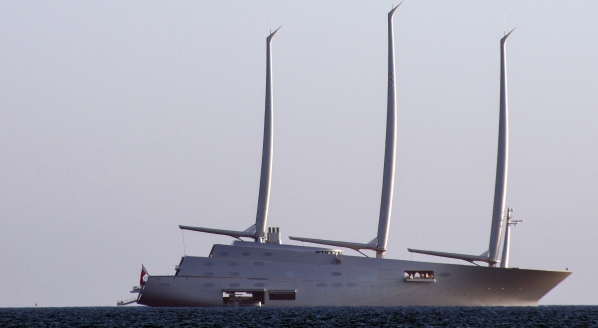
Frozen superyachts: Why Europe’s new rules won’t break the deadlock
Emmanuelle Votat explores why neither Sailing Yacht A or Amore Vero has been sold, nearly five years after being frozen, when early-sale tools already exist
Opinion
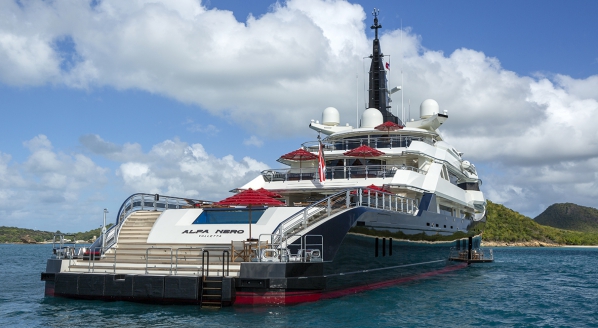
The certificate and the price
How the Beijing Convention, in force for the EU from 15 December, could affect price when a superyacht is sold through judicial or administrative proceedings
Owner
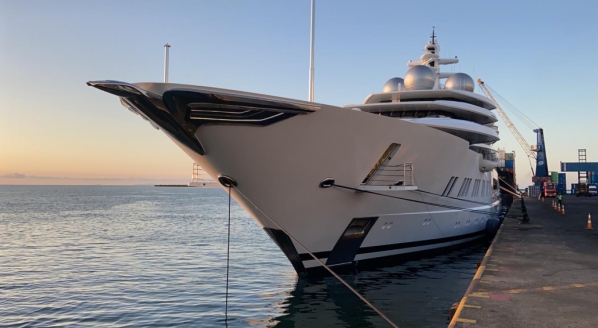
Sale of Amadea: a precedent that could shape Europe’s frozen yacht market
Seasoned superyacht auctioneer, Emmanuelle Votat dissects the challenges and opportunities emerging from the latest development in the sanctions saga
Opinion
Arrest in the Med: when the harbour writes the headline
Deepening the Croatia playbook, and how it compares across key Mediterranean forums – with a sanctions twist
Crew
Phi’s appeal sinks at Supreme Court in watershed ruling
Following a landmark judgement, the stranded superyacht remains detained in a London lock, with its future cast into further doubt
Fleet
Related news
The certificate and the price
2 weeks ago
NEW: Sign up for
SuperyachtNewsweek!
Get the latest weekly news, in-depth reports, intelligence, and strategic insights, delivered directly from The Superyacht Group's editors and market analysts.
Stay at the forefront of the superyacht industry with SuperyachtNewsweek