Is cognitive fitness the next frontier in superyacht excellence?
As superyachts become increasingly sophisticated, are we investing enough in the cognitive capabilities of the people responsible for operating them?
As the demands placed upon captains and crew continue to increase, the importance of developing and protecting the human element in superyacht operations is becoming more important. With many years’ experience as both captain and owner’s representative, Captain Carol Benbrook will be presenting a number of reports on the potential advantages of introducing cognitive training into the superyacht environment. Below is her introduction to a series of articles which will follow over the coming weeks.
As our industry continues to evolve and more demands are put on us, our ability to concentrate, anticipate problems, manage stress and make sound decisions has never been more important. We invest considerable resources in building and maintaining our vessels to the highest standards, equipping them with advanced technology and ensuring our crews undertake extensive training and certification. However, are we paying enough attention to the cognitive performance of the people responsible for operating them?
Before anyone worries that this means introducing another mandatory course into our already saturated training framework, that is not what I am suggesting. Cognitive fitness, much like physical fitness, should be considered a long-term commitment rather than something achieved through a short course. It involves maintaining good routines and general wellbeing, including sufficient sleep, good nutrition, regular physical exercise and opportunities for mental recovery. Specific targeted cognitive exercises also have a role to play, although there are a lot on offer claiming to “train your brain” it is my understanding that only a handful of them actually improve cognition (rather than reduce cognitive decline through ageing etc).
Personally, like most of us at this level, I am increasingly using artificial intelligence to simplify on-board systems, reduce administrative demands and make my own life more efficient. However, making life easier is not the complete solution. Throughout our daily lives, we need to process information, communicate effectively, manage relationships, build teams and make sound decisions, sometimes under considerable pressure. Technology may reduce certain demands on our attention, but it does not remove the need to maintain our cognitive capabilities.
In our industry specifically, for captains and heads of departments, the demands of modern yacht operations have expanded considerably. Navigational responsibilities sit alongside complex logistics, demanding guest schedules with extremely high expectations, reporting requirements, crew management, financial oversight and almost continuous digital communication. In many cases, there is an expectation of availability 24 hours a day, 365 days a year. These pressures also extend to yacht managers, agents and other shore-based support professionals.
What is the value of extensive knowledge and experience if, under pressure, we struggle to access and apply that information effectively?
Experience and technical competence, however valuable, do not make anyone immune to fatigue or cognitive overload. Consider a computer with an enormous database of information but insufficient processing capacity. The information is available, but the system struggles to retrieve and use it efficiently. Although the human brain is considerably more complex, the analogy raises an interesting question: What is the value of extensive knowledge and experience if, under pressure, we struggle to access and apply that information effectively?
Should cognitive fitness become a recognised consideration in leadership development, crew wellbeing and operational risk management? Could appropriately validated cognitive assessments help us better understand the demands placed on individuals and teams? When planning higher-risk operations, such as navigating in ice, entering poorly charted waters or conducting helicopter and submersible activities, should we be paying greater attention to factors affecting concentration, working memory, judgement and decision-making?
I am not suggesting that a single cognitive test should determine someone’s suitability for employment or operational responsibility. Any such assessment would need to be correctly validated, relevant to the role and applied fairly. However, understanding human performance limitations alongside technical qualifications and practical experience could help us make better decisions about training, workload and operational readiness.
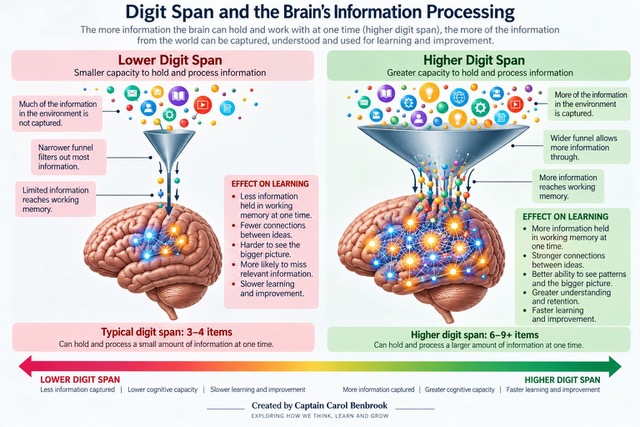
One area that particularly interests me is working memory, our ability to temporarily hold and manipulate information. A simple way of assessing aspects of this capability is through digit span testing. In a forward digit span test, an individual repeats numbers in the same order. In a backward test, the sequence must be recalled in reverse, placing additional demands on working memory. These tests do not measure intelligence or overall professional competence, but they provide insight into some of the mental processes we rely upon every day.
Research suggests that targeted working-memory training can improve performance on certain cognitive tasks, particularly those similar to the exercises being practised. See the diagram below for a visual interpretation.
I have personally incorporated short, regular cognitive training sessions into my routine and have noticed benefits in my own experience and within my family. I use a programme called Simply Smarter, which includes targeted cognitive exercises. I have no financial affiliation with the company, and my personal experience should not be interpreted as scientific proof of improved operational performance. However, it has encouraged me to explore the wider subject of cognitive fitness and its potential relevance to our industry. More information about the programme is available here.
The other training platform I have recently become an affiliate of is Nuerotracker. This programme trains different parts of the neurological pathway than Simply Smarter and so the two together have very good results in my experience. I will be discussing more on this programme in the articles to follow.
We invest heavily in the performance, reliability and maintenance of our yachts. Should we not be equally interested in understanding and developing the performance of the people making the decisions?
The maritime industry already recognises the importance of fatigue management and the human element in operational safety. Perhaps the next step is a more comprehensive approach to cognitive performance, combining adequate rest, physical wellbeing, effective workload management, practical training and evidence-based methods of maintaining mental capability.
Ultimately, the objective should not be to introduce more testing or place additional pressure on already busy professionals. It should be to understand how we can better support the people responsible for operating increasingly complex vessels.
We invest heavily in the performance, reliability and maintenance of our yachts. Should we not be equally interested in understanding and developing the performance of the people making the decisions?
Perhaps cognitive fitness deserves a more prominent place in the conversation about the future of superyacht leadership, safety and operational excellence. I will be exploring this question in more detail and will cover how strong cognition can improve areas such as communication and teamwork, effective communication and positive mental health, crew training, interaction with guests and guest experience, planning and execution of new builds and refits. I will also compare the cognitive training of elite athletes, F1 drivers and financial traders at the highest level.
As an open-source platform we offer an industry-wide invitation to anyone and everyone in our sector to share their knowledge, experience and opinions. If you have an interesting and valuable contribution to make, and would like to join our growing community of guest columnists, share your ideas with us at newsdesk@thesuperyachtgroup.com
NEW: Sign up for SuperyachtNewsweek!
Get the latest weekly news, in-depth reports, intelligence, and strategic insights, delivered directly from The Superyacht Group's editors and market analysts.
Stay at the forefront of the superyacht industry with SuperyachtNewsweek
Click here to become part of The Superyacht Group community, and join us in our mission to make this industry accessible to all, and prosperous for the long-term. We are offering access to the superyacht industry’s most comprehensive and longstanding archive of business-critical information, as well as a comprehensive, real-time superyacht fleet database, for just £10 per month, because we are One Industry with One Mission. Sign up here.
Related news
The 300 steps
A call to arms on how we recruit, on-board and retain the incredible people who run our yachts
Crew

What happens on board after the guests go to bed?
A perspective from the crew side of the superyacht industry on professionalism, silence, welfare and the culture created on board
Opinion
What yacht crew are telling ISWAN
The YachtCrewHelp 2025 Annual Review brings together insights from confidential conversations with yacht crew and their families throughout 2025
Crew

What do you think of Superyacht Management Software?
We want to hear from the market, the operators, the users and the managers to understand what you really think
Crew
The crew management conundrum
Deep Blue Software’s recently upgraded Crew Management Package joins up all of the admin that comes with hiring and managing a team on board
Crew
When guest pressure exposes gaps in crew preparedness
The founder of Yacht Evolve 360°, Aggeliki Monastirioti, explores how professionally the yacht responds when plans change can have commercial consequences
Opinion
Related news
The 300 steps
2 weeks ago
What yacht crew are telling ISWAN
4 weeks ago
The crew management conundrum
1 month ago
NEW: Sign up for
SuperyachtNewsweek!
Get the latest weekly news, in-depth reports, intelligence, and strategic insights, delivered directly from The Superyacht Group's editors and market analysts.
Stay at the forefront of the superyacht industry with SuperyachtNewsweek