Beyond technical competence
How cognitive fitness could improve communication on superyachts…
Captain Carol Benbrook’s follow-up report on the potential advantages of introducing cognitive training into the superyacht environment.

In my first article on cognition, Is Cognitive Fitness the Next Frontier in Superyacht Excellence?, I explored why I believe we should be paying greater attention to the cognitive capabilities of the people responsible for operating our increasingly complex vessels.
As I delve deeper into my understanding of neuroplasticity and cognition, one area I find particularly interesting is how closely our cognitive abilities are linked to effective communication.
Communication is essential in any workplace, but on a superyacht, where we live and work together, often under considerable pressure, misunderstandings can have serious consequences. Whether navigating busy shipping lanes, communicating with crew and guests or responding to an emergency, our ability to receive, process and communicate information clearly is fundamental to safe and happy operations
Are we losing our ability to focus?
Attention is one of the most important cognitive functions affecting communication – but are we becoming less capable of maintaining it?
In his TEDx talk, The Impact of Short Form Content, Nyel Ansari explores concerns about how modern digital content influences our attention. One frequently quoted statistic suggests that the average human attention span has fallen from 12 seconds in 2000 to just 8 seconds today.
Research into digital behaviour suggests that we are switching between tasks more frequently and, as a result, not focusing on the main tasks for long enough to have a positive result.
Although these particular figures have not been scientifically established, research into digital behaviour suggests that we are switching between tasks more frequently and, as a result, not focusing on the main tasks for long enough to have a positive result. I believe this is particularly relevant to the superyacht industry, where we are surrounded by technology, constant communications and competing demands on our attention.
On the bridge, for example, a watch officer must process information from the radar, electronic charts, surrounding vessels, weather conditions and VHF communications. Our brains must decide what is important and when attention needs to shift. As cognitive demands increase, information can be missed or misunderstood, and we may become less aware of how effectively we are communicating. An extreme example is an emergency, where clear communication is essential to contain the situation and preventing a potential domino effect. Often in an emergency there are multiple bridge, radio room and engine room audible alarms sounding, and in addition to this, there are many different channels of information the senior crew have to process simultaneously. As an example, the captain must make decisions based on information from the surrounding conditions, from the damage control or fire team, the engineering team, the DPA and from the interior manager. The smaller the team, the more each crew member has to process and so their ability to manage this information and correctly communicate is vital to the successful outcome.
Memory, communication and human behaviour
Working memory is equally important, particularly when receiving and communicating information during bridge handovers, night watches or tender and chase boat operations. SOPs and checklists support these processes, but we still need sufficient cognitive capacity to understand and communicate important details accurately, especially when fatigued or under pressure.
A calm captain who communicates clearly is more likely to maintain an effective team than someone
who becomes frustrated or aggressive.
However, communication is not simply about how quickly and effectively our brains process information. Confidence, cultural background, leadership and the working environment also influence whether information is communicated effectively.
Malcolm Gladwell explores this in his book Outliers, particularly when discussing aviation accidents and how hierarchy can influence communication between pilots. He describes situations where junior officers recognised potentially serious problems but were reluctant to challenge their captains or communicate concerns directly. I highly recommend this book to anyone considering a leadership role. It has changed how I approach communication training on board and I believe its lessons have direct relevance to the superyacht industry.
A junior crew member may recognise something concerning but hesitate to speak up because they lack confidence or feel uncomfortable challenging someone more senior. Recognising a problem does not necessarily mean it will be communicated effectively.
Too often, we label someone a good or poor communicator, or describe them as someone who struggles under pressure, without considering how we might help them improve. Drills, coaching and training can develop confidence, while good leadership creates an environment where crew feel comfortable questioning decisions, raising concerns and confirming instructions.
Communication under pressure
Stress and emotions also influence cognitive performance. During heavy traffic, restricted visibility or an emergency; for example, our ability to concentrate, remember information and make decisions can deteriorate. A calm captain who communicates clearly is more likely to maintain an effective team than someone who becomes frustrated or aggressive.
These principles are reflected in crowd management and crisis management training within the applicable MCA and STCW passenger-ship framework, which emphasises leadership, human behaviour and effective communication during emergencies. Understanding how frightened or confused guests may respond, and adapting communication accordingly, can make a significant difference to how successfully an emergency is managed.
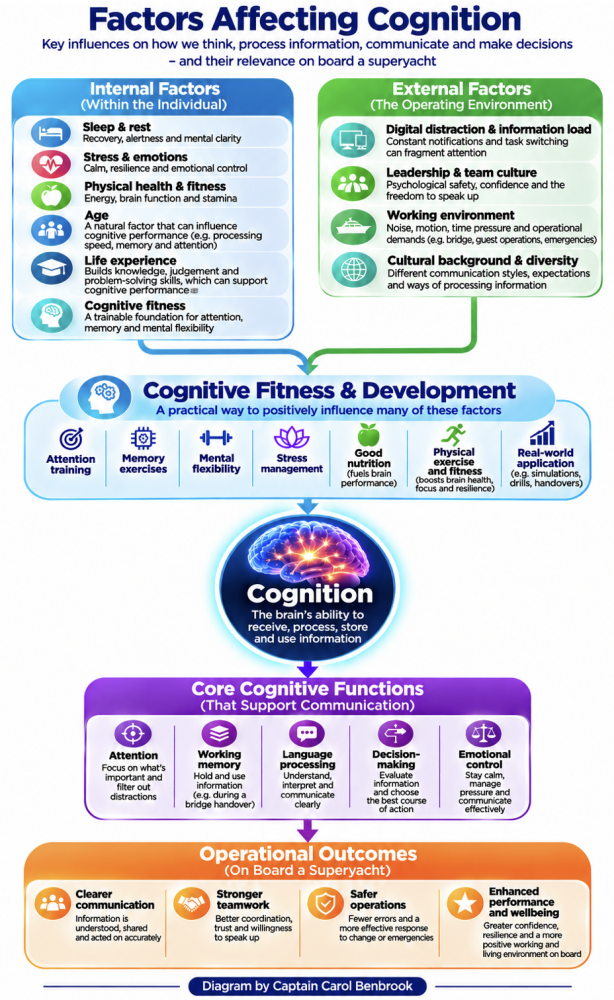
Ultimately, effective communication requires attention, memory, emotional control and the
confidence to speak up
Can cognitive training help us reclaim our attention and become better communicators?
This brings me back to neuroplasticity, the brain’s ability to adapt through learning and experience.
If our increasingly digital lifestyles are encouraging us to switch attention more frequently, perhaps we should be exploring ways to deliberately practise sustained attention and other cognitive skills. I believe programmes such as NeuroTracker and Simply Smarter could be introduced alongside bridge resource management, simulator exercises and practical communication training.
NeuroTracker challenges visual attention and the ability to track multiple moving objects (6 minutes a session), while Simply Smarter provides exercises involving working memory and information processing (around 15 minutes a session).
During quieter periods, crew could be offered additional 15-minute cognitive-training sessions without compromising required rest periods. These could be combined with bridge simulations, communication drills and handover exercises to assess whether improvements in cognitive-training performance translate into practical benefits. The direct impact of these programmes on maritime communication still requires further research, but I believe the opportunity is worth exploring.
Ultimately, effective communication requires attention, memory, emotional control and the confidence to speak up, so rather than accepting reduced concentration or labelling people as poor communicators, perhaps we should be asking how we can better develop and support these abilities. By combining cognitive training with practical experience, good leadership and established maritime safety procedures, I believe we have an opportunity to strengthen teamwork, improve living conditions and create a safer living and working environment on board superyachts.
References
Benbrook, C. (2026). Is Cognitive Fitness the Next Frontier in Superyacht Excellence? SuperyachtNews.
Gladwell, M. (2008). Outliers: The Story of Success. Little, Brown and Company. Chapter 7: “The Ethnic Theory of Plane Crashes.”
Ansari, N. The Impact of Short Form Content. TEDxMonashUniversityMalaysia. YouTube presentation.
Mark, G. (2023). Attention Span: A Groundbreaking Way to Restore Balance, Happiness and Productivity. Hanover Square Press.
International Maritime Organization. STCW Code, Section A-V/2: Passenger-ship training.
International Maritime Organization. (2018). Passenger Ship Crisis Management and Human Behaviour Training. Model Course 1.42.
Efficient Coach / Holistico. Neuroscience Course.
NeuroTracker. Cognitive training programme.
Simply Smarter. Cognitive training programme, National Association for Child Development.
Captain Carol Benbrook is a highly respected Superyacht industry professional with more than 25 years of experience in command of superyachts. Throughout her career, she has developed a strong interest in leadership, crew development and the importance of effective teamwork on board. She is particularly passionate about exploring how cognitive performance, resilience and human factors can contribute to safer operations, stronger teams and greater operational excellence within the superyacht industry. She is also a Nuero Tracker affiliate, you can sign up for your individual training and assessment here.
As an open-source platform we offer an industry-wide invitation to anyone and everyone in our sector to share their knowledge, experience and opinions. If you have an interesting and valuable contribution to make, and would like to join our growing community of guest columnists, share your ideas with us at newsdesk@thesuperyachtgroup.com
NEW: Sign up for SuperyachtNewsweek!
Get the latest weekly news, in-depth reports, intelligence, and strategic insights, delivered directly from The Superyacht Group's editors and market analysts.
Stay at the forefront of the superyacht industry with SuperyachtNewsweek
Click here to become part of The Superyacht Group community, and join us in our mission to make this industry accessible to all, and prosperous for the long-term. We are offering access to the superyacht industry’s most comprehensive and longstanding archive of business-critical information, as well as a comprehensive, real-time superyacht fleet database, for just £10 per month, because we are One Industry with One Mission. Sign up here.
Related news
When yacht instructions conflict, start with the authority file
Who has authority over the yacht? Presented here is a logical solution to give clarity and avoid escalation should disputes arise
Opinion
Where does superyacht talent go when crew step ashore?
New Yotspot member data suggests almost a quarter of yacht crew would consider shore-based or estate work. Here is where they want to go...
Crew
The 300 steps
A call to arms on how we recruit, on-board and retain the incredible people who run our yachts
Crew

What happens on board after the guests go to bed?
A perspective from the crew side of the superyacht industry on professionalism, silence, welfare and the culture created on board
Opinion
What yacht crew are telling ISWAN
The YachtCrewHelp 2025 Annual Review brings together insights from confidential conversations with yacht crew and their families throughout 2025
Crew
The crew management conundrum
Deep Blue Software’s recently upgraded Crew Management Package joins up all of the admin that comes with hiring and managing a team on board
Crew
Related news
The 300 steps
4 weeks ago
What yacht crew are telling ISWAN
1 month ago
The crew management conundrum
2 months ago
NEW: Sign up for
SuperyachtNewsweek!
Get the latest weekly news, in-depth reports, intelligence, and strategic insights, delivered directly from The Superyacht Group's editors and market analysts.
Stay at the forefront of the superyacht industry with SuperyachtNewsweek