Between command and connection
A reflection on authority, connection and what the superyacht industry must confront to secure its future…
Why we sail
Before the bright white hulls and the New Year’s celebration at St Barth, before Beluga and Starlink, there was a reason.
Someone stood at the edge of the water and felt something – a pull, an inexplicable, almost irrational desire to cast off the lines, to trust the wind and to go, against logic and disregarding safety because the human spirit demanded it.
That is why we sail and we learned to love the sea.
Yet somewhere between the first wooden boats and today’s superyachts, a shift happened. The “why”– that original, elemental impulse – was gradually eclipsed by the “what” and the “how” and “who”, followed by performance metrics, delivery schedules and legacy hierarchies built less on purpose than on precedent.
Today, the superyacht industry stands at its own crossroads, not on the water, but within itself. A new generation has arrived at the dock. They are talented, connected and unafraid. The question that now hangs in the salt air is not whether they are ready to sail, it’s whether the industry is ready to let them take the helm.
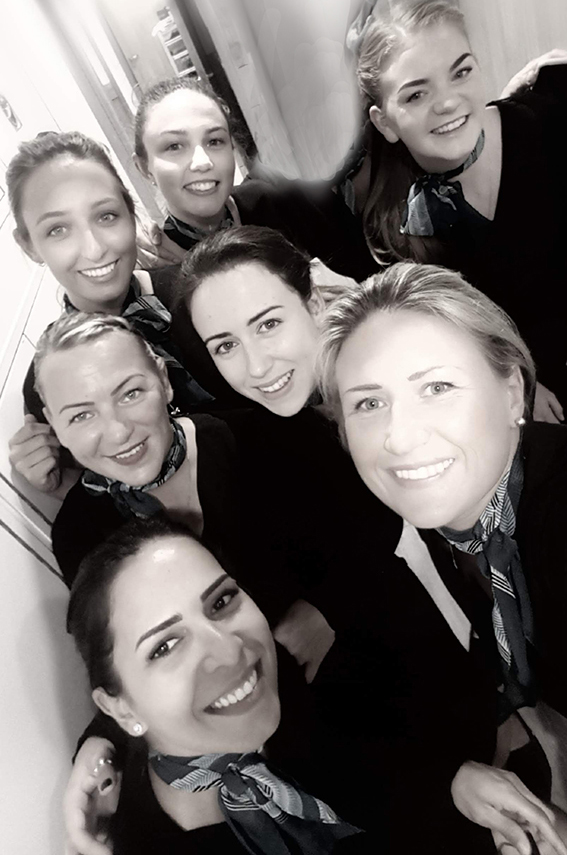
Meeli Lepik, founder and chief consultant of Holistic Yacht Interiors (front right), with the interior team on board M/Y Areti in 2018.
The architecture of authority
For generations, seafaring has been a strange mixture of escape and ultimate mastery.
Respect and positions were earned slowly. You began at the bottom, deferred to those above, and, in time, if you were patient, skilled and willing to prevail, authority was granted. It was a system built on respect for experience and in many ways, it worked, but authority, wisdom and emotional intelligence are not the same things.
Today, superyachts have grown rapidly in size and complexity. What began as love for the sea is now a complex floating luxury hotel,with, let’s say, some sea features. A 100-plus-metre vessel is, in operational terms, a multi-million-euro enterprise requiring sophisticated leadership across technical, logistical and human dimensions. In most industries of comparable scale, leading at that level requires a degree or two, and leadership development is a structured, ongoing process. In yachting, it remains largely informal, often even random, awarded through longevity rather than capability.
The result is predictable: technically exceptional individuals are placed in command without the tools to manage people, team dynamics or organisational culture. Too often, toxic behaviours are not corrected – they are carried upward, normalised and replicated. Part of it is because we still rely a lot on personal reference. A poor manager can give an excellent recommendation to a poor crew member and so the ball rolls further.
The young people now entering the job market were raised in a world shaped by positive psychology, inclusion and constant feedback – a world of instant access, instant response and instant visibility ... They received reward for participating and were told they could become anything – and they believed it.
Authority, in the old model, was positional. It came with the title, the years of service, the grey at the temples and in weathered stripes on epaulettes. It commanded silence in the briefings and deference on deck. It did not invite questions, especially not from the youngest in the room.
A different kind of sailor
They grew up differently – not better or worse, just differently.
The young people now entering the job market were raised in a world shaped by positive psychology, inclusion and constant feedback – a world of instant access, instant response and instant visibility. There is little tolerance to boredom but a constant reach to instant gratification. They received reward for participating and were told they could become anything – and they believed it.
This is not a flaw but it does create tension because real life still has its limits. If you are uncomfortable with weapons, perhaps the police force or military is not for you. If you cannot handle blood, becoming a surgeon may not be the right career path. In the same way, yachting is not an easy industry. Regardless of the size of the vessel or the prestige of the programme, it is a hard career. Rewarding yes, but demanding – physically, mentally and emotionally.
A personal trainer once told me that, with the right system and focus, almost anyone can be trained to become a national champion, particularly in a smaller country. European champions, how-ever, already require natural talent and the very select few Olympic medallists must push the limits of human nature. There have been a few discussions in the media recently about top athletes, where they opened up to say that coming to a podium needed too many sacrifices. And now is the question: how much one should be expected to endure? How well do the means serve the purpose?
The operation of the last yacht I worked on was among the most complex in the industry. We even referred to it internally as the “Olympic league” and one had to deliver at that level every day, every month, every year. Standards were exceptionally high and we had to turn down some great, for sure capable, applications only because they were not at that stage in their career yet.
Performance at top level is not only about skillset, but equally about mental capability, and here, another gap becomes visible. The industry speaks more openly than ever about mental health, and so, it should. Obviously, there is no room for bullying or, God forbid, physical violence, yet even some of the main advocates of crew well-being are admitting that many young people entering the profession are already struggling. What we consistently fail to distinguish is this: mental health does not automatically equal mental fitness. The two are related, but they are not the same. One is a condition to be supported, the other is a capacity to be developed.
Performance vs connection
Performance does not exist in isolation. Teams work in an atmosphere of emotional safety.
The connection is built on relationships, trust and the ability to function as a cohesive unit under pressure. Crew naturally builds a bond through living closely together and, to some extent, being responsible for each other’s life at sea. However, we have never been formally taught how to create that connection either as crew members or later as leaders. It is assumed to happen and often it does not. Critically speaking, we do not measure it either.
Talented professionals leave or, more accurately, they do not choose yachting at all – not because they lack resilience, but because they cannot find it as an environment where they feel seen, heard or valued.
The issues with performance are rooted not in a lack of talent or training, but because of disconnection. We measure technical output, we assess CoCs, sea time and Silver Service training, but we have no credible framework for evaluating the quality of relationships within a team – yet it is felt by everyone. As a result, highly capable individuals can fail in environments where connection is absent and no one identifies why.
That is, connection with others, with the purpose, but more importantly perhaps within themselves because they may not have enough self-reflection to understand the essence of their career choice. This challenge intensifies with youth, who have grown up more digitally connected than ever, yet being the loneliest generations so far in terms of human interaction. So in times of trouble, they are more comfortable turning to a device instead of a fellow human.
Then we have the traditional hierarchy of seafaring meeting new values. One seeks clarity, defined roles and accountability, the other seeks meaning, voice and inclusion. Between the two, friction is not a possibility but rather a certainty – unless actively managed.
What we are losing
The cost of not addressing this is already visible across yachting industry, but it takes two to tango.
Talented professionals leave or, more accurately, they do not choose yachting at all – not because they lack resilience, but because they cannot find it as an environment where they feel seen, heard or valued. As a result, the industry faces a growing workforce shortage. Few reflect to ask why. Instead, the situation is often reduced to a convenient narrative: that the new generation is lazy, weak or lacks stamina.
What is rarely acknowledged is that this is not simply an issue based on your year of birth, but a leadership matter. Meanwhile, promotion continues to reward endurance over leadership capability. Without deliberate intervention, the same patterns repeat across vessels, programmes and generations.
Yet the challenge is not one-sided. Recently I delivered introductory training to a group of young hospitality students wishing to enter the yachting industry. What I anticipated would be a fulfilling exchange felt genuinely disorienting: questions arrived disconnected from context. Expectations were misaligned from reality – everyone wanted to be a boss and have a desk job...? At points I found myself wondering whether I was showing the wrong slides or accidentally participating in a social experiment rather than a professional induction. Those absurd Instagram reels about Gen Z job inter-views to laugh about was suddenly my reality.
It would be easy to attribute this again to generational difference and move on, but that would miss the point. Young people today communicate differently, process information differently and understand things differently and, perhaps most significantly, set boundaries more clearly and earlier than previous generations ever did. Maybe this is not weakness but awareness – not desperately engaging in a system that clearly does not resonate with their lifestyle and needs. What one generation accepted as the price of entry, the other questions entirely.
The assistant dynamic once popularised in The Devil Wears Prada movie – long hours, unreasonable demands, unquestioned authority – was, for many, an accepted reality, even aspirational. Today, it is more often seen as irrational, even a sign of warning and a reflection of poor leadership rather than a pathway to excellence.
It is a different operating model and one the industry has not yet learned to work with. Perhaps the long-accepted model of 16-hour days in the service of others, at the expense of personal life is no longer as rewarding and sustainable as once assumed.

Boundaries and belonging
Boundaries are not the enemy of performance; they are, in fact, part of it.
The greatest value, for all its limitations, is that traditional hierarchy provides clarity: defined roles, clear expectations, structured accountability. Remove it entirely without replacing it with something equally coherent and the result is not freedom, it is confusion.
We are now seeing experimental operational models emerge across the yachting industry: concepts where guest and crew spaces are shared (Oceanco); where different categories of crew operate within the same environment under divergent expectations (REV Ocean). In these settings, the boundary between professional and personal life becomes increasingly difficult to locate.
Such tendencies reflect genuine societal shifts towards more fluid, integrated working environments; call it as close as it gets to Fatboy loungers and pets in offices. For some individuals, it works well but, as cool as it sounds, people still need space – psychological as well as physical. The walls are coming up in open-plan offices again, too.
We must welcome experienced leaders who understand the dynamics between people, not only operations and results; and encourage young professionals who respect process, not only outcome.
I personally have stepped away from an excellent programme only due to the proximity to the principal’s family. The integration was just too complete. For others, such closeness is precisely what makes the work rewarding. I often think that perhaps it is one of the qualities that actually help one through the long days, but that difference matters. And the industry needs frameworks that can hold both realities.
The new helm
The future of superyacht leadership is not a contest between the generations; it is not experience versus innovation or tradition versus transformation.
That framing is a false one and it is precisely the kind of binary thinking that keeps industries anchored when they should be underway. Instead, the future belongs to integration. We must welcome experienced leaders who understand the dynamics between people, not only operations and results; and encourage young professionals who respect process, not only outcome, and understand that real connection and growth take time and is often hard and messy process – while celebrating the organisations that offer structure but also create space for human realities within it.
Who chooses the music
The essence of working at sea has not changed, it is still about challenge, about precision, about operating in an environment that demands complete honesty – with the elements, with your crew, with your guests and with yourself. There is no room for illusion at sea and there never has been.
The real shift is not generational, it is human. That is what the future now demands. However, it will not be an easy voyage. The nature of the yachting industry remains unchanged: those who pay choose the music and expect others to dance with a smile. Strategies, frameworks and conversations can be designed in wheelhouses and forum panels, but their adoption ultimately depends on those who own the stage. The real question is whether leaders, both on board and ashore, have the courage to communicate the message honestly or whether the default remains silent compliance from below, frustration directed at the new generation and responsibility pushed onto the client, until the industry loses the very people it depends on.
Leadership, in this context, is defined not only by setting direction, but by the willingness to listen when nobody is dancing, because the horizon does not move. How we reach it – and who we allow to stand at the helm – does.
This article first appeared in The Superyacht Report: Captains Focus. With our open-source policy, it is available to all by following this link, so read and download the latest issue and any of our previous issues in our library.
NEW: Sign up for SuperyachtNewsweek!
Get the latest weekly news, in-depth reports, intelligence, and strategic insights, delivered directly from The Superyacht Group's editors and market analysts.
Stay at the forefront of the superyacht industry with SuperyachtNewsweek
Click here to become part of The Superyacht Group community, and join us in our mission to make this industry accessible to all, and prosperous for the long-term. We are offering access to the superyacht industry’s most comprehensive and longstanding archive of business-critical information, as well as a comprehensive, real-time superyacht fleet database, for just £10 per month, because we are One Industry with One Mission. Sign up here.
Related news
The Superyacht Report 229: Captains Focus - Out Now
513 whales in a day, a yacht arrested by US Marshals, Guy Booth on refusing to abandon Phi and so much more in TSR 229
Crew
.jpg)
Yachties with a cause – UKSA
Amy Sweeting, Director of Development and Impact, UKSA, on how the superyacht community can make a real difference to the lives of young people
Business

The invisible curriculum
Andrew Roch, founder and CEO of Yacht Crew Recruitment & Training, on leadership, mentorship and how great captains are really made
Crew
New AV/IT training programme launches
The Professional Yachting Association announces the launch of a new AV/IT training programme to address the growing skills gap on board superyachts
Crew

Acting, leadership and the future of command
What acting classes taught me about yachting – by Captain Carsten Franik
Opinion
Related news
The Superyacht Report 229: Captains Focus - Out Now
4 months ago
Yachties with a cause – UKSA
5 months ago
The invisible curriculum
6 months ago
New AV/IT training programme launches
9 months ago
Acting, leadership and the future of command
11 months ago
NEW: Sign up for
SuperyachtNewsweek!
Get the latest weekly news, in-depth reports, intelligence, and strategic insights, delivered directly from The Superyacht Group's editors and market analysts.
Stay at the forefront of the superyacht industry with SuperyachtNewsweek