CHIRP Report: Stored energy in a towing line causes personal injury
Where complacency and making assumptions combined with poor judgement could have led to serious injury – or worse…
The following case study is from CHIRP Maritime’s Superyacht Feedback. It is the first superyacht-specific programme and publication dedicated to improving safety in the maritime industry through vital knowledge sharing, anonymous reporting, analysis and feedback via the Superyacht Maritime Advisory Board.
Initial report
While the vessel was adrift, a tender was prepared for towing from the swimming platform. The line was connected and, following communication between deck and bridge, the operation proceeded on the understanding that the towing line was correctly rigged. As the vessel moved ahead, tension built in the line, which then fouled on the upper section of a bitt, creating a restriction under load.
The officer approached to clear it and, with the line still under tension, attempted to free it by kicking it. When the line suddenly released, it recoiled violently, striking the officer on the arm and neck and briefly rendering them unconscious.
First aid was provided on board and the casualty was taken ashore for assessment. No serious injuries were found and they returned to the vessel later the same day.
The operation proceeded on the assumption that the line was correctly set. The fouling under load, combined with attempts to intervene without first removing tension, increased the risk. This highlights the dangers of working on tensioned lines and the need to pause and make the situation safe before taking action.
CHIRP comment
This report describes a serious incident involving a tensioned line during a towing-related operation between a superyacht and its tender. There is concern over whether the attachment point used – a mooring bitt on the swimming platform – was structurally suitable or approved for towing loads and how this was verified.
The operation appears to have proceeded on the assumption that the line was correctly rigged, without a final check after the vessel moved ahead. As the load was applied, the line fouled on the bitt, creating an unsafe condition that was not immediately recognised. Limited planning and weak communication between the bridge and deck teams contributed to the escalation.
A key learning point is the attempt to intervene while the line was under tension. Handling or attempting to free a loaded line exposes personnel to snapback risk. In this case, poor judgement of load and timing led to a sudden release and injury. Even small timing errors during such operations can have serious consequences.
Basic risk controls were missing. A short toolbox talk, clearer communication or pausing engine power could have reduced the risk.
This incident reinforces the fact that all tensioned lines must be treated as high risk. Equipment suitability and rigging should be positively verified before the load is applied and operations should be stopped to remove tension before any intervention. Strong communication between bridge and deck teams is essential throughout.
This personal injury incident highlights how quickly routine tasks can escalate when stored energy is involved, and the importance of stopping to reassess before acting.
Key issues relating to this report
Factors related to this report
Complacency – is evident in that the towing line was correctly rigged without a positive verification once the load was applied. The operation appears to have been treated as routine, reducing vigilance at a critical moment.
Situational awareness – is reflected in the failure to fully recognise the hazard posed by a tensioned and fouled line, particularly the risks associated with stored energy and snapback zones.
Communication – may have contributed as, although there was contact between bridge and deck, there is no indication that a shared mental model of the developing hazard (fouling under load) was established.
Teamwork/Assertiveness – is suggested by the absence of challenge or pause before intervention, with no evidence of cross-checking or escalation before attempting to clear the line.
Capability (or insufficient application of training) – is indicated in the choice to physically intervene on a tensioned line, contrary to widely taught safe line-handling practices.
Key takeaways
Regulators – Known risks are not the same as managed risks. This case emphasises that well-known hazards such as snapback and stored energy still occur despite extensive guidance, indicating that current safety messages are not consistently influencing operational behaviour. There is an opportunity to better embed, assess and reinforce guidance such as MGN 520 across the industry, particularly regarding dynamic risk assessment and intervention thresholds.
Managers (company/operators) – Procedures only protect people when they shape real behaviour on deck. The incident indicates a gap between procedures and practice, especially in stopping work when conditions deviate from the plan. Managers should consider how effectively crews are trained and empowered to pause operations, how clearly snapback risks are demonstrated, and whether supervision and on-board culture actively reinforce conservative decision-making in routine tasks.
For Seafarers – If it’s under load, don’t touch it, make it safe first. This event is a reminder that tensioned lines are inherently dangerous and can become lethal without warning. Intervening before removing the load, even with simple actions, can lead to serious consequences. Taking a moment to stop, reassess and make the situation safe is always the safer option, even under perceived pressure to continue.
To register to CHIRP or submit your feedback, please click here.
Profile links
NEW: Sign up for SuperyachtNewsweek!
Get the latest weekly news, in-depth reports, intelligence, and strategic insights, delivered directly from The Superyacht Group's editors and market analysts.
Stay at the forefront of the superyacht industry with SuperyachtNewsweek
Click here to become part of The Superyacht Group community, and join us in our mission to make this industry accessible to all, and prosperous for the long-term. We are offering access to the superyacht industry’s most comprehensive and longstanding archive of business-critical information, as well as a comprehensive, real-time superyacht fleet database, for just £10 per month, because we are One Industry with One Mission. Sign up here.
Related news
.jpg)
Who gets to work in yachting – and who never gets the chance?
Chris Frisby, COO at UKSA, argues that yachting has a pipeline problem and its reluctance to take on green crew is breaking the system it depends on
Crew

Are we building for compliance or for crew?
What actually brings stability to a crew and why the answer has as much to do with how we house people as how we lead them
Opinion
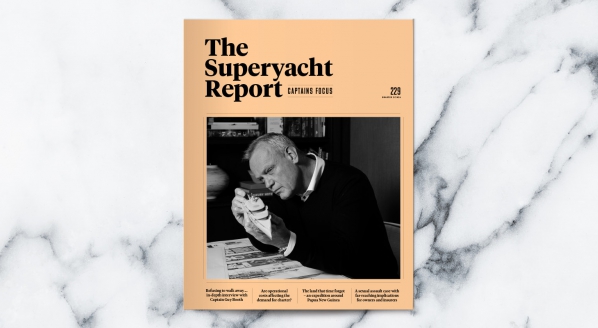
The Superyacht Report 229: Captains Focus - Out Now
513 whales in a day, a yacht arrested by US Marshals, Guy Booth on refusing to abandon Phi and so much more in TSR 229
Crew
Related news
Are we building for compliance or for crew?
2 days ago
Operational defensibility at sea
1 week ago
NEW: Sign up for
SuperyachtNewsweek!
Get the latest weekly news, in-depth reports, intelligence, and strategic insights, delivered directly from The Superyacht Group's editors and market analysts.
Stay at the forefront of the superyacht industry with SuperyachtNewsweek