
EU succession law: the hidden legal fault line
Why a yacht may be legally inherited yet practically immobilised when a superyacht owner dies…
The illusion of legal simplicity
European inheritance law appears, at first glance, reassuringly coherent. Since the introduction of the EU Succession Regulation (Regulation (EU) No. 650/2012), cross-border estates are governed by a single applicable law, typically the law of the deceased’s habitual residence. The objective is clarity: one estate, one legal framework. For many asset classes, this system works reasonably well. For superyachts, it does not.
A yacht is legally classified as a movable asset. Yet economically and operationally it behaves more like a hybrid between real estate and a regulated commercial platform. Its usability, insurability, mortgage structure and flag entitlement depend on compliance with national registry systems and those systems remain entirely outside the harmonising scope of EU succession law.
This structural mismatch becomes visible the moment an owner dies.
Succession law answers “who?” – registry law answers “whether”
Under Article 21 of the EU Succession Regulation, the law of the owner’s habitual residence governs the estate. Article 22 permits a choice of nationality law. The European Certificate of Succession (ECS) was introduced to provide cross-border proof of heirship. However, Article 1(2)(l) expressly excludes entries in public registers from the Regulation’s scope. The Court of Justice of the European Union confirmed in Case C-354/21 (R.J.R.) that national registry requirements remain fully autonomous. The presentation of a European Certificate of Succession does not compel a registry to execute a transfer if domestic formalities are not satisfied.
In practical terms, this creates a decisive distinction: inheritance law determines who inherits the yacht while registry law determines whether that inheritance is recognised in the real world. The two systems operate in parallel – and sometimes in tension.
The yacht as a “registered movable”
From a civil law perspective, a yacht is simply movable property. But in operational reality, it is deeply embedded in regulatory and registry frameworks:
• Flag-state registers
• Ownership registers
• Mortgage and security registers
• Beneficial ownership filings
• Insurance and compliance documentation
Many maritime administrations impose strict documentary requirements. In Croatia, for example, documentation forming the basis of certain register entries must be submitted in original form; scanned copies are insufficient. In other jurisdictions, notarised bills of sale, corporate resolutions or technical certificates are required before registry updates are accepted.
The result is that a yacht may be legally inherited yet functionally unusable until the registry accepts the transfer. In that sense, the yacht is a movable asset with an immobilising procedural layer.
Even where shares transfer automatically by operation of inheritance law, effective control may depend on registration in the company’s register of members or national companies registry.
The continental core: forced heirship and asset fragmentation
The inheritance dynamics differ markedly across Europe.
In Germany, universal succession applies automatically. The compulsory share (Pflichtteil) is a monetary claim rather than a proprietary entitlement. This avoids forced co-ownership but often generates liquidity pressure if the yacht represents the estate’s primary value.
France, by contrast, enforces a strict réserve héréditaire. Mandatory shares for descendants frequently result in fragmentation or forced sale of indivisible assets such as yachts. Even when the yacht is intended to remain within a single operational line, the legal structure may compel redistribution.
Italy combines strong forced heirship (legittima) with a structured nautical registration regime. Even if succession is clear, registry formalities must be satisfied before effective control is recognised. The European Certificate of Succession does not override national registration mechanics.
Spain similarly imposes substantial compulsory shares (legítima), often triggering valuation disputes and liquidation pressure. Regional inheritance variations further complicate predictability.
Croatia illustrates a different, but equally significant, vulnerability: while succession may take effect ipso iure, strict registry formalities and documentary requirements can delay effective control for months.
Across these systems, a pattern emerges: the stronger the forced heirship regime, the higher the probability that a superyacht becomes a liquidation event rather than a continuity asset.
The industry reality: most yachts are not privately owned
The doctrinal discussion above assumes direct ownership. In practice, most high-value yachts are held through corporate vehicles, often in Malta, Cyprus or the Netherlands, among others. The rationale is familiar: liability management, financing flexibility, VAT structuring, operational governance and charter optimisation. In such cases, the estate does not contain the yacht. It contains shares. This transforms the legal landscape.
The share-deal inheritance scenario
Where a yacht is owned by a special purpose vehicle (SPV), succession law determines who inherits the shares. But company law governs whether that heir effectively becomes a shareholder, and under what conditions.
Corporate constitutions frequently contain:
• Transfer restrictions
• Approval requirements
• Buy-back mechanisms
• Forced sale clauses
• Governance reallocation rules
Even where shares transfer automatically by operation of inheritance law, effective control may depend on registration in the company’s register of members or national companies registry. If the company is the registered yacht owner, additional maritime registry updates may be required, particularly where directors, authorised signatories or beneficial owners change.
The superyacht inheritance event thus becomes a three-layered process:
• Inheritance law determines the heir.
• Corporate law determines the validity and exercisability of share ownership.
• Registry and compliance frameworks determine operational recognition.
The EU Succession Regulation governs only the first layer.
Superyacht ownership frequently contains a latent risk that remains invisible during the
owner’s lifetime: the assumption that succession is legally secure because a will exists
or a holding structure has been established.
Flag states as structural amplifiers
Malta provides a telling example. Transport Malta distinguishes explicitly between ordinary transfers and transfers by inheritance. Separate procedures apply and additional documentation may be required. In cases involving minors, court decrees or legal hypothecs may be demanded. The Maltese Merchant Shipping Act also expressly regulates the registration of transfers of ships and shares therein, underlining that both asset-level and share-level succession trigger registry scrutiny.
Cyprus, operating under a forced heirship regime, may shift conflicts onto share valuation and control mechanisms. In SPV structures, compulsory portions affect ownership percentages rather than the physical asset, but the governance consequences can be equally destabilising.
The Netherlands presents a contrasting model. The legitieme portie functions as a creditor claim, not a co-ownership entitlement. This reduces fragmentation risk. At the same time, Dutch registry law is highly structured: ownership registration and flag registration operate in tandem, and operational continuity depends on both.
Charter operations: inheritance becomes corporate continuity
The risk escalates when the yacht is commercially operated. A charter yacht is not merely an asset, it’s a functioning enterprise. Crew employment contracts, management agreements, marina leases, insurance policies and regulatory certifications depend on recognised authority.
If registry updates are delayed or corporate control becomes disputed:
• Insurance coverage may be jeopardised
• Mortgage covenants may be triggered
• Charter commitments may be compromised
• Compliance filings may lapse
In such circumstances, succession becomes not only a private legal issue but a business continuity risk.
The latent risk in superyacht ownership
What emerges from this analysis is not simply legal complexity, but structural vulnerability. Superyacht ownership frequently contains a latent risk that remains invisible during the owner’s lifetime: the assumption that succession is legally secure because a will exists or a holding structure has been established. In reality, inheritance planning that is not aligned with registry mechanics, corporate governance and cross-border compliance frameworks can create instability precisely when clarity is most needed.
• Inheritance law may clearly determine who becomes heir.
• Corporate law may restrict how that heir exercises control.
• Registry law may delay recognition.
• Financing agreements may react to changes in control.
• Charter contracts may depend on uninterrupted authority.
The risk is not theoretical, it’s structural.
Where ownership is concentrated in a single high-value asset – particularly one held through an SPV – succession can trigger governance deadlocks, liquidity pressures, regulatory exposure and operational disruption. For owners of large yachts, especially those engaged in charter activity or structured across jurisdictions, professional cross-border succession planning is not optional, it’s a core element of risk management.
The superyacht industry invests heavily in engineering precision and compliance reliability. Ownership continuity deserves the same strategic foresight. Without deliberate alignment between inheritance law, corporate structuring and flag-state registry requirements, a yacht may be legally inherited yet practically immobilised.
The most significant risk is not open dispute. It is the silent misalignment between legal layers that only surfaces when it is too late to correct without cost.
NEW: Sign up for SuperyachtNewsweek!
Get the latest weekly news, in-depth reports, intelligence, and strategic insights, delivered directly from The Superyacht Group's editors and market analysts.
Stay at the forefront of the superyacht industry with SuperyachtNewsweek
Click here to become part of The Superyacht Group community, and join us in our mission to make this industry accessible to all, and prosperous for the long-term. We are offering access to the superyacht industry’s most comprehensive and longstanding archive of business-critical information, as well as a comprehensive, real-time superyacht fleet database, for just £10 per month, because we are One Industry with One Mission. Sign up here.
Related news

2026 – The year Europe quietly rewrites the superyacht rulebook
From emissions accounting to AML duties and flag‑state standards: what owners, managers and builders must treat as “live law” this season
Crew
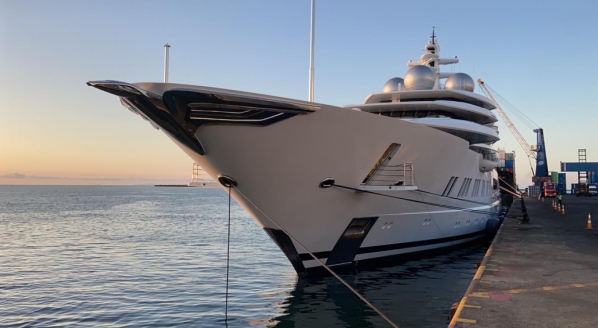
Sale of Amadea: a precedent that could shape Europe’s frozen yacht market
Seasoned superyacht auctioneer, Emmanuelle Votat dissects the challenges and opportunities emerging from the latest development in the sanctions saga
Opinion

Drawing the line between commercial and private use
Substance over weekends: private use inside commercial yacht structures is the EU-compliance frontier
Opinion

Fragmented EU customs rules leave yacht owners exposed
Conflicting EU customs rules risk massive VAT bills for superyachts. A recent case exposes why harmonised enforcement is urgently needed across member states
Business
Related news
Drawing the line between commercial and private use
12 months ago
NEW: Sign up for
SuperyachtNewsweek!
Get the latest weekly news, in-depth reports, intelligence, and strategic insights, delivered directly from The Superyacht Group's editors and market analysts.
Stay at the forefront of the superyacht industry with SuperyachtNewsweek