Meridian A and the structural blind spot of European sanctions
As its Special Survey deadline approaches, Emmanuelle Votat argues that Meridian A reveals a structural gap in EU sanctions and how Italy’s Anti-Mafia Code may offer the model Europe needs…
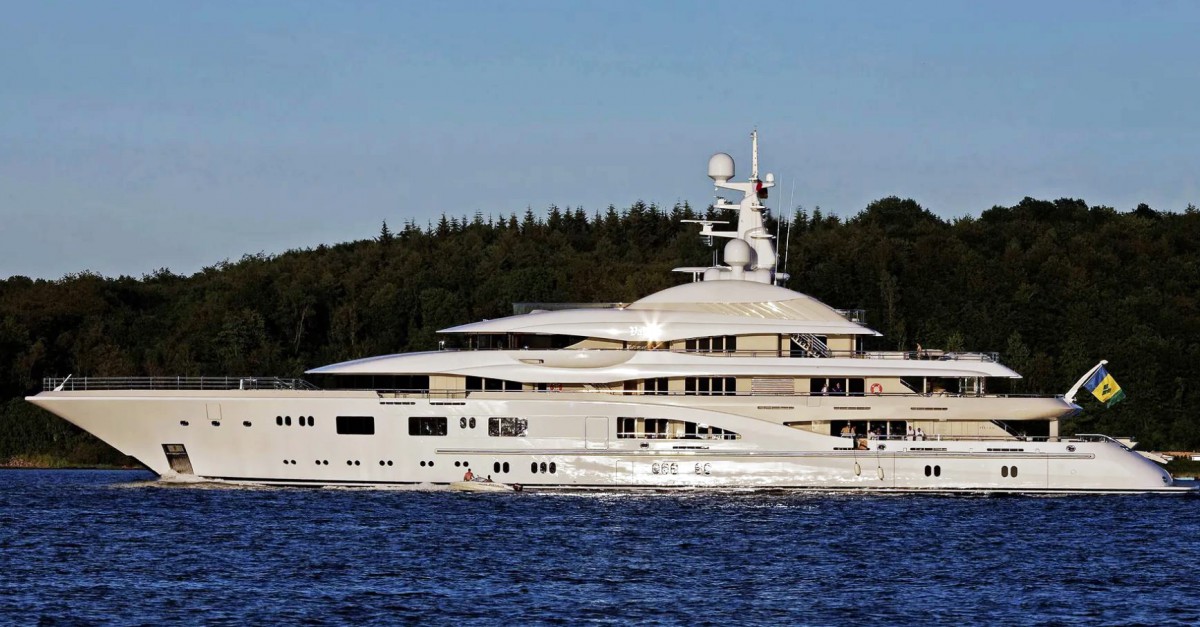
In October 2025, the General Court of the European Union dismissed the action brought by Sulberg Services, a company registered in the British Virgin Islands, which challenged the decisions that led to the seizure of Meridian A. The reasoning here is that only decisions producing direct legal effects can be annulled. The action, focused on the assessment of the link between the yacht and Anastasia Ignatova, did not meet that requirement.
From a legal standpoint, the decision is consistent. From an operational perspective, it produces no tangible change and the yacht remains immobilised in Barcelona.
Since the Court’s decision, no significant judicial developments have been made public, confirming the legal stabilisation of the case without any corresponding operational resolution.
As of April 2026, Meridian A is approaching a key technical milestone, with its Special Survey due in June 2026, based on the last surveys conducted in 2021. For a vessel of this size and complexity, such surveys are not procedural formalities. They condition the maintenance of class, the validity of insurance coverage and, more broadly, the vessel’s operational integrity.
In a context where the asset remains immobilised without a clearly defined operational framework, the ability to meet these requirements becomes uncertain. Time, in this configuration, is not neutral. It introduces a progressive constraint that operates independently from the legal process, directly affecting the asset’s condition and value.
Immobilisation between sanctions and unpaid debts
The story of Meridian A is not solely one of sanctions law, it begins in far more practical terms. In early 2022, then still named Valerie, the yacht entered MB92 in Barcelona for refit works. A few weeks later, in the context of the invasion of Ukraine, Spanish authorities placed it under “provisional retention”. Payments stopped shortly thereafter.
At this stage, the identification of the ultimate beneficial owner remains uncertain and Meridian A remains immobilised alongside the dock.
On 20 September 2022, the yacht was transferred from MB92 to Marina Vela under the control of the authorities. Officially, this was an administrative measure in a context already marked by financial deterioration. On 20 October, the yacht, now renamed Meridian A, requested authorisation to depart from Marina Vela. This was initially granted, before being withdrawn once the authorities identified it as Valerie, already subject to restrictions.
The Guardia Civil then boarded the vessel and put an end to the departure procedure. A few days later, the authorities confirmed that the vessel could not leave the port. The Spanish Prime Minister publicly referred to the case, describing a yacht “provisionally immobilised”, belonging to an oligarch. At this stage, the identification of the ultimate beneficial owner remains uncertain and Meridian A remains immobilised alongside the dock.
A form of ownership that becomes more elusive as it is examined
Public investigations, notably by OCCRP (Organized Crime and Corruption Reporting Project)
and The Kyiv Independent, make it possible to reconstruct a characteristic chain of ownership. The yacht is successively associated with Borys Kogan, an Odessa-based arms logistics operator, then with Anastasia Ignatova, linked to Sergey Chemezov, head of the state-owned conglomerate Rostec, before the name of Albert Avdolyan appears in the structure.
At each stage, formal ownership evolves. At each stage, the understanding of actual control becomes more complex. Offshore entities such as Sightview, Linkpoint and then Sulberg follow one another, all incorporated in the British Virgin Islands. This structure reflects a common organisational model in the holding of exposed assets and largely explains its resilience.
Madrid judges identified an unusual sequence: a sale contract dated 2021, a payment made in 2022 and documents relating to beneficial ownership issued after sanctions had entered into force. This time gap led Spanish authorities to point to attempts to imitate a pre-sanctions sale of the vessel, based on inconsistencies in timing and documentation, as highlighted in investigative reporting by The Kyiv Independent.
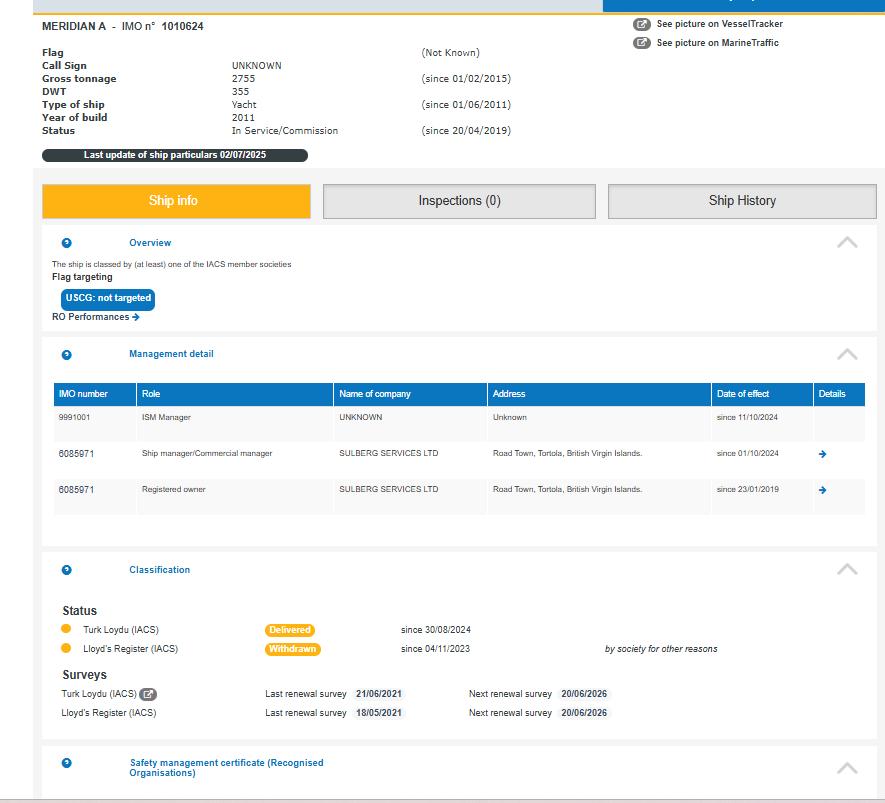
Equasis database screenshot (captured 21 April) regarding the survey timeline
Available elements suggest possible control, without allowing it to be legally established. The law requires proof and in the absence of such proof, the asset remains constrained.
Public data, notably from Equasis (IMO 1010624), indicates that the yacht has been registered since 2019 under Sulberg Services Ltd, acting both as registered owner and commercial manager. Such data reflects a formal situation, but it does not, in itself, establish the identity of the ultimate beneficial owner or the reality of control.
In the context of assets placed under judicial control, this distinction is decisive. Identifying a legal title holder is not sufficient to secure an analysis or enable an operational decision. Protected by structures designed to separate formal ownership from actual control, the asset, once seized, is confronted with the limits of those very mechanisms.
Opacity, which initially enabled the organisation of ownership, becomes an obstacle to its treatment. In the absence of a legally opposable identification of the beneficial owner, the law struggles to qualify, transfer or dispose of the asset. Under these conditions, the technical and operational requirements associated with a yacht of this size, including maintenance, compliance and class follow-up, cannot be fully ensured over time.
Meridian A does not raise the question of whether sanctions are effective or ineffective, it reveals their structural point of limitation, linked to the architecture of the system: without a tool to determine actual ownership or organise an exit, the asset remains suspended.
Learning from Italy and the Anti-Mafia Code
Since 2022, Meridian A has been at the centre of multiple proceedings, challenges and strategies deployed across several fronts. In Spain, before European courts, and in jurisdictions outside the European Union, where lobbying firms have been engaged under the FARA (Foreign Agents Registration Act), a US transparency framework requiring the public disclosure of lobbying activities conducted on behalf of foreign interests, these actions reflect a constant attempt to reframe the legal status of the asset.
Structures evolve, arguments shift and courts are seized, yet the asset remains without any stabilised legal trajectory. Meridian A does not raise the question of whether sanctions are effective or ineffective, it reveals their structural point of limitation, linked to the architecture of the system: without a tool to determine actual ownership or organise an exit, the asset remains suspended.
This is precisely where the blind spot lies. The European framework allows for the identification of an asset and its freezing. In certain configurations, it does not allow for a sufficiently robust determination of actual control when that control relies on layered and transnational structures.
In several Member States, including Spain, the circumvention of sanctions does not, in itself, constitute an autonomous criminal offence. In the absence of related offences such as money laundering or trafficking, the tools available to move beyond freezing remain limited. Without the characterisation of a primary offence, the structure remains legally enforceable, preventing any confiscation or disposal.
The Meridian A case does not defeat the freeze, it highlights the absence of any mechanism capable of bringing it to resolution.
The Italian model, based on the Rognoni-La Torre Law (Law No. 646/1982) and incorporated into the Anti-Mafia Code (Legislative Decree No. 159/2011), offers an alternative, including confiscation based on the disproportion between assets and declared income, as well as a potential reversal of the burden of proof. Strictly supervised by the judiciary, this mechanism allows action without waiting for a criminal conviction. Adapted at the European level, it could provide a decisive tool against opaque ownership structures.
The Meridian A case reflects dynamics that are now structural: the use of intermediary structures, fragmentation of legal frameworks and the difficulty for asset-freezes to produce operational outcomes.
In the yachting sector, these configurations raise specific issues linked to the very nature of the assets involved: technically complex assets, inherently exposed, requiring continuous management and whose value depends on the ability to secure their legal transfer. A yacht is not merely a luxury object, it is a financial vehicle, a legal construct and, in some cases, a strategic instrument. The Meridian A case does not defeat the freeze, it highlights the absence of any mechanism capable of bringing it to resolution.
How Europe is attempting to address this gap
Directive (EU) 2024/1260, which is to be transposed by November 2026, requires Member States to provide strengthened structures not only to identify and freeze assets, but also to manage them and, where appropriate, organise their disposal. This marks an important shift. It implicitly recognises that freezing is only one step and that the effectiveness of sanctions now depends on the ability to address the asset as a whole. Europe had stopped halfway; it is now beginning to correct that trajectory, albeit late.
However, this development comes after several years of large-scale freezing of complex assets, some of which, such as Meridian A, Phi or Luminosity, are already embedded in particularly constrained legal and operational situations.
NEW: Sign up for SuperyachtNewsweek!
Get the latest weekly news, in-depth reports, intelligence, and strategic insights, delivered directly from The Superyacht Group's editors and market analysts.
Stay at the forefront of the superyacht industry with SuperyachtNewsweek
Click here to become part of The Superyacht Group community, and join us in our mission to make this industry accessible to all, and prosperous for the long-term. We are offering access to the superyacht industry’s most comprehensive and longstanding archive of business-critical information, as well as a comprehensive, real-time superyacht fleet database, for just £10 per month, because we are One Industry with One Mission. Sign up here.
Related news
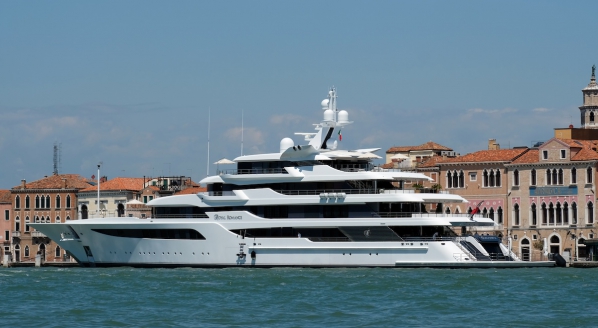
Royal Romance and the price of Europe’s sanctions success
Public auction may satisfy transparency requirements, but will it work for a sanctioned yacht? Emmanuelle Votat explores
Opinion
Sale of Amadea: a precedent that could shape Europe’s frozen yacht market
Seasoned superyacht auctioneer, Emmanuelle Votat dissects the challenges and opportunities emerging from the latest development in the sanctions saga
Opinion
US government sells sanctioned Amadea
Authorities have confirmed the sale of the 106-metre Lürssen yacht at auction. But a pending appeal could still complicate the transfer…?
Fleet
Arrest in the Med: when the harbour writes the headline
Deepening the Croatia playbook, and how it compares across key Mediterranean forums – with a sanctions twist
Crew
.jpeg)
Phi’s appeal sinks at Supreme Court in watershed ruling
Following a landmark judgement, the stranded superyacht remains detained in a London lock, with its future cast into further doubt
Fleet
Related news
US government sells sanctioned Amadea
1 year ago
NEW: Sign up for
SuperyachtNewsweek!
Get the latest weekly news, in-depth reports, intelligence, and strategic insights, delivered directly from The Superyacht Group's editors and market analysts.
Stay at the forefront of the superyacht industry with SuperyachtNewsweek