
Is there a labour bottleneck?
Paint sector leaders on what needs to be done to ensure there is sufficient workforce capacity to deliver the quality required by today’s refit projects…
The fourth part of News Editor Conor Feasey’s report on the future of coatings in the refit sector, from issue 227 of The Superyacht Report: Refit Focus.
Paint is where expectations, regulation and practical reality collide most visibly. The pressures aren’t due to a single change – skilled labour has become harder to secure and more expensive, particularly at the level required for large, high-profile yachts. At the same time, finish expectations have continued to rise, with darker hull colours and “near-new-build standards” now commonplace, even though refit conditions remain defined by existing substrates, access constraints and fixed schedules.
Environmental regulation has added another layer, with a variety of requirements now shaping how paint projects are planned and executed. While generally accepted as manageable, their consequences become painfully apparent when outcomes are rejected: repeated sanding, extensive shrink-wrapping and weeks added to already complex refit timelines. Paint also rarely operates in isolation.
Taken together, these factors help explain why paint has become such a sensitive part of the refit equation. And how those pressures translate into day-to-day delivery is best understood through the captains of industry managing refits in practice.
Below are their responses to the third of five questions posed to them by Conor Feasey. Their responses to the first and second questions have already been published and those to the remaining two questions will be published over the coming days.
As the global fleet grows in both numbers and size, do you think the industry has sufficient skilled capacity and infrastructure to meet refit demand or are we already approaching a bottleneck?

Txema Rubio, Commercial Director, MB92 Group
MB92 is in the process of launching a new training academy that will focus on developing skill sets across the refit sector. The pressure on skilled capacity is currently a limiting factor, but deseasonalising might help relieve these constraints.

Gianni Paladino, Commercial Director, Lusben
We are not at a true bottleneck yet, but the need for expanded infrastructure and workforce capacity is increasingly clear. If the industry does not grow in a balanced way, it risks being unable to respond promptly to rising demand. What matters, however, is not just quantity. Crucially, every facility must be equipped to deliver the exceptional level of quality required by contemporary refit projects.
At Lusben, we have significantly expanded our capabilities at the Livorno site, following substantial investments in infrastructure and available space. This allows us to meet current refit demand with confidence. That said, we are fully aware that the market is evolving quickly, and we are prepared to continue strengthening our capacity in the near future.
We are not at a true bottleneck yet, but the need for expanded infrastructure and
workforce capacity is increasingly clear.

Remy Millott, CEO, GYG Ltd
With the current growth in the superyacht industry, skilled labour resources are stretched, resulting in much higher labour costs. Addressing this is going to be crucial for future growth.
Skilled labour resources are stretched, resulting in much higher labour costs.

Manuel Di Tillio, Technical & Sales Director, Amico & Co
Not only are vessel numbers increasing: the fleet is aging and – in particular since Covid – being used more and more by owners who are not only embracing the lifestyle that yachting can offer but also spending more and more of their daily lives on board, living and working on the vessel.
While the availability of infrastructure is constantly being renewed – in some areas at breakneck speed – any possible bottleneck to the refit industry meeting the client demand lies with the availability of skilled human resources to manage refit projects. By this we intend both refit shipyard project-management resources and skilled technicians, as well as the corresponding OEM technicians and service networks necessary, to assist vessels with their maintenance and repair requirements.
Clients should be advised that efficient forward planning is necessary, in particular in order to be able meet their project timeline goals and maximise the period in which they can enjoy their asset.
Amico & Co is working hard to create a more reactive technical network, in order to work more efficiently with the equipment manufacturers and to be able to dovetail their highly specialised workforces with our refit specialised in-house technicians, reducing the pressure on their afte- sales teams. However, in order to be able to navigate this period, in which vast numbers of the current operational fleet meet their special survey class requirements, clients should be advised that efficient forward planning is necessary, in particular in order to be able meet their project timeline goals and maximise the period in which they can enjoy their asset.

Kay Wrede, CEO and Creative Head, Wrede Consulting
In short: no. The global fleet is growing in both number and size, but the pool of highly skilled painters and coating specialists is not growing at the same pace. In key refit hubs, we already see capacity bottlenecks during peak seasons.
This shortage affects not only execution but also supervision, quality control and realistic scheduling. Without targeted training programmes and long-term workforce development, this bottleneck will intensify.
The interviews describe a refit market that has become far less forgiving. Labour availability emerges as the primary constraint and heads of industry consistently point to shortages of skilled painters, supervisors and inspectors as the most notable driver of cost and delay.
Of course, environmental regulation is widely accepted as a necessary part of the landscape, but it also carries practical consequences. Naturally, we look to technology, but it cannot compensate for poor preparation or unrealistic expectations.
Paint in the refit sector remains a technically mature and well-understood discipline but the margin for error is wafer-thin. More paint moving through established cycles means more labour tied up for longer and more projects whose outcomes are less tolerant of delay, which will have ripple effects across the market. That’s not to say the market can’t and won’t adapt, but it’s the canary in the coal mine indicating it should.
This article first appeared in The Superyacht Report: Refit Focus. With our open-source policy, it is available to all by following this link, so read and download the latest issue and any of our previous issues in our library.
Profile links
NEW: Sign up for SuperyachtNewsweek!
Get the latest weekly news, in-depth reports, intelligence, and strategic insights, delivered directly from The Superyacht Group's editors and market analysts.
Stay at the forefront of the superyacht industry with SuperyachtNewsweek
Click here to become part of The Superyacht Group community, and join us in our mission to make this industry accessible to all, and prosperous for the long-term. We are offering access to the superyacht industry’s most comprehensive and longstanding archive of business-critical information, as well as a comprehensive, real-time superyacht fleet database, for just £10 per month, because we are One Industry with One Mission. Sign up here.
Related news

Treading a fine line
You might not want to watch paint dry, but as the margin for error diminishes, you will definitely want to keep an eye on how the coatings market is developing
Crew

The Superyacht Report 227: Refit Focus – out now!
From people and paint capacity, to project control and insurance, we asked the refit market what really matters to them. Read TSR: Refit Focus today…
Crew

Choosing the right shipyard for refit
TSR: Terry Allen explains why choosing the right yard is not about finding ‘the best’, it’s about finding the right fit for the specific scope
Crew
-gyg-ltd-2024.jpg)
MB92 Group acquires GYG
MB92 seals the much-awaited GYG deal in year-end push to deepen its foothold in the superyacht sector
Business
The bigger the fleet, the harder the challenge
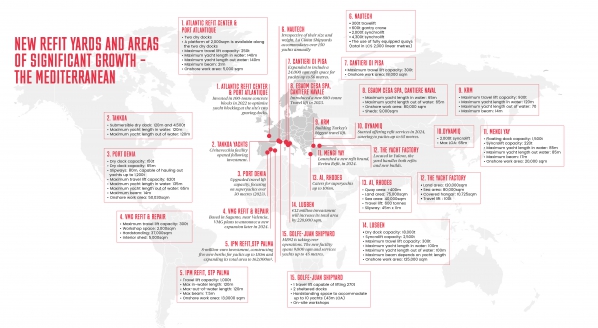
Nowhere else in the industry are the strains of the growing fleet and expansion more pronounced than on refit. But alongside the household names, the emergence
Business
Related news
Treading a fine line
9 months ago
The Superyacht Report 227: Refit Focus – out now!
9 months ago
Choosing the right shipyard for refit
9 months ago
MB92 Group acquires GYG
2 years ago
The bigger the fleet, the harder the challenge
2 years ago
NEW: Sign up for
SuperyachtNewsweek!
Get the latest weekly news, in-depth reports, intelligence, and strategic insights, delivered directly from The Superyacht Group's editors and market analysts.
Stay at the forefront of the superyacht industry with SuperyachtNewsweek