
Why are we repairing the same damage again?
Why surface protection film should become part of the yacht lifecycle before recurring damage becomes routine maintenance…
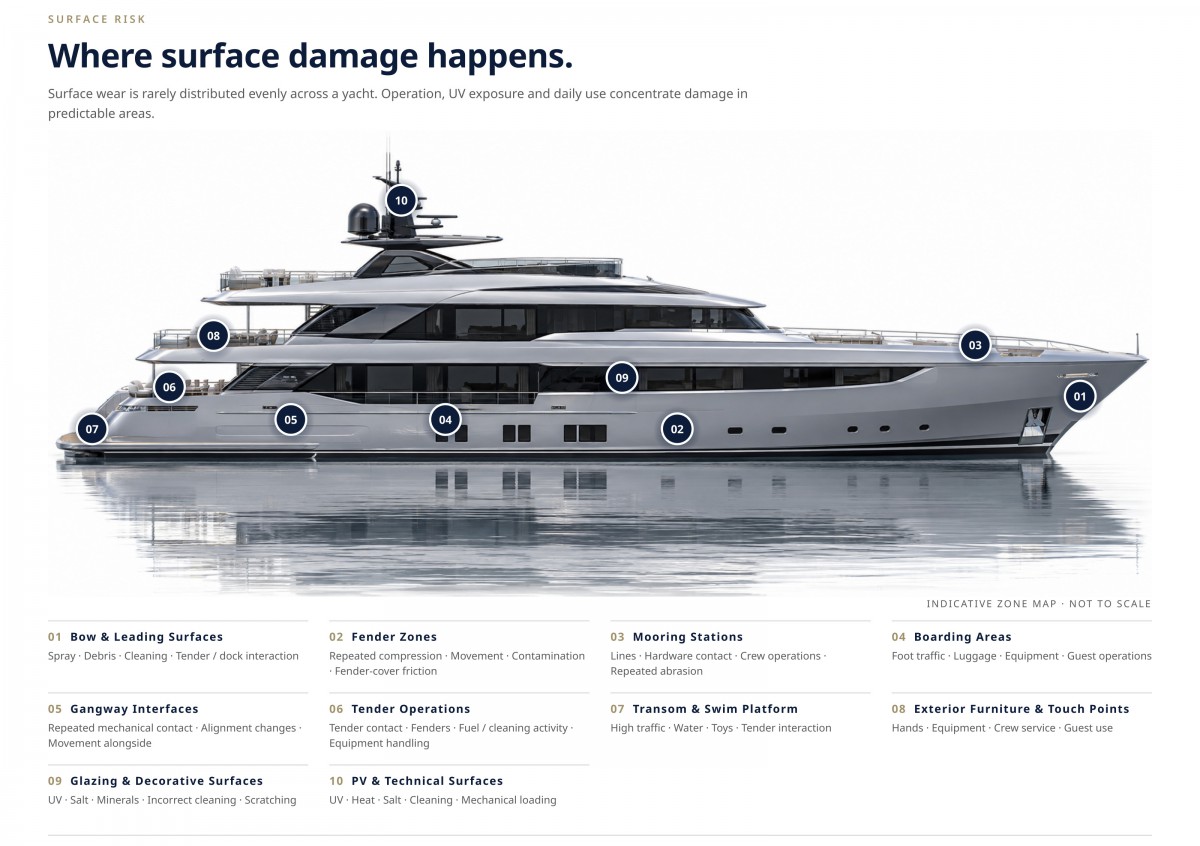
If the same fender marks, boarding scuffs or tender-bay abrasions return season after season, they are no longer isolated incidents, they are predictable results of repeated mechanical and environmental stress. The same applies to UV exposure, salt contamination, washdowns and polishing cycles. Each may seem minor, but over time they become part of the yacht’s maintenance burden. So if the exposure is predictable, why is protection still so often considered only after visible damage occurs?
Superyachts represent significant craftsmanship, time and investment. Paint systems, carbon components, high-gloss interiors and exterior finishes should therefore be preserved as part of the yacht’s lifecycle from the outset.
Damage starts before we can see it
Mechanical damage is easy to recognise: a fender leaves a mark, a transom gets scratched or a boarding area begins to show wear. However, environmental deterioration is more gradual. Intense sunlight can influence colour stability, gloss and the visual consistency of exposed finishes, particularly in Mediterranean and similarly demanding climates. Salt, minerals, water spotting and other contamination add to the maintenance burden.
Keeping these surfaces presentable requires regular cleaning and, depending on their condition, may eventually involve stronger chemistry, corrective polishing or local refinishing. Surface deterioration is therefore often the result of hundreds of small exposures and maintenance interventions rather than one dramatic incident.
This is where preventive protection becomes relevant. A suitable protective film creates a serviceable layer above the original surface and absorbs part of that exposure throughout the operating life of the yacht.
A relatively small defect can lead to a much larger intervention. Access may need to be arranged, fittings removed and surrounding areas prepared and masked. Even a small area of damage can require a much larger repair area to ensure a consistent finish ...
Depending on the system, substrate and application, Surface protection film (SPF) can provide resistance against abrasion and contact while helping to protect suitable finishes from UV exposure, contamination and the everyday effects of operation. Premium systems can also offer hydrophobic properties that make water, salt and contamination easier to remove.
The practical benefit extends beyond preventing an occasional scratch. Easier contamination release can reduce the need for aggressive cleaning and repeated corrective work. Over time, that can mean fewer polishing cycles, fewer local refinishing interventions and less disturbance of the underlying finish. The real value then becomes literally visible over several seasons.
The economics of preserving the original finish
A yacht finish is valuable partly because of how it looks and partly because of what it takes to recreate it. A relatively small defect can lead to a much larger intervention. Access may need to be arranged, fittings removed and surrounding areas prepared and masked. Even a small area of damage can require a much larger repair area to ensure a consistent finish, while access, contractors and the yacht’s operating schedule all need to be coordinated. Surface protection should therefore be evaluated by its ability to reduce repeated maintenance, repair work and operational disruption over the yacht’s lifecycle.
Repeated correction has consequences – polishing removes material, refinishing alters the existing surface and repainting involves significantly more time, labour and material. A sacrificial protection layer can introduce the possibility of renewing the protective surface while leaving the underlying finish substantially untouched, provided the substrate and application are technically suitable.
For an owner or yacht manager, this changes the calculation. The relevant question becomes how long the original finish can be preserved before significant corrective work is required. That matters throughout ownership and becomes particularly relevant when a yacht is sold, refitted or refreshed.
Protection has to work in real operation
A yacht is an operating asset rather than a static showroom; any protection system, therefore, has to make sense for the people responsible for maintaining it.
Captains and crew work in an environment where surfaces are continually exposed to salt, water, sunlight, equipment, fenders, tender operations and human contact. Protection becomes particularly useful when it helps reduce the amount of corrective work required to maintain presentation standards.
A yacht may leave the yard with freshly restored surfaces, only to return immediately to the same conditions that caused the damage in the first place. Where those risks are known, protection should be considered before the yacht returns to service.
On appropriately protected surfaces, hydrophobic properties can make contamination easier to manage, while resistance to abrasion and contact can help reduce recurring cosmetic damage in exposed areas. Less frequent corrective polishing and refinishing can save crew time and reduce the number of reactive maintenance interventions required during the season.
The appropriate level of protection will vary from yacht to yacht. Some vessels may benefit most from protecting specific high-risk areas. On others, particularly where preserving a large newly painted or refinished exterior is the objective, a broader protection concept can make technical and economic sense. The decision should follow the surface, its exposure and the intended result.
Manufacturers and refit yards have an opportunity to think one step further
The condition of a yacht after several years also contributes to how owners experience the quality of the original product. A yacht that retains its finish well reinforces the standards associated with the builder. Visible wear, fading, repeated corrections or local repairs can influence that perception even when the original workmanship was not responsible for the deterioration.
This creates an opportunity for manufacturers to consider surface protection earlier in the ownership lifecycle. Defined protection packages can potentially be integrated into new-build specifications or offered as part of the handover process, particularly for areas known to experience predictable exposure.
The same principle applies after refit – a yacht may leave the yard with freshly restored surfaces, only to return immediately to the same conditions that caused the damage in the first place. Where those risks are known, protection should be considered before the yacht returns to service.
For a refit yard, SPF helps preserve completed paint and refinishing work and can extend the time before further correction is required.
Extending the life of what already exists
The sustainability case is practical: protection can help existing high-value finishes last longer and reduce the need for repeated polishing, aggressive cleaning, local refinishing and repainting. That can mean less material, labour, chemical use and repeated intervention over time. In an industry where appearance standards are exceptionally high, extending the service life of an existing finish is a meaningful benefit.
Film alone is not the solution
Different yacht surfaces require different protection strategies : painted aluminium, gelcoat, carbon, glass and interior finishes all react differently to UV exposure, heat, cleaning chemistry, contact and wear. Effective protection therefore depends on more than choosing a premium film. The substrate, condition, environment and intended use all need to be considered.
The real value of SPF lies in what happens to the surface underneath it: fewer polishing cycles, fewer repairs and more time with the original finish preserved.
Depending on the yacht, this may involve protecting large exterior areas or focusing on specific zones with recurring exposure and damage. The objective remains the same: preserve the original finish for as long as technically and economically sensible.
From installation to surface strategy
For manufacturers and refit yards, assessing how yacht surfaces are exposed, how they deteriorate and where protection can be integrated into new-build, refit and operational environments helps preserve finished surfaces. For captains and crew, it can reduce recurring maintenance, and for yacht managers and owners, it supports condition, lifecycle cost and long-term value.
The real value of SPF lies in what happens to the surface underneath it: fewer polishing cycles, fewer repairs and more time with the original finish preserved. Extending the life of those finishes also means fewer materials, chemicals and repair processes are required over time.
When exposure is predictable, protection should become part of the plan before the same damage has to be repaired again.
We will shortly be commissioning content for our Q4 edition, focusing on Refit, so if you have something worthwhile and informative to add to the debate, then contact us here.
As an open-source platform we offer an industry-wide invitation to anyone and everyone in our sector to share their knowledge, experience and opinions. If you have an interesting and valuable contribution to make, and would like to join our growing community of guest columnists, share your ideas with us at newsdesk@thesuperyachtgroup.com
NEW: Sign up for SuperyachtNewsweek!
Get the latest weekly news, in-depth reports, intelligence, and strategic insights, delivered directly from The Superyacht Group's editors and market analysts.
Stay at the forefront of the superyacht industry with SuperyachtNewsweek
Click here to become part of The Superyacht Group community, and join us in our mission to make this industry accessible to all, and prosperous for the long-term. We are offering access to the superyacht industry’s most comprehensive and longstanding archive of business-critical information, as well as a comprehensive, real-time superyacht fleet database, for just £10 per month, because we are One Industry with One Mission. Sign up here.
Related news

Why the best LED refits are the ones you never notice
An insider’s view of the considerations to be made when undertaking a refit that involves the lighting
Opinion

Demonstrating refit is in capable hands
High-quality refit skills take years of experience and practice to acquire – the case for professionalising the sector is presented here
Opinion
Hull integrity compromised during refit
Where failure to follow ISM Code reporting requirements and lack of Class involvement exposed both crew and shipyard personnel to unnecessary risk
Crew
Looking beneath the surface
Captains of the paint industry reveal the role technology plays – and will play in the future – in increasing efficiencies
Crew
Related news
Demonstrating refit is in capable hands
2 months ago
Hull integrity compromised during refit
7 months ago
Looking beneath the surface
9 months ago
NEW: Sign up for
SuperyachtNewsweek!
Get the latest weekly news, in-depth reports, intelligence, and strategic insights, delivered directly from The Superyacht Group's editors and market analysts.
Stay at the forefront of the superyacht industry with SuperyachtNewsweek