
Olesinski Real-Time Refit: the captain’s new superpower
Changing the way owners and captains approach upsizing…
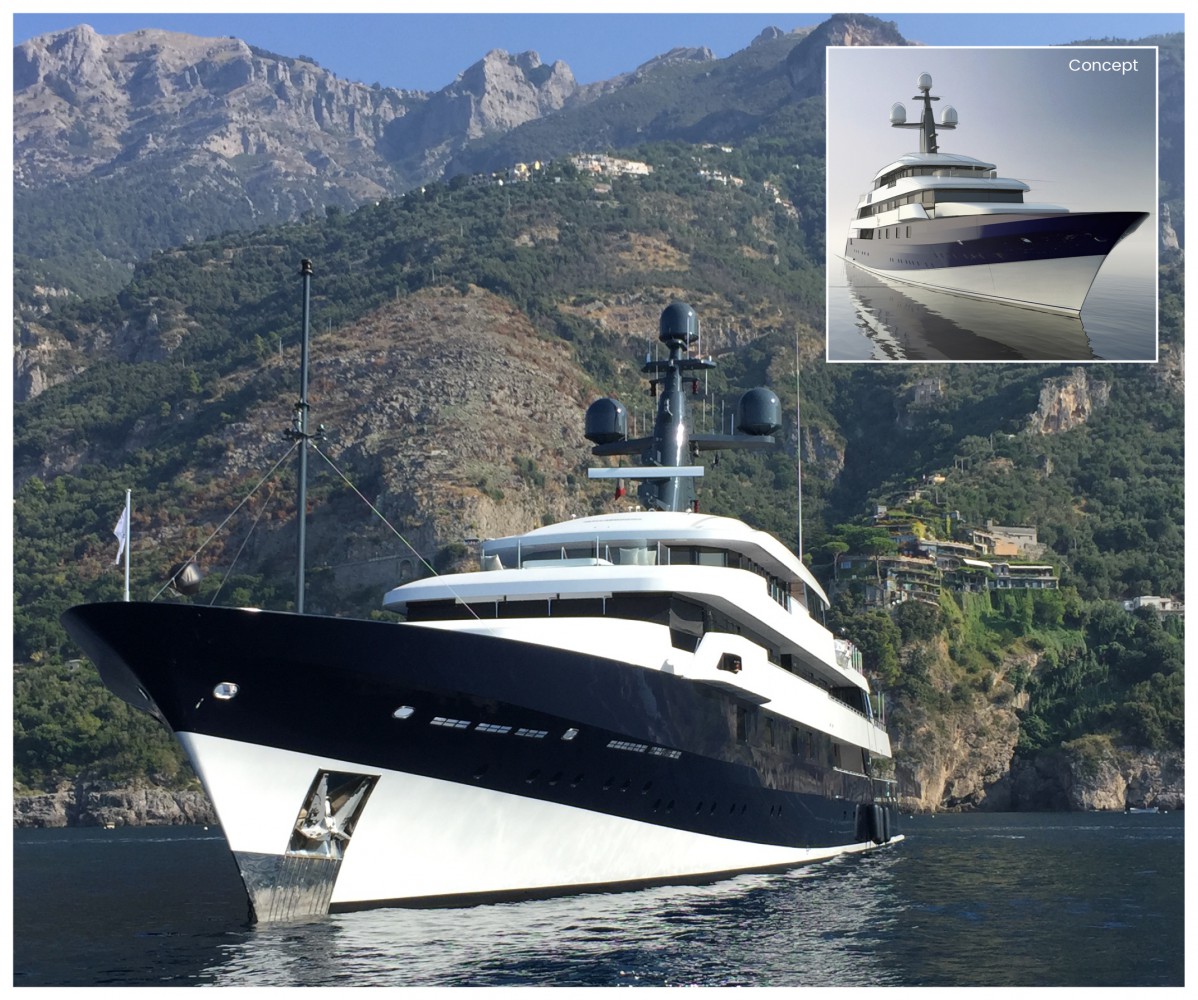
There is a conversation that happens in the superyacht world with remarkable regularity, and experienced captains know it well. The owner, who has spent three or four seasons on their yacht, begins hinting they are ready for more: more space, capability, zones, a larger sun deck, a beach club that is more than just a bathing platform or simply wanting a more modern exterior. Their yacht they once considered was their forever boat no longer meets their needs and they are now imagining going bigger.
The traditional options to this conversation have always followed a classic path: upsize with a new-build or brokerage yacht. New builds are a substantial time and cost investment and for many life is too short to wait. The second-hand market offers a more immediate solution but can only go so far matching and meeting the owner’s requirements.
A third option, rarely considered because of its complexity, is the transformational refit. These substantial rebuilds are more than a mere facelift and create a solution that meets all an owner’s needs.
Olesinski launched and won the innovation Passerelle Pitch Award at this year’s YARE with their Real-Time Refit process (ORTR) that is proven to combine the positives of new builds and refits.
The owner’s dilemma
To understand why Olesinski Real-Time Refit matters so profoundly for owners contemplating a step change in yacht size, it helps to understand the psychological and practical barriers that typically obstruct that decision.
A 55-metre owner who would like everything a 65 to 70-metre offers faces a genuinely difficult calculation. A new build can command €70 to €100 million with delivery windows that stretch well beyond the point where today’s enthusiasm remains intact. The owner’s commitment is huge given they will not see their yacht completed for years and is based on conceptual sketches and renderings hoping that their taste and requirements remain unchanged.
The second-hand route offers a different set of problems. Available yachts in this sector are finite in number, with the best examples frequently sold quickly and quietly. Yachts that reach the open market then require the new owner to accept the yacht was designed for someone else who had different needs.
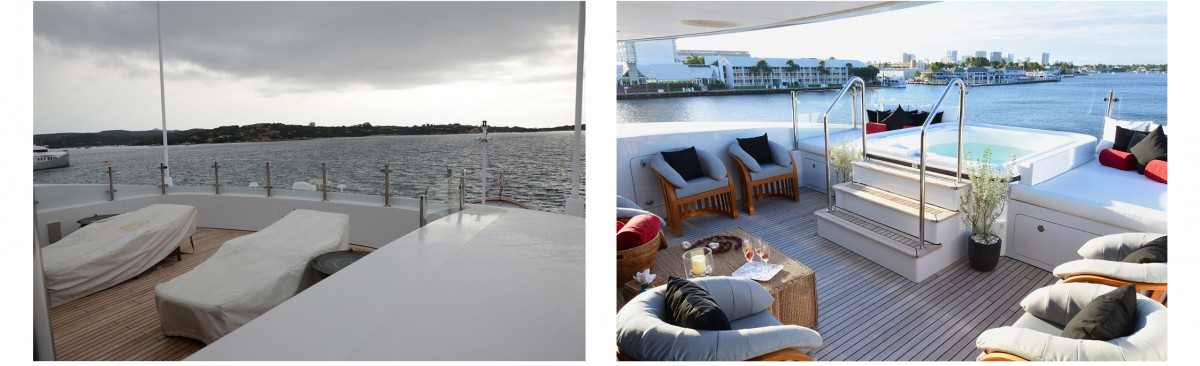
Forward upper: before and after.
A refit can genuinely transform scale ... these are not marginal improvements, they are step-changes in the ownership experience, achieved on a hull whose performance characteristics and class history are already known.
The real alternative
For owners seriously considering moving up in size, the implications of this process are profound and captains are uniquely positioned to help their owners.
The starting point is a fundamental reframing of what a refit can achieve. The superyacht industry has long understood that a well-executed refit can add years of life to a yacht and meaningfully update her aesthetic. What has been less explored is the extent to which a refit can genuinely transform scale. Extending an entirely new deck level to create more living space that rivals a yacht five or ten metres longer or adding a beach club where none existed. These are not marginal improvements, they are step-changes in the ownership experience, achieved on a hull whose performance characteristics and class history are already known.
The economics become compelling when examined clearly. A well-chosen and maintained 55 to 65-metre brokerage yacht and that has been through a transformational refit effectively delivers the space and amenity of a 70 to 75-metre new build, can represent a saving of thirty, forty, or even fifty per cent against a comparable new construction and be delivered in twelve to eighteen months rather than three to four years. The owner does not simply save money, they save time as they start enjoying the result of their investment sooner.
The obstacle, historically, has been convincing the owner that the transformation is not only an option, but that it is possible and attractive before they commit. No owner of serious means will authorise a multi-million-pound refit based simply on discussions and concepts; they need to see the whole package with costs, timings and design. With Olesinski Real-Time Refit they can in a single collaborative day. The conversation moves from abstract possibility to concrete vision in a matter of hours.
The owner is no longer weighing up the gap between what they see and what they want. They are evaluating the distance between where the yacht is today and where it could realistically be in eighteen months, visualised with precision, validated by a team of naval architects and costed against alternatives they already understand.
Process: Traditional vs Olesinski Real-Time Refit
Traditionally significant superyacht refit restyles or rebuilds have taken the approach where the owner or owner’s team search for a suitable donor yacht, review a number of designers on brokers’ books and choose their favourite designer simply based on a few, often irrelevant concepts based on other yachts. Once chosen, the designer only has a few hours to understand the owner’s personality, likes, dislikes, needs, concerns, expectations, style, tastes, inspirations and aspirations. All these variables are then, over a few weeks or months, condensed into a concept that is based on flaky information that may be used as the foundation of a multi-million-pound project. The designer designs, the owner decides.
Once a suitable donor yacht has been chosen and wishlist finalised Olesinski can deliver a fully explored concept that meets the owners and all stakeholders needs within a week. Perhaps more importantly this engages and enthuses the owner as they are now the designer.
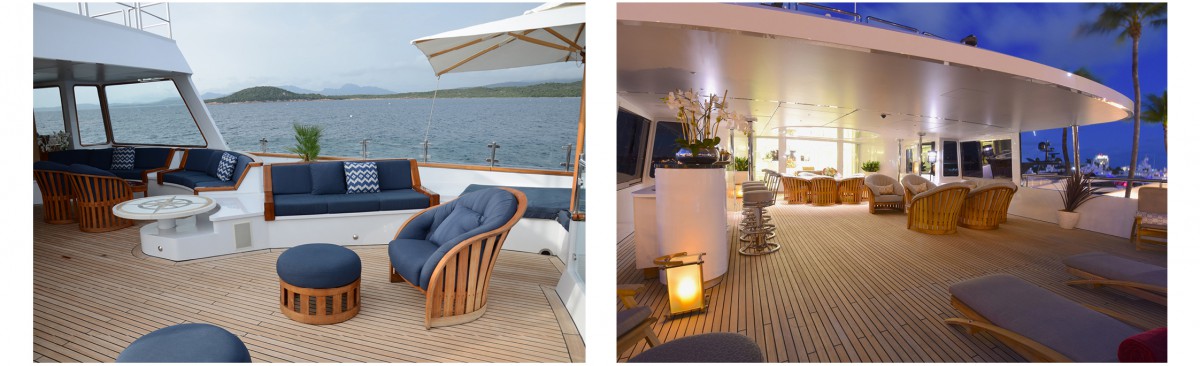
Main deck: before and after
Is it really novel?
The Olesinski Real-Time Refit Process is the innovative and clever combination of over 20 experienced naval architects and designers and AI, both in-house and open source. They can explore and manipulate a multitude of feasible concept options collaboratively with the owner in real-time.
The technology underpinning the process was born by their R&D department over a decade ago, in collaboration with Southampton University and the Alan Turing Institute. The result is a modelling system of considerable sophistication capable of generating and modifying complex three-dimensional yacht designs at breakneck speeds.
In the preparation phase, Olesinski gathers all available information, often limited to broker brochures and uses in-house AI techniques to generate an adjustable 3D model within days. This model is then refined to approximately 90 per cent accuracy, capturing existing hull and deck form with genuine fidelity. Their project team then adds the design proposals into this master model.
On the day of the kick-off meeting, with all stakeholders present, Olesinski show their first-hit concept to the owner, owner’s representative, captain and yard project managers on a wall projection or screen. In the background, remotely their project team are plugged into the live 3D master model. The owner is shown the initial proposal and invited to change anything or everything. Point to the transom and ask for the bathing platform to be extended, two minutes later … done and visible from all angles, not as a rough approximation but based on an accurate representation of the donor yacht. Any change is interrogated by their experienced team who can immediately highlight any proposal that may have adverse structural or flag implications. At the end of the day, a resolved concept is completed and high-resolution renders are generated for the owner to take away.
Rebuilds require someone to initiate it, someone who understands both the yacht and the owner well enough to know when the conversation is ready to have. That person is almost always the captain.
The second-hand acquisition: changing perception and opening potential
The application of ORTR that carries perhaps the greatest immediate value for captains is its use during the active search for a larger yacht. When an owner is viewing candidates in the brokerage market, the captain’s role is critical, not only in assessing technical condition but in helping the owner see past the limitations of what exists today to the potential of what could exist tomorrow.
This is where ORTR becomes a genuinely transformative tool in the captain’s hands. Armed with nothing more than photographs of a yacht under consideration or a copy of the general arrangement plan, the captain can engage Olesinski to prepare a first-pass concept of what that yacht could become after a serious refit. This can be ready within days, before the owner has made any commitment whatsoever. The viewing of the yacht is no longer purely an evaluation of present condition, it becomes a preview of future potential – the owner standing on the aft deck of a yacht they might buy, already looking at photorealistic images on a screen showing how that same deck could be extended, reconfigured and transformed.
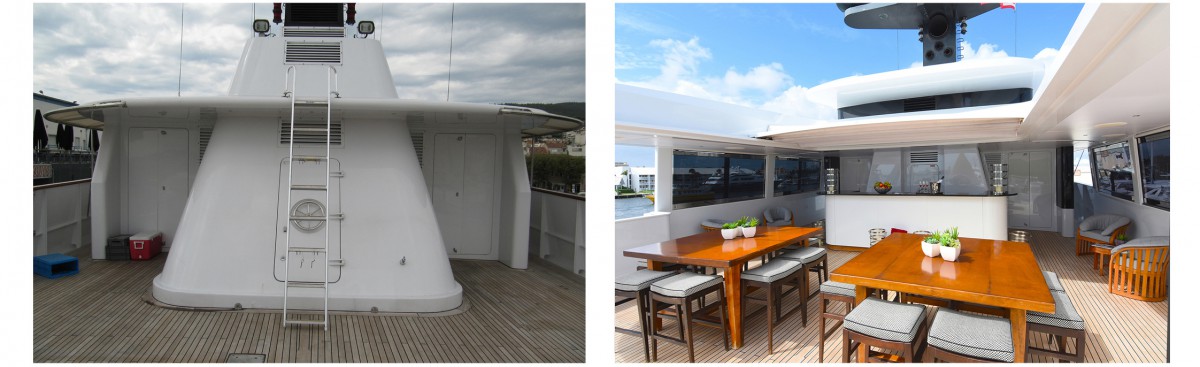
Helideck: before and after.
The owner is no longer weighing up the gap between what they see and what they want. They are evaluating the distance between where the yacht is today and where it could realistically be in eighteen months, visualised with precision, validated by a team of naval architects and costed against alternatives they already understand. Yachts that previously might have been dismissed as too dated or too small for serious consideration enter the frame as out-standing value propositions. The captain who can make this case, supported by credible visuals, is not simply advising. They are actively shaping the owner's investment decision in a way that is both valuable and deeply trusted.
Why the captain is the key
Rebuilds require someone to initiate it, someone who understands both the yacht and the owner well enough to know when the conversation is ready to have. That person is almost always the captain.
The captain knows which elements of the current yacht frustrate the owner most and what the owner admires about other yachts they have seen in the anchorage. They know whether the priority is volume, exterior styling, operational capability or simply the statement that a larger yacht makes. This knowledge and process shapes the initial proposal in ways that immediately resonate with the owner. The concept feels personal because it is personal, drawn from the captain's intimate understanding of how this owner actually uses their yacht.
The captain who can bring this approach into conversation with an owner is not simply facilitating a design process, they are demonstrating a level of strategic thinking and industry awareness that owners value enormously. They are shortcutting a decision into a focused, visual, actionable proposition.
The refined concept proposal can then be issued to the yard to quote far more accurately, reducing financial fat being added for unknowns, reducing cost even further.
To explore how Real-time Refit could help you and your owner contact Olesinski.
NEW: Sign up for SuperyachtNewsweek!
Get the latest weekly news, in-depth reports, intelligence, and strategic insights, delivered directly from The Superyacht Group's editors and market analysts.
Stay at the forefront of the superyacht industry with SuperyachtNewsweek
Click here to become part of The Superyacht Group community, and join us in our mission to make this industry accessible to all, and prosperous for the long-term. We are offering access to the superyacht industry’s most comprehensive and longstanding archive of business-critical information, as well as a comprehensive, real-time superyacht fleet database, for just £10 per month, because we are One Industry with One Mission. Sign up here.
NEW: Sign up for
SuperyachtNewsweek!
Get the latest weekly news, in-depth reports, intelligence, and strategic insights, delivered directly from The Superyacht Group's editors and market analysts.
Stay at the forefront of the superyacht industry with SuperyachtNewsweek