Are Europe’s new “No-Russia clauses” reshaping the circulation of maritime assets?
The EU’s 20th sanctions package is primarily aimed at the shadow tanker fleet but its reasoning, Emmanuelle Votat argues, reaches much further…
The EU’s 20th sanctions package, adopted on 23 April 2026, introduces so-called “no-Russia clauses” requiring European operators selling certain vessels to third-country buyers to include contractual prohibitions on any future resale or use for Russia’s benefit. Primarily aimed at the shadow tanker fleet, the mechanism signals that Europe is beginning to move from just freezing sensitive maritime assets to controlling how they circulate over time.
Since 2022, the EU sanctions regime has evolved far beyond a traditional asset-freeze mechanism. It is progressively becoming a system designed to control the flows, services, infrastructures and intermediaries enabling the circulation of sensitive assets. The objective is increasingly extending to ownership structures, logistics chains, technical intermediaries, service providers and jurisdictions considered vulnerable to circumvention practices.
The activation of the anti-circumvention mechanism against Kyrgyzstan is the first time the EU has deployed this tool against a third country, following evidence that sanctioned goods were being systematically re-exported to Russia. And this illustrates the direction of travel. The core issue now extends beyond the sanctioned individual to the traceability of flows, re-export chains and intermediary structures.
The new mechanism now requires European operators selling certain tankers to buyers in third countries to implement enhanced due diligence, notification obligations and contractual clauses prohibiting any resale or future use of the vessel for the benefit of Russia. But perhaps the most significant evolution is not the prohibition itself. The real shift lies in the way the EU is beginning to organise liability, traceability and risk allocation.
The system increasingly relies on documentation, compliance procedures, contractual safeguards and evidentiary traceability. Where a European seller has properly fulfilled its compliance obligations, subsequent breaches may progressively fall under the responsibility of the third-country buyer.
This marks an important structural evolution that sanctions risk is becoming documented, traceable, operationally monitored and partially contractualised, rather than being managed solely through prohibition.
Extending the logic beyond tankers
At first glance, these clauses appear primarily directed at Russia’s shadow fleet and the energy sector. But limiting their significance to oil transport alone would probably be a mistake. The 20th package now extends restrictions to technical services, brokerage, port infrastructure, financial operators, crypto platforms and actors indirectly facilitating Russia-related flows.
One particularly revealing detail is the introduction of a “scrapping clause” designed to facilitate the dismantling or withdrawal from service of certain shadow-fleet vessels. This goes far beyond a simple technical measure. Behind dismantling lies the broader strategic logic that the EU is beginning to think in terms of the full lifecycle of sensitive maritime assets.
The 20th package reveals that the EU is increasingly targeting the operational ecosystem enabling the circulation and use of sanctioned assets."
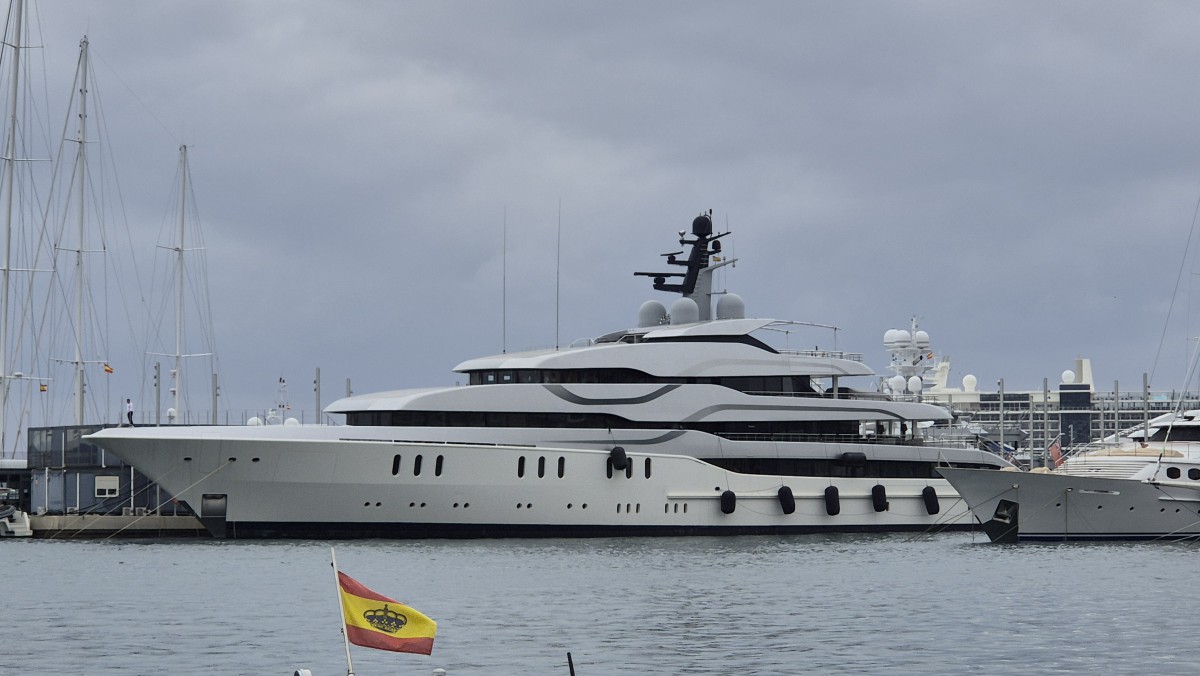
This reasoning directly affects the yachting market. A superyacht depends on flags, ports, insurers, brokers, management companies, banks, classification societies, technical suppliers and port infrastructure. Sanctions risk, therefore, increasingly rests on the entire network of services enabling its operational viability.
This evolution is reinforced by a growing logic of cascading compliance: from seller to buyer, from parent company to subsidiary, from supplier to reseller, and from primary contract to downstream operators. In a sector as internationalised as yachting, this is a notable shift.
The superyacht market also faces another emerging reality: what could be described as “historical sanctions risk”.
The case of La Datcha is a good example. Despite a reported flag change, the yacht allegedly faced refusal of access to an Icelandic port because of its post-Ukraine sanctions history. This shows that in today’s sanctions environment, immediate legal status alone is insufficient to restore a yacht’s operational normality.
Even where legal ownership evolves, a vessel’s sanctions history may continue to generate operational, financial and reputational consequences. Banks, insurers, ports, registries, brokers and shipyards increasingly assess past sanctions exposure alongside the intrinsic value of the vessel itself.
Cases such as Amadea and Alfa Nero already illustrate how a yacht may remain commercially and operationally sensitive years after seizure, sale or a change in legal status. The sale of a sanctioned yacht does not mark the end of the risk, but the beginning of a new phase of monitored circulation.
An increasingly behavioural system
Another aspect of the 20th package has attracted far less attention: the lifting of certain measures against several vessels following documented compliance commitments and the cessation of the activities concerned.
The EU is progressively beginning to sanction behaviours. The system is becoming more dynamic, more adaptive and far more centred on risk management. And perhaps most importantly, it quietly introduces an idea that has so far remained largely absent from the debate: a vessel may also exit sanctions risk.
In this context, the “no-Russia clauses” acquire a much broader significance. They suggest that a sensitive maritime asset could eventually circulate again because the risk becomes structured, documented and contractually managed.
Sale as the only operational exit?
The longer sanctions persist, the more complicated the preservation of immobilised yachts becomes – financially, technically, legally and environmentally. The maritime industry understands this reality perfectly well: even under minimal maintenance, an immobilised yacht deteriorates. The question is therefore no longer simply how to freeze a yacht, but becomes: what is the next move?
The answer may increasingly lie in preserving value rather than allowing the gradual exhaustion of the asset itself. Selling does not necessarily mean abandoning sanctions. A sale may also become a mechanism for preserving value, containing operational risk and preventing a complex maritime asset from gradually turning into a technical, financial and environmental liability.
Behind sanctioned yachts, there are not only political symbols but also an entire European maritime economy and thousands of jobs dependent on an increasingly fragile operational balance.
What now?
The 20th sanctions package does not create a European mechanism for the sale of a sanctioned yacht, but it already reveals that the EU is no longer reasoning solely in terms of immobilising assets. Instead, it is progressively building a broader framework based on flow control, traceability, operational oversight and risk management. The “no-Russia clauses” may well mark the beginning of that transition.
NEW: Sign up for SuperyachtNewsweek!
Get the latest weekly news, in-depth reports, intelligence, and strategic insights, delivered directly from The Superyacht Group's editors and market analysts.
Stay at the forefront of the superyacht industry with SuperyachtNewsweek
Click here to become part of The Superyacht Group community, and join us in our mission to make this industry accessible to all, and prosperous for the long-term. We are offering access to the superyacht industry’s most comprehensive and longstanding archive of business-critical information, as well as a comprehensive, real-time superyacht fleet database, for just £10 per month, because we are One Industry with One Mission. Sign up here.
NEW: Sign up for
SuperyachtNewsweek!
Get the latest weekly news, in-depth reports, intelligence, and strategic insights, delivered directly from The Superyacht Group's editors and market analysts.
Stay at the forefront of the superyacht industry with SuperyachtNewsweek