2026 Yacht Safety Culture and Wellbeing: Crew Impact Report
Lloyd’s Register presents the findings of a survey on the safety and wellbeing standards experienced by yachting professionals…

1. Participant demographics: Who answered the survey
This report synthesises high-level findings from a comprehensive sector-wide survey, establishing a baseline for safety culture maturity and mental health within the yachting industry. The respondent base provides a robust operational and strategic cross-section of the maritime workforce.
Staff distribution:
Yacht crew: 75.85 per cent
Shore staff: 24.15 per cent
Vessel tonnage: The survey data predominantly reflects the environment of larger vessels, with 79.06 per cent of responses coming from yachts of 500gt or more. Vessels under 500gt accounted for 20.94 per cent of the data.
Industry tenure: The profile illustrates a deeply experienced workforce, with the majority of respondents being established professionals possessing over 10 years of tenure. However, a critical ‘dip’ is evident in personnel with 6 to 10 years of experience. This period represents a vital ‘evaluation period’ where crew members determine their long-term career pathing based on their lived experiences. Notably, very few respondents were new to their specific roles, indicating that these insights come from a seasoned demographic.
2. Safety culture performance data
The following table details the Positive Response Rates (PRR) across core survey categories, reflecting the degree of agreement with safety and wellbeing protocols.

Performance analysis: In accordance with established maritime safety benchmarks scores below 70 per cent (Engagement, Learning and Wellbeing) signal “significant room for improvement” and necessitate “urgent action” to mitigate latent risks. Leadership, falling within the 70 to 89.9 per cent range, indicates “room for development”, where targeted interventions are required to move from mere compliance toward a strong positive consensus.
3. The operational reality: key findings on daily crew life
The ‘owner priority’ dynamic: There is a systemic conflict between established safety procedures and guest-related or commercial pressures. Crew frequently report that safety priorities are compromised to satisfy guest expectations or financial targets. This creates a precarious operational environment where, as noted in free-text feedback, any “conflict between safety and guest-related yacht operations” results in an inevitable and dangerous “conflict of interest”.
The procedure-practice gap: While a professional ethos of following rules remains, a staggering 40 per cent of respondents believe that rules are not followed in the daily operational reality. This is most critically evidenced by the inconsistent application of the Permit to Work (PTW) system. The failure to utilise PTW systems consistently represents a major failure in managing high-risk operations on board, leaving vessels vulnerable to preventable incidents.
Leadership and accountability: Identifying clear supervisory structures on board remains a significant challenge for many crew members. This lack of clarity is driven by flat crewing arrangements and poorly defined roles. Consequently, there is a pervasive perception that safety is secondary to operational performance, with many crew reporting they have been actively pressured to perform tasks they considered unsafe.
4. Wellbeing and living conditions
Engineering staff sentiment: Engineering personnel expressed the least positive perceptions across all surveyed dimensions. Analysis suggests this group is susceptible to overconfidence and a dangerous reduction in vigilance. The data indicates a lack of “chronic unease”, where a high knowledge of basic risk principles may lead engineers to underestimate latent hazards.
Fatigue and workload: Time pressure remains a primary stressor, fuelled by a pervasive “culture of presenteeism” where excessive overtime is seen as a prerequisite for professional advancement. This strain is most acute during rushed yard periods. Management frequently mandates rapid returns to operation, forcing two-person engineering teams to conduct equipment testing under extreme time constraints and exhaustion, significantly increasing the likelihood of oversight.
Living challenges: Life at sea is further complicated by cabin sharing and the social friction inherent in confined environments. The overarching wellbeing of the crew is disproportionately influenced by the interpersonal dynamic between the captain and the owner. When this relationship is strained or prioritises commercial output over safety, the resulting stress permeates the entire vessel hierarchy.
5. Demographic variations in sentiment
The table below highlights the sharp contrasts in perception based on yacht size, tenure and professional location.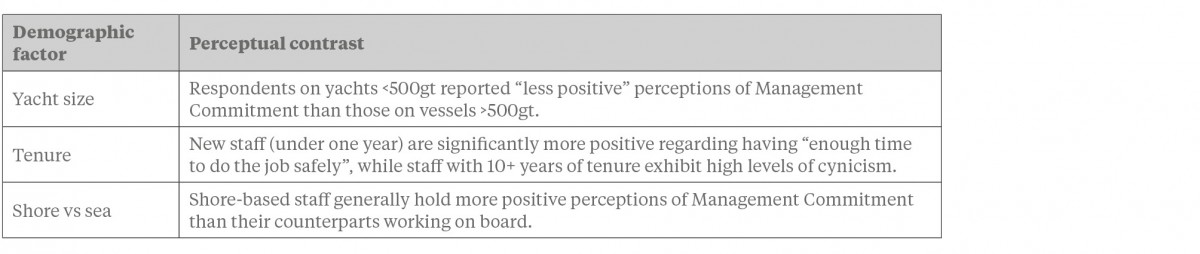
6. Conclusion: Strategic imperatives for crew
To halt the erosion of crew wellbeing and the rise of operational risk, the industry must move beyond passive observation. We must mandate the standardisation of the following four strategic imperatives to ensure the sustainability of yacht operations:
Leadership behaviours: We must mandate the standardisation of supervisory structures and ensure all on-board leaders are trained to prioritise safety protocols over guest or commercial pressures.
Psychological safety: The industry must actively dismantle “blame culture”, fostering an environment where crew members feel empowered to suggest safety improvements and challenge unsafe orders without fear of retribution.
Fatigue management: We must move away from the “presenteeism” model. This requires enforcing adequate manning levels and ensuring refit schedules are realistic rather than commercially driven.
Reporting culture: Management must address the structural barriers to reporting minor incidents and near misses. Facilitating a transparent reporting culture is the only way to ensure proactive risk management and organisational learning.
The 2026 Yacht Safety Culture and Wellbeing: Crew Impact Report can be downloaded here.
As an open access platform, we invite contributions to The Superyacht Report: Captains issue, which focuses on captains, crew and operations. Published in May, this is your opportunity to write a guest column or feature article about a topic close to your heart, whether it be an opinion or an educational and informative piece. If you feel you have something important to say on the theme of on-board operations, contact newsdesk@thesuperyachtgroup.com
NEW: Sign up for SuperyachtNewsweek!
Get the latest weekly news, in-depth reports, intelligence, and strategic insights, delivered directly from The Superyacht Group's editors and market analysts.
Stay at the forefront of the superyacht industry with SuperyachtNewsweek
Click here to become part of The Superyacht Group community, and join us in our mission to make this industry accessible to all, and prosperous for the long-term. We are offering access to the superyacht industry’s most comprehensive and longstanding archive of business-critical information, as well as a comprehensive, real-time superyacht fleet database, for just £10 per month, because we are One Industry with One Mission. Sign up here.
NEW: Sign up for
SuperyachtNewsweek!
Get the latest weekly news, in-depth reports, intelligence, and strategic insights, delivered directly from The Superyacht Group's editors and market analysts.
Stay at the forefront of the superyacht industry with SuperyachtNewsweek