
Custom-made propulsion system to feature on board 120m conversion project
Alewijnse Marine Systems (AMS) in Holland took 450 hours to arrive at the best alternative propulsion system for the 120m yacht's owners. …
AMS fitted the system for the owners of the huge passenger vessel, which is to be converted into a luxury superyacht. The clients were part of the 'environmentally conscious' class of owner, said AMS, who want to minimise their carbon ‘hullprint’ via hybrid and alternative propulsion systems as a substitute for diesel engines, which are highly pollutant and the biggest energy consumer on a yacht.
The process took AMS 450 man-hours of development work, with two systems proposed, then rejected, before the third was finally approved by the client. The report said:
“For most people the phrases ‘alternative propulsion’ and ‘diesel electric’ are largely interchangeable but, as [this project has] demonstrated, there is a good deal more to it than that.”
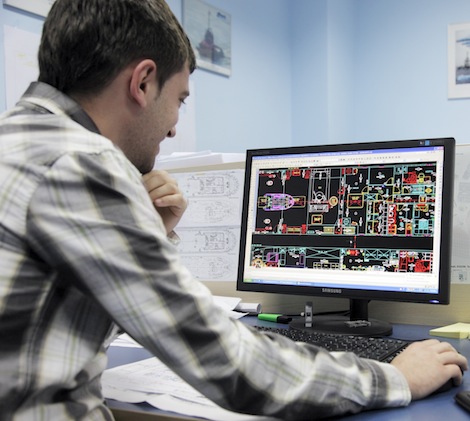
An AMS engineer at work on development of the 120m yacht's propulsion system
AMS began the design process by resolving a number of performance variables, such as where she was to operate (the owner wished to charter extensively) and what the optimal operating speeds should be. This latter difference was significant as deviating just one knot from the optimum speed threatened an efficiency loss of around 10 per cent, with greater consequences as the divergence increases. The client also required that the existing controllable pitch propeller (CPP) and gearbox be retained.
Two complex options were then developed and presented to the client before the final option was settled on.
The first was a standard diesel electric installation using diesel generators to supply power to electric motors that drive the propeller. Its aim was to deliver lower fuel consumption and lower emissions at slow speeds plus optimum maneuvering capabilities.
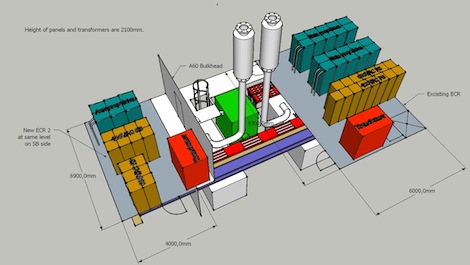
Layout of the engine control room - version one
Additional advantages included the fact that the auxiliary diesel-gen sets would be silent mounted without direct hull contact, yielding minimal noise and vibration. Still, the client decided that: “diesel electric was too expensive and asked the Alewijnse team to consider alternatives.”
Proposal number two presented a hybrid drive on the basis that it would require less space and be less expensive than the original diesel electric option.
“The new design incorporated a new asynchronous electrical motor and variable speed, providing a big reduction in costs without any loss of functionality,” said the report.
“The hybrid propulsion solution with variable speed drive would provide high propulsion efficiency over a large range of speeds and the electric component of the propulsion system would enable electric propulsion at slow speeds and then generate electricity at cruising speeds with optimum pitch on the CPP,” it continued.
However, this second proposal was dismissed by the owner because costs were still too high.
The solution AMS found, which at last won the client over, also used hybrid technology but was based on a synchronous assembly without a variable speed drive.
“Although with this arrangement the operational profile is limited to two optimal operating speeds the initial cost savings resulting from the increased efficiency that it would deliver were expected to more than compensate for that loss of flexibility,” said the report.
In addition, the system offered appreciable weight savings, electrical propulsion for slow speeds and power generation at the two optimal operating speeds. One downside was that efficiency at slow speed-sailing would not be as good as the original hybrid solution.
Nonetheless, the client decided that “the loss in operational flexibility was more than compensated for by the other benefits,” and the third solution was agreed.
The report concluded that, not only is this evidence of the complexity of alternative propulsion, but:
“It demonstrates the flexibility of alternative propulsion systems when it comes to meeting specific needs of individual yachts and owners and the importance of undertaking pre-order engineering for such a critical and expensive part of any superyacht.“
Related Links
Alewijnse Marine Systems Profile | Alewijnse Marine Systems Website
NEW: Sign up for SuperyachtNewsweek!
Get the latest weekly news, in-depth reports, intelligence, and strategic insights, delivered directly from The Superyacht Group's editors and market analysts.
Stay at the forefront of the superyacht industry with SuperyachtNewsweek
Click here to become part of The Superyacht Group community, and join us in our mission to make this industry accessible to all, and prosperous for the long-term. We are offering access to the superyacht industry’s most comprehensive and longstanding archive of business-critical information, as well as a comprehensive, real-time superyacht fleet database, for just £10 per month, because we are One Industry with One Mission. Sign up here.
NEW: Sign up for
SuperyachtNewsweek!
Get the latest weekly news, in-depth reports, intelligence, and strategic insights, delivered directly from The Superyacht Group's editors and market analysts.
Stay at the forefront of the superyacht industry with SuperyachtNewsweek